Smart Agents and CRM: The AI Revolution for SMEs in 2026
Le brief IA que les pros lisent chaque soir
Les 7 actus IA du jour, décryptées en 5 min. Gratuit.
Inclus dès l'inscription : notre sélection des meilleurs guides & comparatifs IA.
Choisis ton rythme
Gratuit · Pas de spam · Désabonnement en 1 clic
What is an intelligent agent and how does it differ from a simple chatbot?
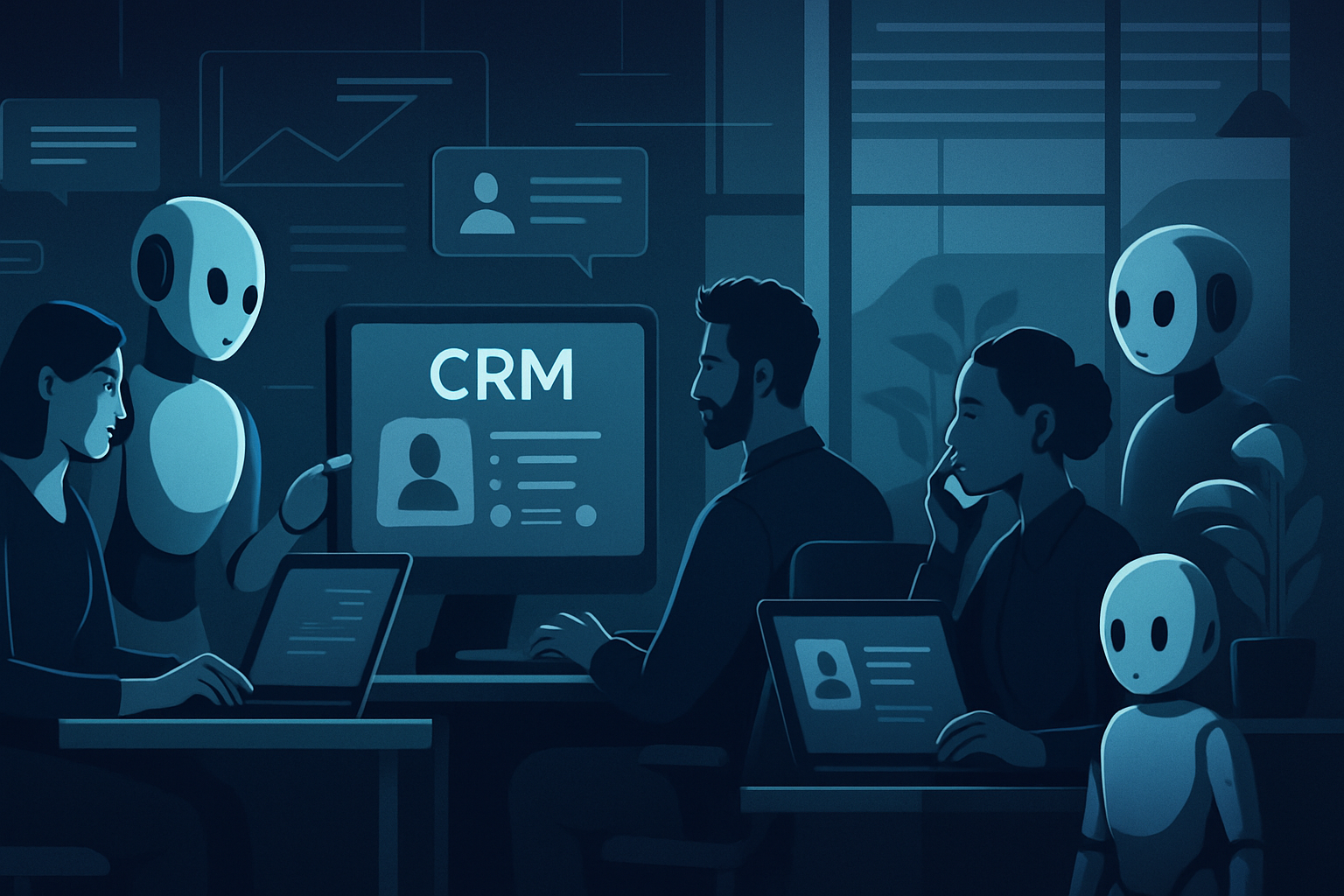
For small and medium-sized enterprises in France, integrating an intelligent agent into a CRM represents a significant paradigm shift. Unlike a simple assistant that merely responds or an automation that follows a predefined script, an intelligent agent acts autonomously. It does not just follow a decision tree like a classic chatbot, nor does it go through fixed steps like an automation. Instead, it understands a goal, plans the necessary actions, and executes them independently. For example, an intelligent agent can be tasked with qualifying new leads and scheduling appointments with those who fit the target profile. It accepts this objective, breaks it down into concrete actions such as consulting the CRM, analyzing profiles, checking the calendar, and drafting a message, all while adhering to a defined framework.
This change signifies the end of tedious manual data entry, a more reliable prioritization of leads, and time freed up to focus on what truly matters: the customer relationship. The numbers confirm this transformation: 83% of sales teams using AI agents report an increase in their revenue, compared to 66% for those that do not have them. The main challenge is no longer how to create an AI agent, but rather how to integrate it seamlessly and securely to enhance performance without losing control or compliance with the GDPR.
What technological pillars support an AI-powered CRM?
A high-performing AI CRM relies on three complementary technological components. The first is predictive AI, which analyzes the CRM's history to estimate probabilities such as conversion chances, risk levels, or follow-up priorities. The goal is to help salespeople invest their time where the return on investment is highest.
The second component is generative AI, which produces useful sales content, such as follow-up emails, meeting summaries, or responses to objections. It transforms CRM data into actionable text, significantly reducing the administrative time required.
The third component is conversational AI, which analyzes calls and exchanges to extract key information, such as needs, objections, budget, and timing. This component feeds directly into the CRM without requiring perfect data entry after each interaction.
An intelligent agent combines these three components to predict whom to contact, generate the right message, and capitalize on each conversation to improve follow-up.
How to create an AI agent when you don't know how to code?
The barrier to entry for creating AI agents has significantly lowered. Today, several platforms allow users to configure agents in natural language without writing a single line of code. The process typically follows four steps:
-
Identify the business need, such as lead qualification, quote follow-ups, or responses to frequently asked questions. It is crucial to choose a specific use case before expanding.
-
Write instructions in natural language so that the agent understands what it needs to do, with what rules, and within what scope.
-
Connect relevant data sources, such as the CRM, emails, call history, and the document repository.
-
Define access rights by team or role, a dimension often underestimated but critical with the European AI Act coming into effect in 2026. For example, a financial agent should only access financial documents, not the entire company environment.
Bitrix24 natively integrates granular rights management that directly applies to its automation tools and AI (CoPilot), thus avoiding the need to overlay a third-party rights management tool.
Why prioritize an all-in-one ecosystem over specialized tools?
An intelligent agent is only truly effective if it has access to all of the company's data. In practice, salespeople spend less than a third of their time selling, with the rest absorbed by administrative tasks, internal exchanges, or CRM data entry.
An agent connected to all points of contact, such as chats, emails, social media, and telephony, can build a coherent view of the customer and propose relevant actions at each stage of the journey.
If the CRM, project management, and billing operate on separate platforms, the agent remains blind to a large portion of the company's data, leading to risks of information loss. This is the logic behind Bitrix24, which consolidates CRM, project management, multichannel contact center, and billing under a single interface. When the agentic AI is added, everything communicates natively, without a third-party integration layer.
What use cases generate rapid impact for an SME?
Five applications consistently emerge from field feedback:
-
Automatic lead qualification, where the agent analyzes the profile and behavior to assign a score, allowing salespeople to focus on high-potential opportunities.
-
Detection of at-risk deals, where the agent alerts when an opportunity stagnates for too long without action, before it "dies" silently.
-
Generation of reports and next actions, where after each exchange, the AI agent proposes a summary and the next steps.
-
Personalized follow-ups, where the agent generates context-appropriate emails without starting from scratch each time.
-
Contextualized sales recommendations, where the intelligent agent suggests the right approach at the right time to accelerate the sales cycle.
An industrial SME can reduce its opportunity processing time by 30% and increase its sales by 19% within six months.
What mistakes are most commonly observed during deployment?
Confusing automation, assistants, and agents remains the most frequent mistake in 2026. Many SMEs believe they are investing in "AI agents," while they are actually implementing classic automations enriched with a layer of generative AI, leading to disappointment in use and often to misallocated budgets. If you are faced with a rigid workflow, it is an automation that is indeed useful in many cases, but it does not constitute a true intelligent agent.
The second mistake is the desire to automate everything immediately. It is better to start with a specific use case, master it, measure a KPI, and then gradually expand.
The third mistake is neglecting data quality. Gartner estimates that poor data quality costs companies an average of $12.9 million per year.
Brief IA — L'actualité IA en français
L'essentiel de l'actualité de l'intelligence artificielle, décrypté et expliqué chaque jour.