Anthropic Under Pressure: U.S. Restrictions and AI Challenges
Le brief IA que les pros lisent chaque soir
Les 7 actus IA du jour, décryptées en 5 min. Gratuit.
Inclus dès l'inscription : notre sélection des meilleurs guides & comparatifs IA.
Choisis ton rythme
Gratuit · Pas de spam · Désabonnement en 1 clic
American Restrictions Disrupt the AI Sector
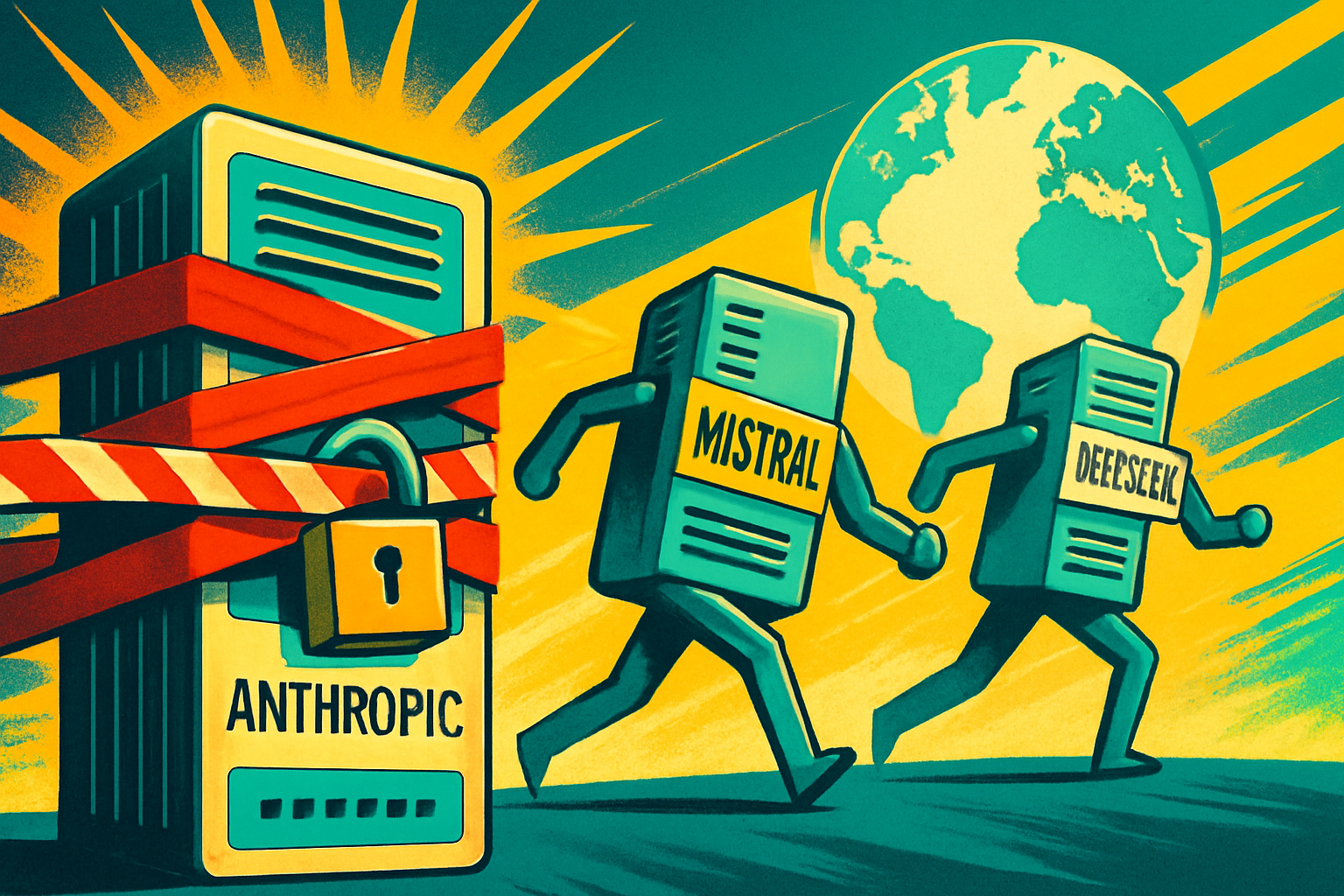
The United States has recently imposed significant restrictions on new cybersecurity artificial intelligence models developed by Anthropic. This decision has led Anthropic to suspend access to its models, creating winners and losers in the global competition for AI development.
Mistral: A Favorable Wind of Change
Verdict: Winner.
The French startup Mistral is positioning itself as a key player in this context. For over a year, it has advocated for Europe not to depend on American AI providers. Unlike Anthropic, which tightly controls access to its advanced models, Mistral offers open-weight models. These models allow clients to deploy them on their own infrastructure and customize them with their data.
The restrictions imposed on Anthropic perfectly illustrate the risk that Mistral has always highlighted. Arthur Mensch, CEO of Mistral, reaffirmed on social media that future models from his company would be open-weight, emphasizing the importance of allowing users to "own, inspect, audit, or improve" the AI systems they use.
This context is particularly opportune for Mistral, especially as France announced this week that its national intelligence agency would replace Palantir's AI data tools with those from a French provider. Prime Minister Sébastien Lecornu warned against "strategic dependencies" on foreign technology, further strengthening Mistral's argument.
DeepSeek: An Opportunity to Seize
Verdict: Winner.
DeepSeek, like Mistral, could see its open-weight approach gain popularity. Unlike Anthropic's tightly controlled Mythos 5 and Fable 5 models, DeepSeek's models can be downloaded, modified, and deployed by clients themselves.
This flexibility could appeal to governments and businesses that prioritize control and sovereignty over access to the latest closed models. Additionally, this episode offers China an opportunity to highlight the geopolitical risks associated with dependence on American AI providers, thereby strengthening its position in the global AI competition. At a recent event, Anthropic CEO Dario Amodei noted that Chinese AI models lag 6 to 12 months behind the most advanced American systems.
Anthropic: The Pressure of Restrictions
Verdict: Loser.
Anthropic is directly affected by these restrictions. Export controls prevent foreign nationals, including some Anthropic employees, from accessing the Mythos 5 and Fable 5 models, limiting the company's ability to distribute its advanced systems internationally.
This episode also highlights a weakness of closed AI models. The control exercised by Anthropic over access to its systems allows governments to influence who can use them. This situation further complicates the already strained relations between Anthropic and the White House, after the company expressed its opposition to the use of its technology for mass surveillance and autonomous weapon systems. In response, the U.S. government labeled Anthropic as a supply chain risk, a decision the company is contesting in court.
American AI Companies: Between Opportunities and Challenges
Verdict: Short-term winners, long-term losers.
In the short term, the restrictions could provide an advantage to Anthropic's American competitors. However, they raise questions for the future of these companies. Giants like OpenAI, Google, and xAI primarily distribute their advanced models through platforms they control.
Meta, although partially an exception with some models from the Llama family being open-weight, is leaning towards closed models like Muse Spark, over which it exercises strict control. For governments and businesses, the Anthropic case serves as a reminder that access to AI depends on the decisions of providers and the governments that regulate them. This dynamic could enhance the appeal of sovereign and open-weight alternatives in Europe and beyond.
Brief IA — L'actualité IA en français
L'essentiel de l'actualité de l'intelligence artificielle, décrypté et expliqué chaque jour.