Apple and AI Security: A Revolutionary Private Cloud
Le brief IA que les pros lisent chaque soir
Les 7 actus IA du jour, décryptées en 5 min. Gratuit.
Inclus dès l'inscription : notre sélection des meilleurs guides & comparatifs IA.
Choisis ton rythme
Gratuit · Pas de spam · Désabonnement en 1 clic
Apple Private Cloud Compute: A Major Advancement for AI Security
Generative artificial intelligence is profoundly changing the way we interact with technology, but it also raises concerns about the security of personal data. In response to these worries, Apple has developed an innovative solution: Apple Private Cloud Compute. This technology aims to extend the rigorous security standards of its devices to the cloud, thereby providing enhanced data protection.
The architecture of this private cloud has been specifically designed to support Apple Intelligence. It stands out significantly from traditional cloud models by eliminating opaque processing and prohibiting access to administrators. This article explores the foundations of this infrastructure, its recent opening to third-party developers, and its future implications.
Understanding Apple Private Cloud Compute
Apple Private Cloud Compute is a remote server infrastructure dedicated to running artificial intelligence models. This system comes into play when the local device's hardware resources are insufficient. It is designed to handle the most demanding AI models, thus providing essential computational power for everyday tasks.
Unlike traditional clouds, this infrastructure applies the same privacy standards as those of a secure local processor. The servers create a completely isolated computing environment, thereby protecting user privacy. No external entity can observe or manipulate ongoing operations.
A crucial aspect of this system is the complete absence of data persistence. User information only temporarily passes through the system and is never stored or used for training models. This private cloud ensures that requests cannot be intercepted by any external entity.
The Hardware Limitations of AI on Devices
Modern Apple chips, such as the Neural Engine, are integrated into processors like the A17 Pro and A18, as well as in the M series processors for computers. This co-processor is designed to execute lightweight artificial intelligence models directly on the device.
These common tasks are processed locally, offering extremely low latency and ensuring total privacy since the data does not leave the device. Features like grammar corrections or notification sorting rely on this model.
However, autonomous agents require much more complex calculations, exceeding the RAM capabilities of smartphones. Local processing of these models would lead to rapid battery drain and device overheating. Therefore, resorting to remote servers becomes essential.
The Five Security Pillars of Apple Private Cloud Compute
Apple has built Private Cloud Compute around five strict security principles:
-
Stateless Processing: Servers use data only to respond to the current request, then immediately erase it from memory without ever storing it.
-
Total Digital Lockdown: Cryptographic signatures prevent any unauthorized software modifications. Apple teams have no privileged access to the servers, and there are no emergency commands to bypass these barriers.
-
Protection Against Targeting: The architecture prevents targeting of a specific user or profile. A hacker would need to compromise the entire global network to intercept a single request, which would trigger a major security alert.
-
Transparency: Apple publishes the source code of its servers to allow for independent audits, thereby proving its commitments to security.
Technical Architecture and Stateless Data Processing
When a request is made to Apple Intelligence, the device assesses its complexity. If the local model is insufficient, only the necessary data is isolated, packaged, and encrypted with the server's public key. The request is then sent in an unreadable form over the internet.
Upon arrival at the secure servers of the private cloud, the request is decrypted within an isolated hardware enclave. The data is processed in ephemeral RAM, and the AI model generates a response.
This result is encrypted and sent back to the originating device. Once the transfer is complete, the server performs a complete purge of the RAM, overwriting the data with random information. No system logs or temporary files remain after this operation.
The Shift to Third-Party Cloud
Initially, Apple Private Cloud Compute operated exclusively within Apple’s data centers, utilizing high-end Apple Silicon chips. However, the success of Apple Intelligence quickly saturated these facilities. In June 2026, Apple announced the expansion of its infrastructure to third-party hosts to manage the growing demand.
This decision allows Apple to effectively handle the heaviest AI requests on a global scale. Data privacy no longer depends on the physical ownership of data centers but relies on robust cryptography integrated into the chips. This advanced model ensures total security and eliminates interception risks.
The Role of NVIDIA Blackwell and Google Cloud
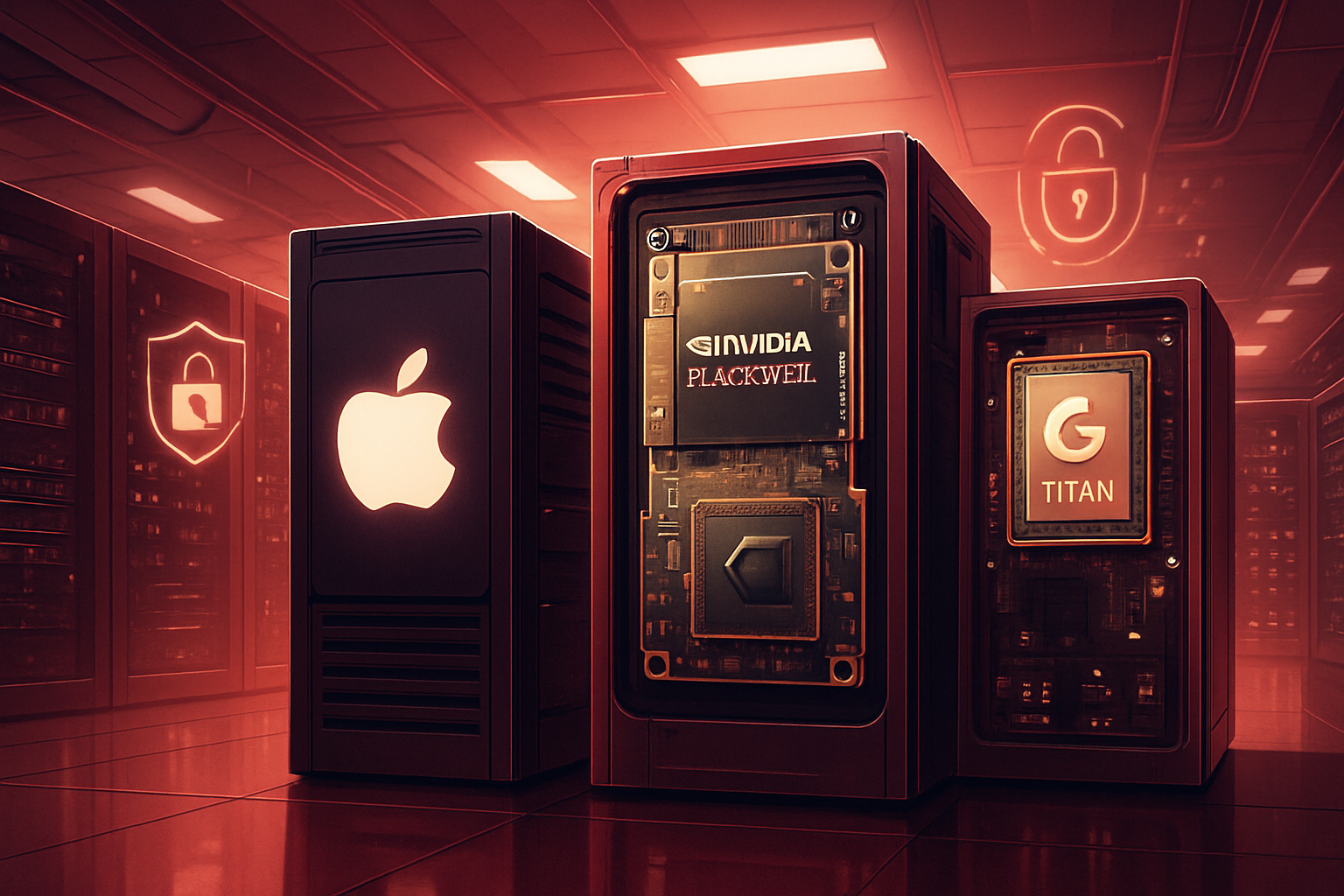
To expand its infrastructure, Apple has partnered with Google Cloud and NVIDIA. Google provides its data centers and global network, while NVIDIA supplies its next-generation graphics processors based on the Blackwell architecture. These chips offer the raw power and bandwidth necessary for Apple’s AI models.
Hosting data with a third party requires absolute security. The architecture deploys a cutting-edge hardware shield. NVIDIA Confidential Computing technology isolates data at the core of the graphics chip, and the Intel TDX system locks central processors in airtight trusted zones.
A final lock controls the physical integrity of the servers. Upon startup, a Google Titan hardware chip checks the compliance of each machine. An immutable cryptographic ledger continuously monitors the infrastructure, preventing any malicious modification of the hardware.
Transparency and Bug Bounty Program
To demonstrate its transparency, Apple systematically publishes the code for each update of its servers. Cybersecurity experts and independent firms can analyze these files to verify the absence of vulnerabilities or hidden data collection.
Apple also offers a Bug Bounty Program with attractive financial rewards. Reporting a data leak in system logs can earn $250,000, while intercepting requests or executing code can yield up to $1 million. A total compromise of the cloud can be worth up to $2 million.
Integration for Third-Party Developers
Initially, Private Cloud Compute was reserved for Apple applications like Siri or Notes. Now, all developers in the App Store can access this secure infrastructure through the API Foundation Models. A simple line of code is enough to integrate this cloud into their projects.
Once configured, the application automatically detects whether it needs to request remote servers. This represents a significant advancement for independent publishers. On iPhone, local AI is limited to 4,000 tokens of context, but switching to the cloud increases this limit to 32,000 tokens.
Management or photo editing tools can thus analyze larger documents and execute complex autonomous actions while preserving user privacy.
Server Models and Quota Management via iCloud
Accessing infrastructures equipped with NVIDIA Blackwell chips is generally costly. Apple innovates by offering this access for free to members of the App Store Small Business Program, which includes entities registering fewer than two million downloads annually.
This initiative allows small studios to compete with AI giants without bearing exorbitant costs.
Brief IA — L'actualité IA en français
L'essentiel de l'actualité de l'intelligence artificielle, décrypté et expliqué chaque jour.