ArcticSwarm: Snowflake AI Revolutionizes Multi-Agent Research
Introduction
On June 2, 2026, Snowflake AI Research published a technical blog post that caught the attention of the tech community. The article introduces ArcticSwarm, an innovative multi-agent system designed to transform how businesses conduct in-depth research. This system stands out for its ability to integrate structured data from SQL databases with unstructured information from web pages, documents, and other external sources. ArcticSwarm addresses a major challenge in enterprise artificial intelligence: the effective combination of structured and unstructured evidence.
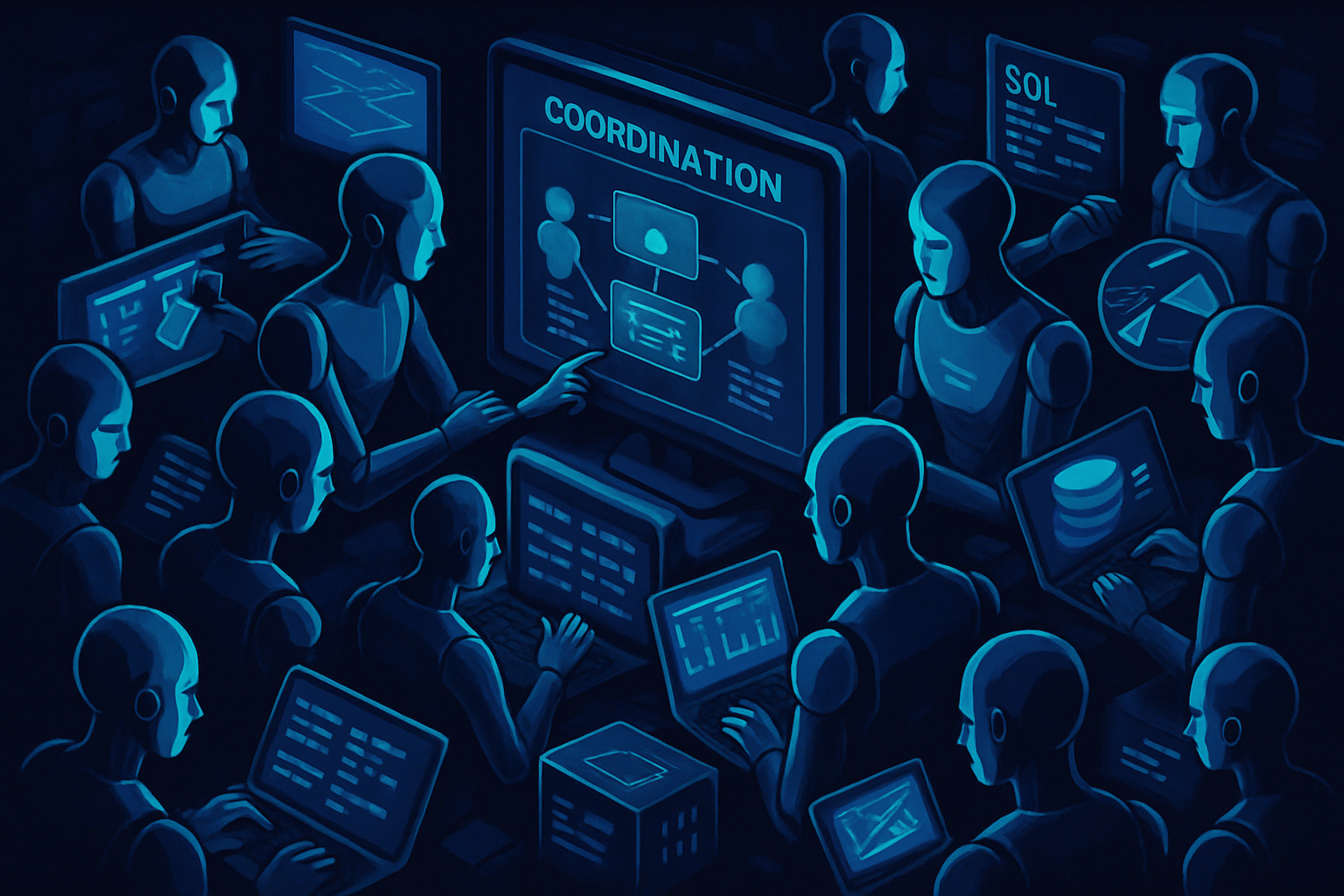
Unlike traditional approaches that rely on a single reasoning agent, often subject to confirmation bias, or poorly coordinated groups of agents that can quickly converge on similar conclusions, ArcticSwarm coordinates up to 16 specialized agents. These agents are dedicated to specific tasks such as browsing, coding, SQL analysis, and reasoning. The system employs a Bulletin Coordination System (BBS) to orchestrate these agents. The process unfolds in three distinct governance stages:
-
Mode 1 — Isolation: Agents independently explore the problem. They can share their findings on the bulletin but cannot consult the contributions of other agents, promoting diverse exploration.
-
Mode 2 — Collaboration: Agents have the ability to read and write on the bulletin, allowing them to cross-reference evidence, validate conclusions, and resolve inconsistencies.
-
Mode 3 — Synthesis: A Hybrid Evidence Gate ensures that a sufficient amount of SQL and web evidence has been collected before the orchestrator produces the final report, thereby reducing unsupported conclusions and hallucinations.
According to Snowflake AI Research, ArcticSwarm significantly enhances the performance of hybrid research tasks in enterprises compared to single-agent approaches, demonstrating the value of independent exploration, collaborative verification, and evidence-regulated synthesis.
What Makes ArcticSwarm Different
Research conducted by Snowflake has highlighted three common structural pitfalls in traditional multi-agent configurations:
-
The Exploration Trap: Agents share their leads too early, leading to premature consensus.
-
The Exploitation Trap: In the absence of structured evaluation, agents cannot confidently engage with their responses.
-
The Reliability Trap: Unverified merges of SQL data and web prose lead to hallucinations.
ArcticSwarm overcomes these obstacles through its three governance modes applied via a central bulletin:
| Mode | Mode Name | Rule | |--------|-----------------|--------------------------------------------------------------------------------------------------------------------------------------------| | Mode 1 | Isolation | Agents can WRITE on the BBS but cannot READ, forcing independent exploration and preventing bias from the discoveries of other agents. | | Mode 2 | Collaboration | Agents can READ and WRITE on the BBS, allowing for cross-referencing of evidence, knowledge sharing, and collaborative refinement of findings. | | Mode 3 | Synthesis | Only the Orchestrator writes on the BBS, consolidating verified findings into the validated final report. |
Le brief IA que les pros lisent chaque soir
Les 7 actus IA du jour, décryptées en 5 min. Gratuit.
Inclus dès l'inscription : notre sélection des meilleurs guides & comparatifs IA.
Choisis ton rythme
Gratuit · Pas de spam · Désabonnement en 1 clic
The Hybrid Evidence Gate prevents the final output until configurable evidence thresholds are met, for example, at least two SQL evidence publications, two web evidence publications, and one cross-domain synthesis.
Overview of the Architecture
The architecture of ArcticSwarm is designed to be comprehensive and integrated:
-
End-to-End ArcticSwarm Architecture: Queries are processed by a FastAPI orchestrator that generates isolated agents for specific tasks such as browsing, coding, and reasoning. These agents are coordinated via a Gated BBS supported by Redis, utilizing three governance modes, and produce evidence-regulated research reports—all powered by a single free LLM call.
-
Three Containerized Services: Redis BBS for coordination, FastAPI for orchestration, and Streamlit for the user interface.
-
ArcticSwarm Connection — built with Streamlit and deployed via Docker Compose.
The Key Innovation: Retrieve Then Analyze
The original architecture of ArcticSwarm relies on LLM tool calls for agent-tool interaction. However, on free LLMs like Groq, tool calling has proven unreliable. Agents tended to hallucinate evidence, fabricating URLs and SQL results, as the LLM was not actually executing any tools.
To address this issue, a Retrieve Then Analyze model has been implemented. Instead of following the traditional process where the LLM decides to call a tool, executes the tool, and then analyzes the result, the new model operates as follows:
- The agent directly executes the tool, the actual results are posted on the BBS, and a single LLM synthesizes all the evidence.
This means that:
-
BrowsingAgent directly calls the DuckDuckGo API without going through an LLM call.
-
CodingAgent executes SQL directly against Snowflake, without an LLM call.
-
A single LLM call is made per search query for the final synthesis.
The result is that URLs come from actual web searches, eliminating hallucinated sources.
Deep Dive into the Implementation
- The Bulletin Coordination System
The BBS is the heart of ArcticSwarm. All inter-agent communications pass through it, with structured access:
class GatedBBS:
    async def post(self, task_id, agent_id, post, current_mode):
        """Mode 3: Only the orchestrator can write."""
        if current_mode == GovernanceMode.SYNTHESIS and agent_id != "orchestrator":
            raise PermissionError("Mode 3: Only the orchestrator can post")
        # ... write to Redis

    async def read(self, task_id, agent_id, current_mode):
        """Mode 1: READ access DENIED for agents."""
        if current_mode == GovernanceMode.WRITE_ONLY and agent_id != "orchestrator":
            raise PermissionError("Mode 1: Agents cannot read the BBS")
        # ... read from Redis
This is not just a prompt instruction — it’s an architectural application. An agent in Mode 1 cannot physically read the BBS, no matter what the LLM "decides."
- The Browsing Agent (Real Web Search)
class BrowsingAgent(BaseAgent):
    async def run(self, instruction: str) -> list[BBSPost]:
        # Extract the main query from the instruction
        search_query = instruction.split("on the web:")[-1].strip()

        # Step 1: Execute the DuckDuckGo search directly (NO LLM CALL)
        browser = WebBrowserTool()
        search_results = await browser.web_search(search_query, num_results=5)

        # Step 2: Format the results as structured evidence
        findings = "\n".join(
            f"- [{r['title']}]({r['url']}): {r['snippet']}" for r in search_results
        )

        # Step 3: Post the ACTUAL RESULTS on the BBS with real URLs
        post = BBSPost(evidence_type=EvidenceType.WEB_FINDING, […]
The ArcticSwarm architecture thus enables more efficient and reliable research, integrating governance mechanisms that promote independent exploration and collaborative validation of results.
Brief IA — L'actualité IA en français
L'essentiel de l'actualité de l'intelligence artificielle, décrypté et expliqué chaque jour.