AI in Crisis of Popularity in the U.S.: Big Tech Under Pressure
Le brief IA que les pros lisent chaque soir
Les 7 actus IA du jour, décryptées en 5 min. Gratuit.
Inclus dès l'inscription : notre sélection des meilleurs guides & comparatifs IA.
Choisis ton rythme
Gratuit · Pas de spam · Désabonnement en 1 clic
AI in Crisis of Popularity in the United States: Big Tech Under Pressure
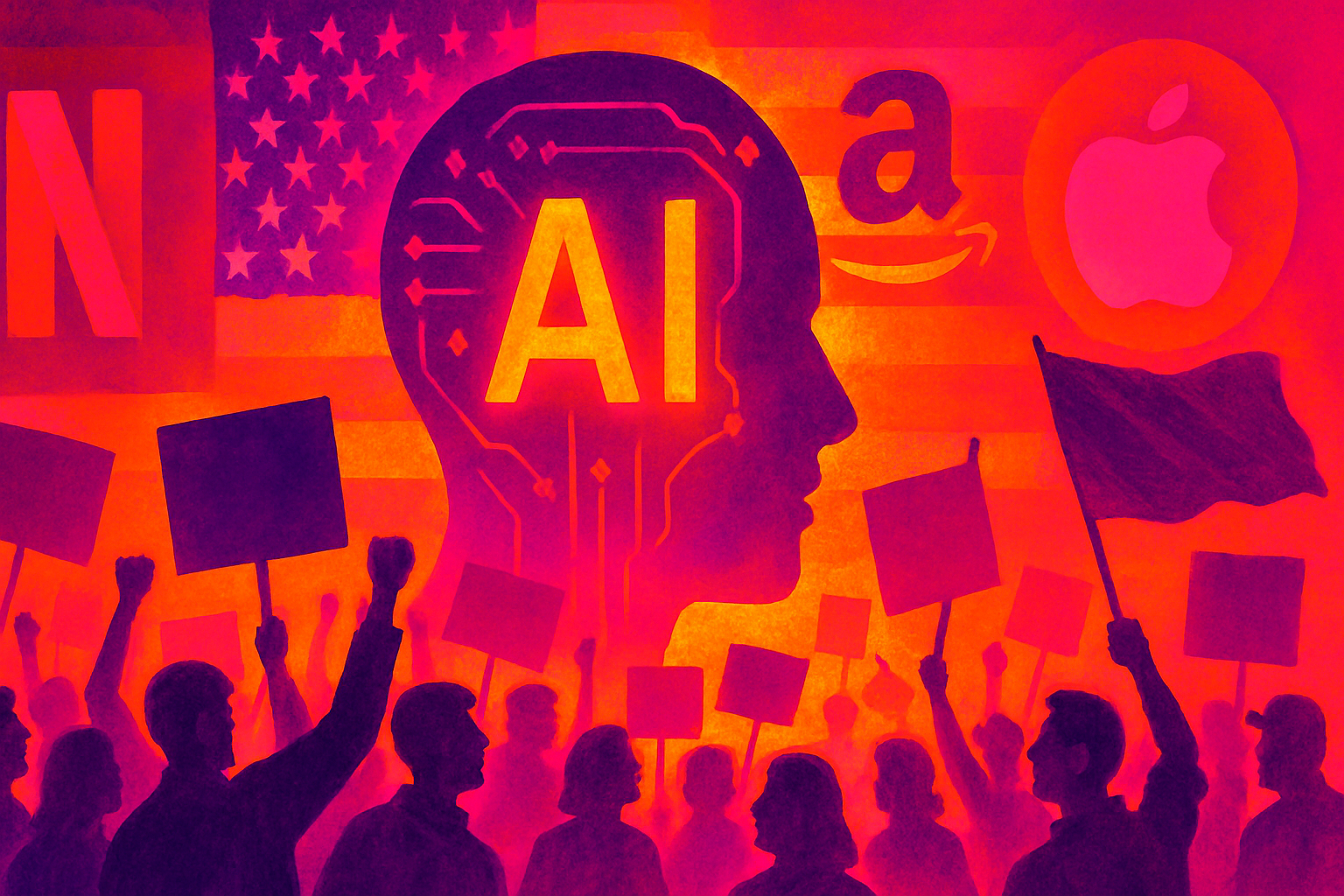
Artificial intelligence technology, once celebrated as a major advancement, is now facing growing unpopularity in the United States, even surpassing that of ICE, the immigration agency. This disaffection crosses traditional political lines and is prompting AI leaders to rethink their communication, often perceived as alarmist.
On May 15, during a graduation ceremony at the University of Arizona, Eric Schmidt, former CEO of Google, attempted to convince students of the monumental impact of AI. However, his speech was met with boos, illustrating the prevailing skepticism. This incident, while isolated, reflects a broader trend of distrust towards AI among the historically tech-savvy American public.
Widespread and Bipartisan Skepticism
A survey conducted by the Pew Research Center in September 2025 revealed that 50% of American adults are more worried than enthusiastic about AI, while only 10% hold the opposite view. A NBC News poll in March 2026 confirmed this trend, with 57% of voters believing that the risks of AI outweigh its benefits. These results are particularly significant given that the giants of AI are predominantly American, which eliminates fears of technological sovereignty loss, commonly found in Europe.
This rejection of AI transcends usual political divides. While Silicon Valley is aligning more closely with Donald Trump, one might expect opposition primarily from Democrats. However, a University of Maryland poll in August 2025 showed strong bipartisan support for AI regulation: 84% of Republicans and 81% of Democrats want companies to subject their AIs to government testing before deployment.
Younger generations, in particular, are expressing increasing skepticism. An April poll conducted by Gallup, the Walton Family Foundation, and GSV Ventures indicated that only 22% of Generation Z Americans are enthusiastic about AI, down from 36% the previous year. This disaffection is often attributed to the challenges young people face in the job market, which some link to the adoption of AI by businesses, although this hypothesis is contested by some economists.
Opposition to Data Centers: A Headache for Silicon Valley
The rejection of AI is also manifesting in growing opposition to the establishment of data centers, essential for AI development. According to a survey, 71% of Americans oppose the construction of these infrastructures near their homes, a higher rate than that concerning nuclear power plants.
This opposition is translating into concrete actions. In Festus, Missouri, four city council members were ousted after approving a $6 billion data center project. Inspired by this example, many municipalities are seeking to ban new data centers, posing a serious threat to Big Tech in a country where local democracy is highly influential.
In 2025, approximately $156 billion worth of projects were blocked or delayed due to local opposition, according to Data Center Watch. In the first quarter of this year, twenty projects were canceled, and many others are facing similar obstacles.
Politicians are beginning to respond. Missouri Republican Senator Josh Hawley and Connecticut Democratic Senator Richard Blumenthal have proposed legislation requiring data centers to find independent energy sources. South Carolina Republican Representative Nancy Mace has proposed a one-year moratorium on the construction of new data centers in her state, while a Texas lawmaker wants to ban any new AI data center developments, citing concerns about costs for farmers and pressure on the electrical grid.
More violent acts have also been reported: in Indiana, gunshots were fired at the home of a city council member who supported a data center project. Sam Altman's home was also targeted with a Molotov cocktail.
A Communication Strategy to Reassess for Silicon Valley
The unpopularity of AI poses a major public relations problem for Silicon Valley. Experts have long pointed out that the alarmist rhetoric of AI leaders contributes to the growing hostility from the public. "Our product will make you economically useless and may even kill you" is not a very appealing argument, wrote economist Noah Smith last March.
According to him, AI leaders have exaggerated the impact of their technology to attract investments but now find themselves trapped by a narrative that is unappealing to the public. "At first, enticing businesses and investors with the promise of reducing labor costs may have been a good strategy, but today, that is no longer the case. The American public, and likely that of other countries, values economic well-being in terms of employment above all. Few people are willing to accept a life of dependency, with all that entails in terms of reliance and precariousness."
Even Donald Trump recently admitted that AI needs a better communication strategy. Aware of this issue, AI leaders have begun to adjust their messaging. "We want to build tools to augment and elevate people, not to replace them," Sam Altman stated on his X account on May 1. Marc Andreessen of Andreessen Horowitz claimed that AI would create jobs rather than destroy them, while Jensen Huang criticized his colleagues for associating AI with job losses.
However, the risks highlighted by these entrepreneurs for years, such as mass unemployment or autonomous weapons, will not disappear overnight from people's minds. More than just a change in rhetoric will be needed to convince the public that AI will bring more good than harm.
Brief IA — L'actualité IA en français
L'essentiel de l'actualité de l'intelligence artificielle, décrypté et expliqué chaque jour.