Magic 8 Ball vs Generative AI: An Unexpected Duel in Prediction
Le brief IA que les pros lisent chaque soir
Les 7 actus IA du jour, décryptées en 5 min. Gratuit.
Inclus dès l'inscription : notre sélection des meilleurs guides & comparatifs IA.
Choisis ton rythme
Gratuit · Pas de spam · Désabonnement en 1 clic
Two Worlds of Prediction: the Magic 8 Ball and Generative AI
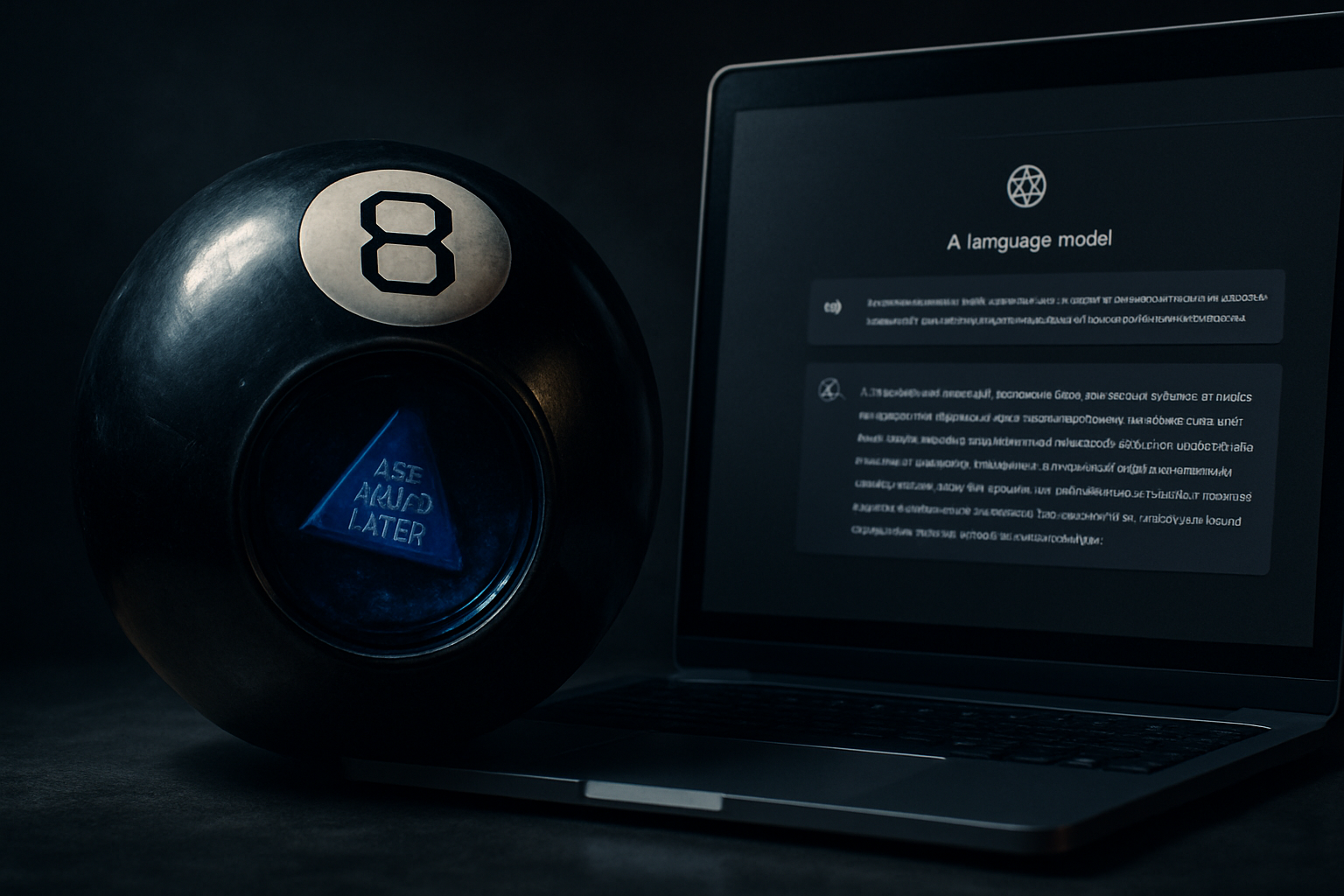
The Magic 8 Ball and generative artificial intelligence models share a common goal: answering human questions. However, their approaches and economic implications differ radically. On one side, a simple plastic sphere; on the other, cutting-edge technology requiring colossal investments. Despite their differences, both tools serve a similar function—predicting the future, each in its own way.
In 1950, Brunswick Billiards commissioned a company in Cincinnati to create a unique promotional item. The result was the Magic 8 Ball, a gadget containing a floating 20-sided die in dark blue liquid, offering twenty pre-printed answers. At the time, this product cost only two dollars. It has endured through decades, surviving major technological evolutions, and remains an iconic object that fits in a pocket. The Magic 8 Ball has outlasted about seven generations of personal computing, with the exception of a few die-hards with Blackberry, the entirety of New Coke, and the series Everybody Loves Raymond.
Seventy-five years later, large language models (LLMs) have emerged, capable of answering nearly any imaginable question with a sophistication that the Magic 8 Ball could not match. These models, while technically impressive, involve much higher costs. Modern AI is described as a trillion-dollar bet on the future of computing.
Random Honesty vs. Fluid Uncertainty
Both devices, the Magic 8 Ball and LLMs, operate by sampling distributions. The Magic 8 Ball offers twenty possible answers, divided into ten positive, five neutral, and five negative, simulating a dice roll. In contrast, LLMs generate responses by sampling tokens from probability distributions, influenced by user queries and training data.
The Magic 8 Ball is transparent: it shows the die, and the user knows it is a simple game of chance. In contrast, the interfaces of LLMs, with their fluid prose and structured formatting, do not explicitly reveal their probabilistic nature. A study published in 2024 in Nature Machine Intelligence found that users often overestimate the accuracy of LLMs, as confident language is perceived as evidence of justified trust. For example, Stanford's RegLab found high hallucination rates, between 58% and 88%, on federal legal questions, with models often being incorrect while expressing confidence.
More recent models and AI tools designed for legal purposes perform significantly better, which is reassuring if you plan to be sued.
Initial Costs vs. Amortized Costs
In 1950, the Magic 8 Ball cost about two dollars, a one-time payment with no additional fees for the user. No subscription, no complex infrastructure was required. In contrast, modern AI relies on a complex economic infrastructure. For example, training GPT-3 consumed about 700,000 liters of freshwater for cooling data centers, according to a 2023 study from UC Riverside.
The Magic 8 Ball required just a bit of plastic and simple liquid, while LLMs necessitate an invisible yet costly infrastructure. The Magic 8 Ball sold its cost upfront, whereas modern AI amortizes its costs through an infrastructure that the user does not see. This invisibility makes marginal queries seem apparently free, encouraging users to ask questions without worrying about the resources consumed. Estimates per query vary by an order of magnitude—from a fraction of a milliliter to about half a liter per 100-word query—depending on cooling and how you define 'a query.'
Borrowed Revelation vs. Preserved Fluidity
To design honest AI, one can draw inspiration from the Magic 8 Ball. It included responses like "Reply hazy, try again" or "Better not tell you now," representing 25% of its outputs. This refusal rate, while difficult to defend today, demonstrates a level of honesty that users tolerate.
Modern AI should not sacrifice fluidity. The transition from "shake the ball, interpret it yourself" to "ask in natural language" is a real improvement in user experience. The challenge is to allow the prose to stop before making uncertain claims while maintaining a smooth and natural interaction.
The discipline of design is a matter of restraint: let the prose stop before making claims the model is unsure about.
Push interpretation toward the user when reasonably possible. Citations from a source beat a paraphrased summary. Citations beat claims without sources. Ranges beat point estimates. None of this is technically difficult, and most already appear in marketed products—labeled sources, confidence ranges in copilot tools, structured models saying "I'm not sure about that." The design language for honest AI is formed in real time.
The Contract vs. Capability
Today, over a million Magic 8 Balls are sold by Mattel, becoming a familiar object in many households. The contract it offers is clear: "I am a guess, treat me accordingly." Modern AIs, on the other hand, propose a different contract: "I am an answer, trust me accordingly."
Both contracts are honest in their own way, each designed for specific tasks. The crucial question for designers and product managers is not which product is better, but what can be shared between them. Transparency is one aspect that can travel from one product to another, while capability remains specific to each technology.
The challenge for the future is to combine these two contracts, leveraging lessons from the Magic 8 Ball and advancements in modern AI. In 1950, the Magic 8 Ball understood its contract, in plastic, for two dollars. Today, modern AI masters capability, in silicon, at much higher costs. The design work ahead of us is to merge these two approaches to create tools that are both transparent and powerful.
Brief IA — L'actualité IA en français
L'essentiel de l'actualité de l'intelligence artificielle, décrypté et expliqué chaque jour.