China: AI Revolutionizes Solo Entrepreneurship Against Europe
Le brief IA que les pros lisent chaque soir
Les 7 actus IA du jour, décryptées en 5 min. Gratuit.
Inclus dès l'inscription : notre sélection des meilleurs guides & comparatifs IA.
Choisis ton rythme
Gratuit · Pas de spam · Désabonnement en 1 clic
China Bets on AI-Augmented Sole Proprietorship
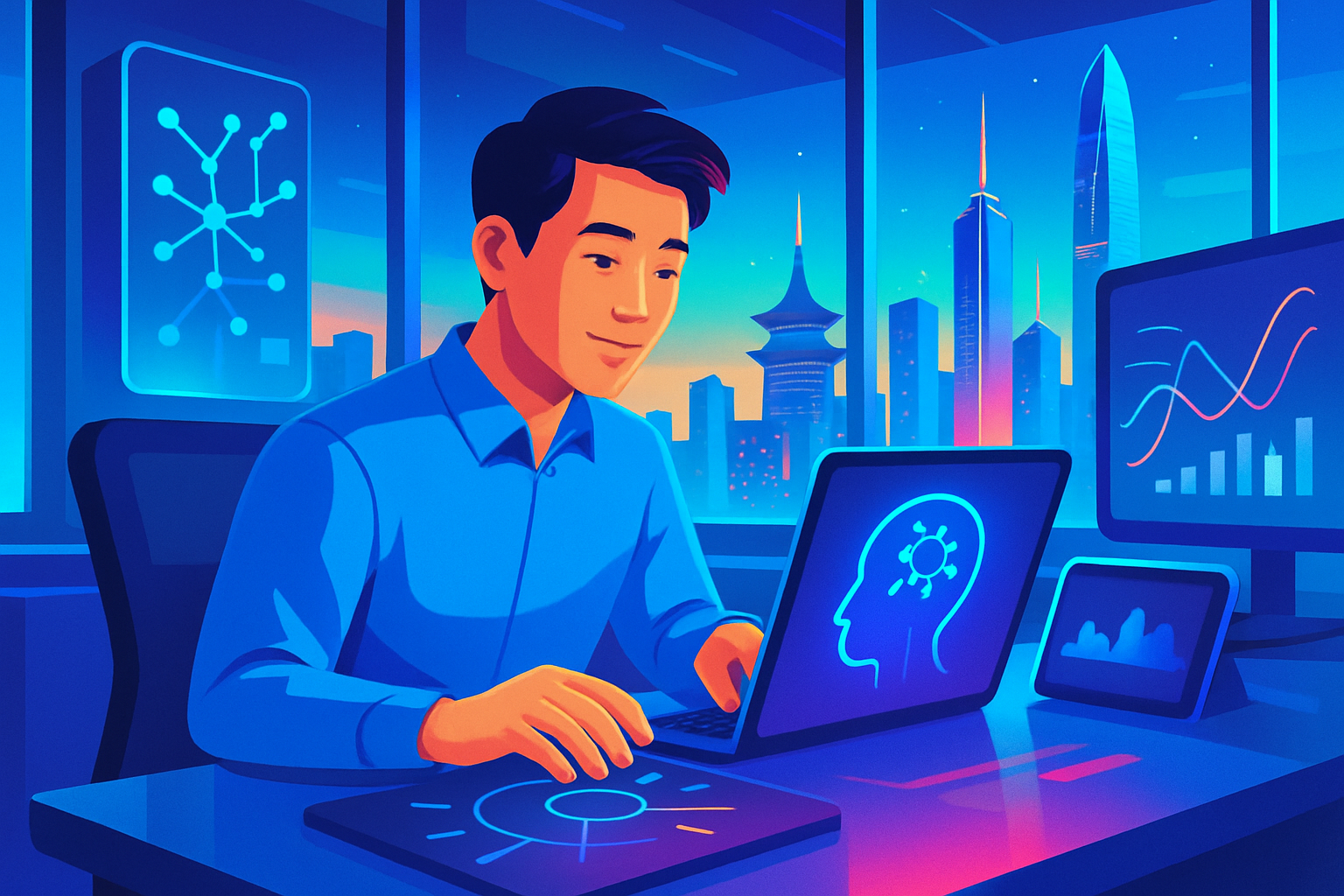
While Europe values individual expertise, China is innovating with the One-Person Company (OPC). This model, which transforms a solopreneur into an industrial production unit through artificial intelligence, is on the rise. In China, cities like Beijing and Shenzhen see these solitary entrepreneurs, supported by AI, as engines of innovation.
In China, local authorities are no longer content with merely supporting traditional startups. They are betting on a new economic paradigm: the One-Person Company (OPC). Unlike traditional freelancing, the Chinese OPC is defined by a single founder who orchestrates a suite of artificial intelligence tools to manage their entire value chain: from R&D to marketing, and even customer service. For municipalities like Beijing or Shenzhen, these "super-individuals" have become a strategic pillar for innovation.
Massive State Support for Solopreneurs
Unlike in the West, where solopreneurs often have to create their own set of tools, China offers structured support. Hangzhou provides "AI vouchers" for free access to GPUs, essential for training AI models. In Shenzhen, infrastructures consolidate various services to facilitate the transition from prototype to mass production. Additionally, Hangzhou has established an investment fund of 120 million euros specifically dedicated to OPCs.
In contrast to the Western model where the solopreneur often has to cobble together their own "tool stack," China is industrializing support for independents:
-
Subsidized computing power: Cities like Hangzhou distribute "AI vouchers" allowing solopreneurs to access GPUs necessary for training their models for free.
-
All-in-one infrastructure: In Shenzhen, buildings house seven service platforms (data, compliance, servers) to enable a solitary creator to transition from prototype to mass production in record time.
-
Public funding: The district of Hangzhou has launched a specific investment fund of 120 million euros dedicated exclusively to these one-person structures.
While in Europe, solopreneurship is often the culmination of a quest for autonomy for a passionate expert, China views the OPC as an atomized production unit capable of competing with SMEs through total automation.
Integration into the Real Economy
To succeed, these OPCs must integrate into the real economy. In Shenzhen, authorities are opening "business scenarios" in sectors like health and logistics to test solopreneurs' solutions. The goal is to transform these innovations into public contracts or integrate them into global supply chains.
The success of these OPCs hinges on their ability to fit into the real economy. In Shenzhen, authorities are now opening state "business scenarios" (health, logistics) to solopreneurs to test their solutions. The challenge is no longer just to create an AI tool, but to capture public contracts or integrate into global industrial supply chains.
A New Era for Solopreneurship
The Chinese model of the OPC, supported by the state, could revolutionize solopreneurship. If AI allows an individual to match the productivity of a team, Europe may need to rethink its support structures to transform its independents into true technological micro-powers.
This Chinese model of the "one-man company" backed by public power marks a turning point. If AI truly enables an individual to match the impact of a team of ten, should our support structures (incubators, banks) reconsider their criteria?
The question remains open for our decision-makers: in the face of this industrialization of solopreneurship, should Europe continue to protect the independent worker as an isolated individual, or should it empower them as a full-fledged micro-technological power?
Brief IA — L'actualité IA en français
L'essentiel de l'actualité de l'intelligence artificielle, décrypté et expliqué chaque jour.