Claude Code and OpenClaw: The Rise of AI Loops
Le brief IA que les pros lisent chaque soir
Les 7 actus IA du jour, décryptées en 5 min. Gratuit.
Inclus dès l'inscription : notre sélection des meilleurs guides & comparatifs IA.
Choisis ton rythme
Gratuit · Pas de spam · Désabonnement en 1 clic
The Growing Importance of Loops in AI
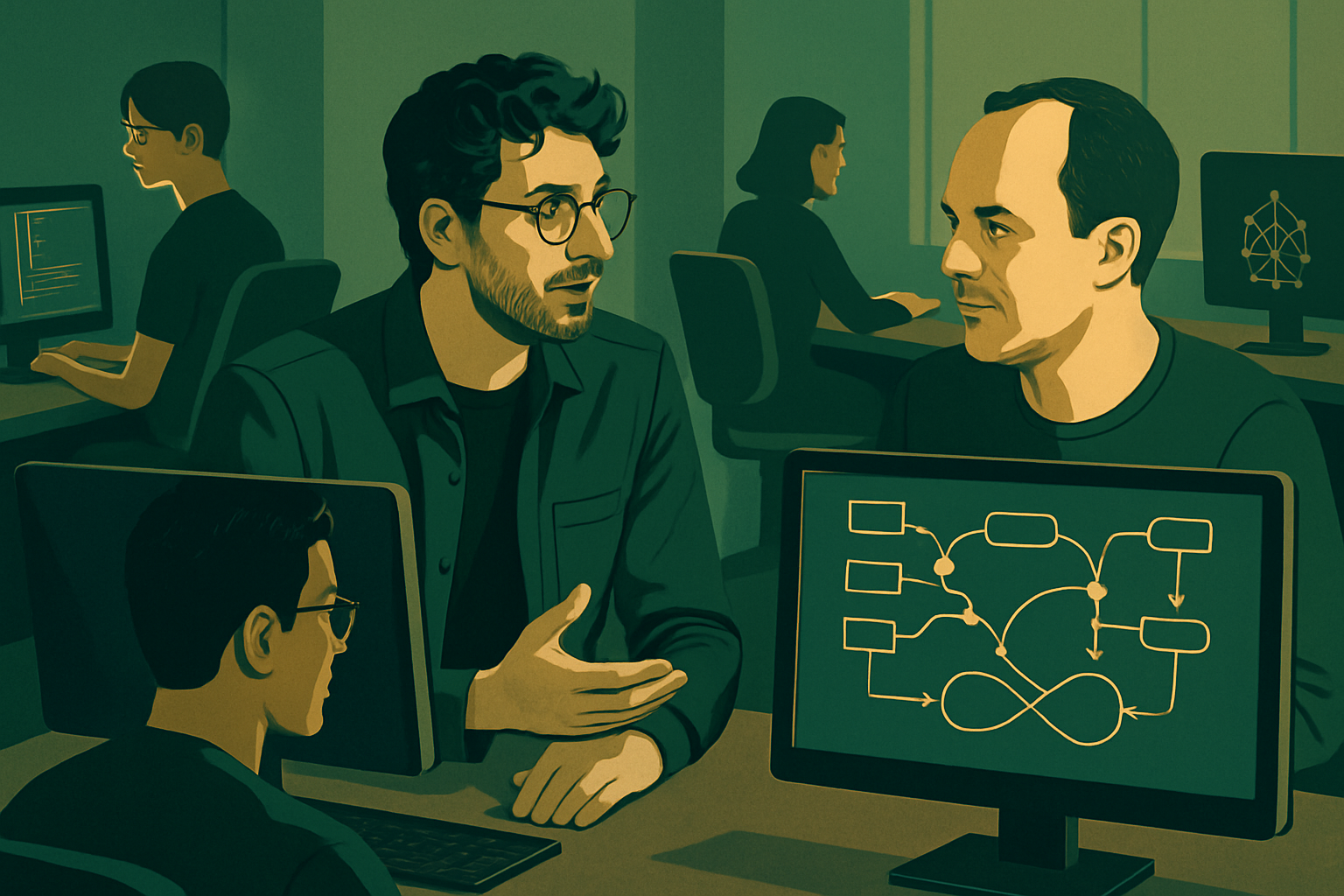
Boris Cherny, the creator behind Claude Code, recently expressed his enthusiasm for loops, a technology he considers revolutionary in the field of artificial intelligence. According to him, among all the innovations he is working on, loops will be what he is most proud of in ten years. This statement was made during an interview with CNBC, where Cherny explained how loops are changing the way AI agents are utilized. He emphasized that he no longer needs to write his own prompts thanks to this technology. "It's an agent that queries Claude," he clarified, adding that Claude now generates the prompts, allowing him to communicate with an improved version of Claude.
Peter Steinberger, an engineer at OpenAI and creator of OpenClaw, shares this enthusiasm. He recently reminded users on the platform X that it is time to stop writing prompts for coding agents. According to him, the future lies in designing loops that autonomously query these agents.
Understanding Loops
Loops are systems designed to guide AI agents in a recurring manner, thereby eliminating the need for users to constantly draft prompts. A concrete example is the command /goal, which allows tools like Claude Code from Anthropic or Codex from OpenAI to continue a task until completion without human intervention. Claire Vo, founder of ChatPRD, explained that this means users no longer need to manually type instructions for their agent to perform tasks.
Addy Osmani, director at Google Cloud, also addressed this topic in a post detailing the concept of loops. He described the five essential components for their operation: automations, work trees, skills, plugins and connectors, and sub-agents. Automation is crucial as it allows loops to repeat, unlike a one-time event.
In the coding domain, a common setup involves dividing tasks among multiple agents: one writes the code while the other checks the final result. Osmani emphasized that the model generating the code should not be the one evaluating it, as it may lack objectivity.
Steinberger illustrated the use of loops with a personal example: he configures Codex to maintain his repositories, waking up every five minutes to direct work to different threads, which facilitates parallelization and optimization of tasks.
Applications of Loops Beyond Coding
Although current discussions about loops primarily focus on coding, their potential extends far beyond. Claire Vo pointed out that loops can be utilized in various fields, such as management or customer service. She compared designing a loop to onboarding a new employee, whether it be an executive assistant or a software engineer.
You may already be using loops without realizing it. For instance, if you have scheduled a recurring task in ClaudeCowork, you have actually created a loop, as Vo explained.
The Limitations and Costs of Loops
However, the adoption of loops is not without challenges, particularly in terms of costs. Utilizing multiple agents and sub-agents on advanced AI models can quickly deplete a token budget, which may concern users or their employers.
Steinberger addressed concerns about costs by suggesting limiting the frequency of API calls, for example, by spacing them an hour or a day apart to reduce token consumption. He also mentioned his privilege of having access to unlimited tokens due to his job at OpenAI.
Addy Osmani advises spending wisely by using sub-agents only when necessary, as each sub-agent consumes tokens to perform its own work. He recommends seeking a second opinion only when it is truly warranted.
Brief IA — L'actualité IA en français
L'essentiel de l'actualité de l'intelligence artificielle, décrypté et expliqué chaque jour.