Claude and ChatGPT: The Battle of AIs and the Illusion of Prophets
Le brief IA que les pros lisent chaque soir
Les 7 actus IA du jour, décryptées en 5 min. Gratuit.
Inclus dès l'inscription : notre sélection des meilleurs guides & comparatifs IA.
Choisis ton rythme
Gratuit · Pas de spam · Désabonnement en 1 clic
Claude and ChatGPT: The Battle of AIs and the Illusion of Prophets
In the ever-evolving world of artificial intelligence, each new model is often met with a wave of enthusiasm that proclaims it as the next great winner. However, these certainties are often fleeting, and what seems to be an absolute truth today may be called into question tomorrow.
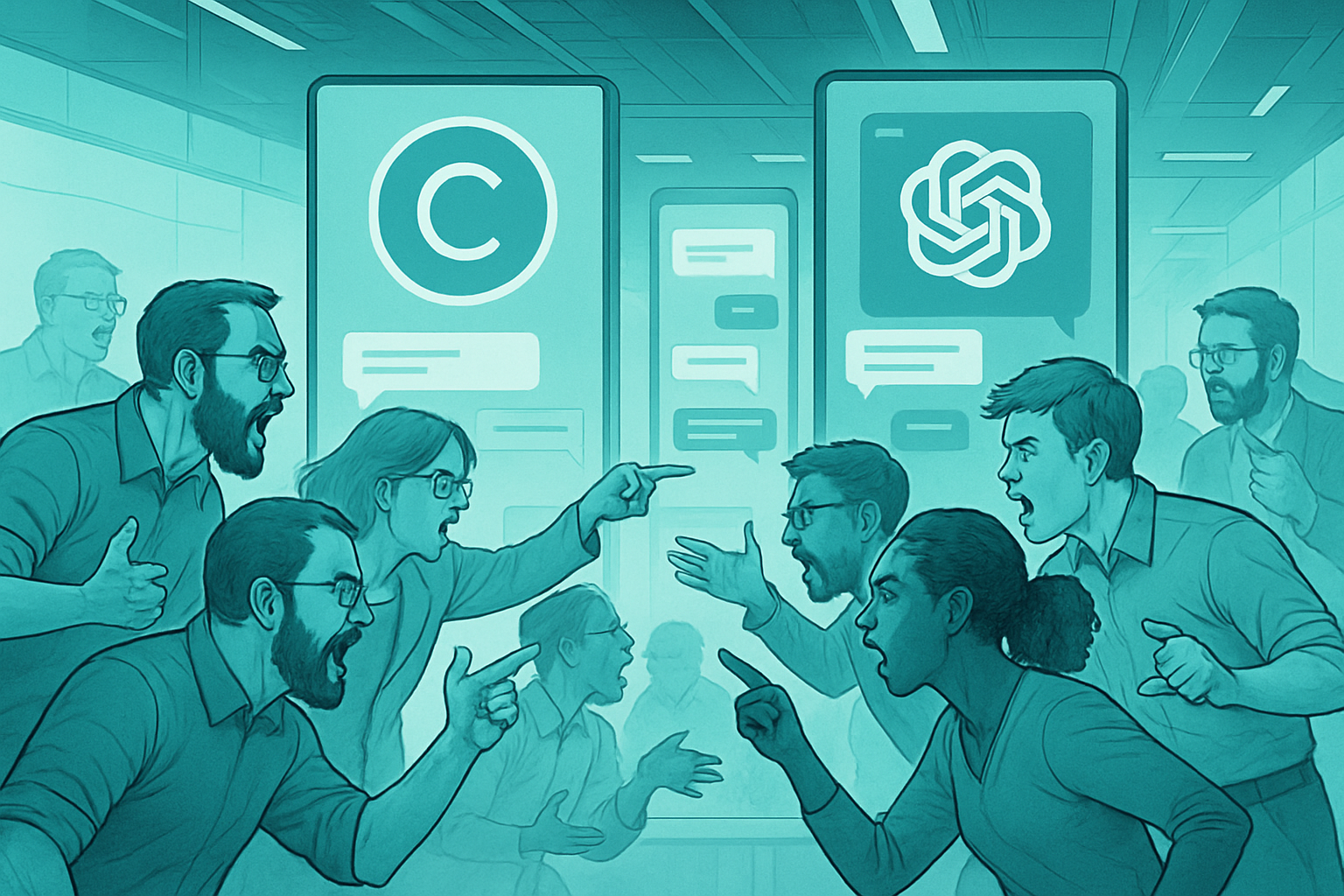
Claude, an AI tool that has captivated many users, continues to demonstrate its remarkable capabilities. Its strengths are not diminished by the advancements of ChatGPT, just as OpenAI's progress does not necessarily spell the end for Anthropic, Google, or other market players. Each AI has its strengths and weaknesses, and may be suitable for specific uses while being less adapted to others.
The debate over the best AI model is often simplistic, as it rests on the erroneous idea that there is a universal hierarchy applicable to all. In reality, the quality of a tool depends on many factors, such as the context of use, memory, interface, tone, work habits, expected accuracy, and even personal affinity with the tool.
Recognizing the advancements of ChatGPT does not mean proclaiming OpenAI's victory. Similarly, appreciating the qualities of Claude does not designate it as the ultimate savior of digital humanity. The market is filled with high-performing tools, but often lacks the perspective to evaluate them objectively.
The Emergence of New Technological "Religions"
Each launch of an AI model is accompanied by a well-established ritual. Impressive demonstrations emerge, followed by screenshots and infographics that claim to redefine the world of work. Enthusiastic users share their experiences as if they have witnessed a historic event, and hasty conclusions soon follow.
The discourse surrounding these models does not merely highlight their performance on certain tasks. It goes so far as to claim that these models have understood humanity, buried the competition, and rendered generations of tools, even entire professions, obsolete, before most professionals have had the chance to seriously test them.
The vocabulary used to describe these innovations is often hyperbolic, evoking revolutions, disruptions, and new eras. Innovation is no longer seen as mere progress, but as a revelation that forces everyone to choose a side. Those who hesitate are viewed as laggards, those who qualify their statements are accused of lacking vision, and those who remind us that a use case does not constitute general proof are perceived as not understanding the speed of change.
This phenomenon is not exclusive to artificial intelligence. Every technological market experiences its cycles of excessive enthusiasm and replacement narratives. However, AI accelerates this process, as users can immediately notice a difference in behavior, publish their results, and transform an individual experience into a public demonstration. The narrative power of a brilliant response or impressive reasoning often surpasses its statistical value.
We are no longer just seeking tools, but regularly a new "savior."
The Civilizational Scope of Technological Hype
Hype no longer merely accompanies a commercial release. It confers a civilizational scope to a product, creating around it a community of converts who proclaim that everything that existed before already belongs to the past. The tool becomes a sign of belonging, preference an identity, and criticism almost a betrayal.
Those who first occupy public space are not always those who have tested the new tools the most. Many produce neither research, nor rigorous benchmarks, nor sufficiently long comparisons to withstand the next launch. They mainly comment on the collective emotion at the moment it becomes profitable, then give it a more spectacular form to appear slightly ahead of the rest of the crowd.
They do not necessarily predict the future. They quickly rephrase the dominant enthusiasm. Their main ability lies in recognizing the wave of attention, adopting its vocabulary, and publishing before the nuances have had time to slow the narrative. Speed then becomes a substitute for expertise, as the one who speaks first gains a symbolic advantage, even when their analysis is based on a few trials and a momentary conviction.
This logic rewards strong certainties. Saying that a model seems promising, but that it will take time to compare uses, has little effect. Claiming that it buries all others, disrupts the market, and permanently changes the way we work attracts much more attention. Caution appears weak, while exaggeration seems like foresight until the prophecy ceases to be convenient.
It would be unfair to consider that everyone who shares their enthusiasm is incompetent or opportunistic. Some genuinely test, document their uses, and correct their conclusions. The problem arises when the displayed authority far exceeds the work done, and when a seductive demonstration is enough to produce a universal verdict.
The competence of some prophets is therefore not always about evaluating technology. It mainly consists of recognizing where attention will focus, then transforming that attention into a posture of expertise before it shifts elsewhere.
Prophecies Without Accountability
For a few weeks, claims become categorical. One model is proclaimed the winner, another is declared dead, certain jobs are announced as extinct, and companies are judged as having missed their turn. Nuances are erased, contextual differences disappear, and the entire market seems to have to obey a demonstration made on a screen, in a particular situation, by a person with their own habits and expectations.
Then a new model arrives, or an update sufficiently improves a competitor to shift the center of gravity of the conversation. Old certainties are almost never revisited. Failed prophecies are not subject to any accountability, and their authors do not return to explain that they generalized too quickly, confused a one-off performance with lasting superiority, or took a personal preference for a market shift.
They simply change their vocabulary, screenshots, and "god." Consistency matters little, as the flow quickly erases previous statements and the collective attention already prefers the next novelty. Amnesia becomes a condition for the system's operation, as it allows everyone to remain a prophet without ever being held accountable for their past prophecies.
The lifespan of certainties has become shorter than that of the models they claim to analyze. A tool can retain its qualities for several years, while the narrative built around it may last only a few weeks. This gap reveals that the real object of commentary is not always the technology, but the position each person seeks to occupy in the conversation.
The Diversity of Preferences and the Illusion of Universal Truth
It is entirely possible to prefer Claude for certain uses, ChatGPT for others, or even to choose a less publicized model because it better meets a specific constraint. A preference can be perfectly rational without becoming a general law. It may rest on writing quality, memory, speed, interface, privacy, price, integration into an ecosystem, or simply a way of conversing that suits the individual better.
A tool can be remarkable without being so for all professions. A model can progress without rendering previous ones useless. A spectacular difference in a demonstration can become secondary in daily use, while an apparently mundane feature can prove decisive for a particular team. Value depends less on theoretical ranking than on the fit between the tool, the task, and the organization.
The problem is therefore not enthusiasm. It begins when enthusiasm presents itself as proof, when a use case becomes a general rule, and when an individual preference is sold as a technological truth. This confusion produces fragile recommendations, as it pushes professionals to change tools at the pace of narratives rather than at the pace of their needs.
A serious evaluation should distinguish between one-off performance, use cases, supplier communication, sustainable market evolution, and personal user experience. It should also accept that two competent individuals can arrive at different conclusions without either necessarily being wrong.
Maturity does not consist of never being enthusiastic. It consists of not confusing enthusiasm with demonstration.
Brief IA — L'actualité IA en français
L'essentiel de l'actualité de l'intelligence artificielle, décrypté et expliqué chaque jour.