Scout AI and Its $100 Million: Military AI Takes Center Stage
Le brief IA que les pros lisent chaque soir
Les 7 actus IA du jour, décryptées en 5 min. Gratuit.
Inclus dès l'inscription : notre sélection des meilleurs guides & comparatifs IA.
Choisis ton rythme
Gratuit · Pas de spam · Désabonnement en 1 clic
A Strategic Fundraising for Scout AI
On a military base nestled in the heart of Central California, four-seat all-terrain vehicles traverse rugged trails. However, these exercises are not meant for the people on board, but rather to train artificial intelligence models to navigate conflict zones. These autonomous vehicles are operated by Scout AI, a startup founded in 2024 by Colby Adcock and Collin Otis. Describing itself as a "cutting-edge laboratory for defense," the company recently announced a $100 million fundraising during a Series A funding round led by Align Ventures and Draper Associates. This amount adds to the $15 million raised during an initial round in January 2025.
Scout AI offered TechCrunch an exclusive tour of its training operations on a military base whose name remains confidential at the company's request. Scout's primary goal is to develop an AI model, dubbed "Fury," designed to operate and command military assets. This model is initially intended for logistical support, with the ambition to expand into autonomous weapons. CTO Collin Otis compares this process to training soldiers, emphasizing the importance of starting with a basic level of intelligence.
"Soldiers start at 18, and sometimes after college, so it's crucial to begin with a baseline intelligence," Otis explains to TechCrunch. "It's advantageous to start from an existing investment and then teach that entity to become an exceptional military AGI, rather than a generic AGI."
Military Contracts and Rigorous Testing
Scout AI has secured military technology development contracts totaling $11 million, collaborating with entities such as DARPA, the Army Applications Laboratory, and other clients from the Department of Defense. Scout's technology is also being tested by the 1st Cavalry Division of the U.S. Army during its regular training cycle at Fort Hood, Texas. The hope is that the unit will adopt these technologies during its next planned deployment in 2027.
For its internal testing, Scout utilizes the hilly terrain of the military base, where its operations team, composed of former soldiers, puts the vehicles to the test in simulated missions. These exercises allow for testing the robustness and effectiveness of the AI models in conditions close to reality.
Innovation in Visual Language Action Models
Scout AI is turning to an innovative autonomy technology: visual language action models (VLA). These models, based on LLMs, are used to control robots. First published by Google DeepMind in 2023, these technologies have inspired several robotics startups, such as Physical Intelligence and Figure AI, a humanoid robotics company led by Brett Adcock, Colby’s brother.
Colby Adcock, a board member of Figure, saw this experience as an opportunity to bring broader intelligence to the growing fleet of autonomous military vehicles. His brother introduced him to Otis, who was advising Figure, and together they began applying the latest advancements in AI to military solutions.
"If I handed you a drone controller right now and put a headset on you, you could learn to pilot that thing in a few minutes," Otis asserts. "You learn to connect your prior knowledge to those few little joysticks. It's not a big leap. That's how to think about VLAs and why they represent a breakthrough."
Field Experiences
During the visit, I had the opportunity to drive one of Scout's ATVs on the rugged trails. The terrain was challenging: steep hills, loose sand in the turns, missing paths, confusing intersections. Although I am not an experienced ATV driver, I managed to perform well on my first attempt. This is the type of general intelligence the company aims to integrate into its models, which it has been training with these ATVs for only six weeks, starting with civilian ATVs.
I also took a ride in the autonomously controlled ATV and could feel the difference: it accelerates faster than a human who might consider passenger comfort. The operations team highlighted how the vehicles tend to veer right on wider trails but remain centered on narrow paths, just like their trainee drivers. They also suddenly slow down when confused to think about their next move, which happened several times as the ATV took us on a 6.5 km loop before returning to base.
The Future of Autonomous Weapons
While VLAs are still relatively new and have not yet been deployed by a company in an operational setting, "the technology is good enough to do this field experimentation with soldiers to determine how to be most effective for U.S. forces," said Stuart Young, a former DARPA program manager who worked on ground vehicle autonomy. Like other autonomy companies, Scout's full stack also includes deterministic systems and other AI variants to complement its agents' capabilities.
Scout primarily sees itself as a software company building an intelligence layer for military machines. It does not intend to manufacture the autonomous vehicles themselves but rather to build on top of them.
Adcock expects that the first product from the startup to be widely adopted will be a command and control software called "Ox," paired with robust hardware such as GPUs, communications, and cameras. It is designed to enable individual soldiers to orchestrate multiple drones and autonomous ground vehicles using commands like: "Go to this waypoint and monitor enemy forces."
However, operating this software requires training on real vehicles, which is why it has set up Foundry, its training field at the military base. There, drivers spend eight-hour shifts putting the ATVs to the test, then work through a reinforcement learning system to record where they had to take control, which is used to improve the model. The base commander even requested the company's ATV to take a turn with the security patrols.
One hypothesis that Scout is testing is that VLAs will allow this relatively limited dataset, combined with training data from simulations, to provide a fully capable driving agent. While the vehicle seems comfortable on trails, for example, it is not yet ready to operate fully off-road.
Scout is also practicing with drones for reconnaissance and defense, giving them intelligence with visual language models.
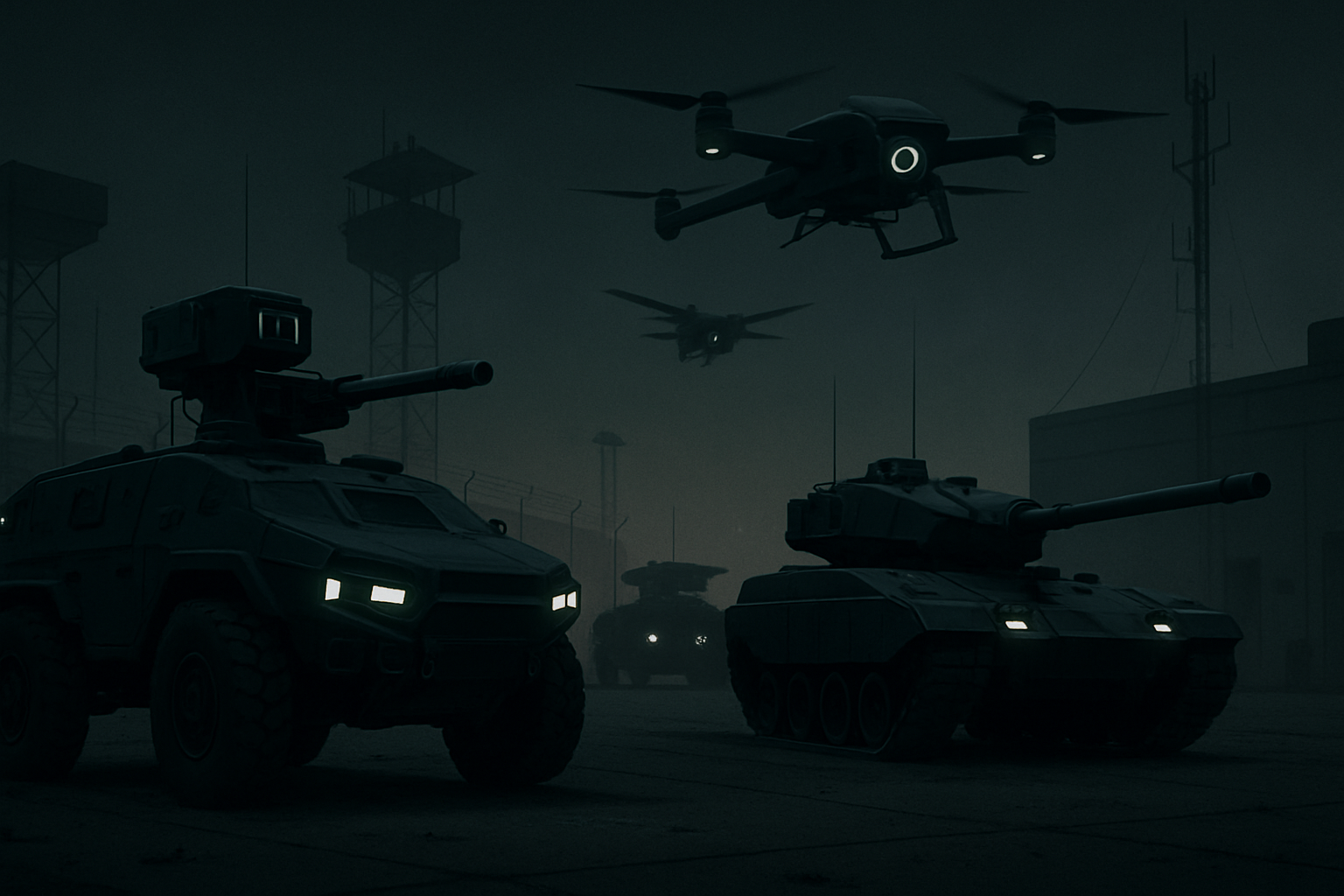
The startup is working on a system that would see groups of munition drones flying with a larger "quarterback" platform that provides more computing resources to command them. For example, the drones could scout a geographical area for hidden enemy tanks and attack them, possibly without human intervention. Otis argues that the alternative approach in such a scenario could be indirect artillery fire, which is imprecise compared to drone strikes.
Although autonomous weapons are a point of friction in defense technology policy, experts note that the concept is not new: homing missiles and mines have been used in warfare for decades. The question for technologists is how the weapons are controlled, according to Jay Adams, a former U.S. Army captain who leads Scout's operations team.
Adams notes that the company's munition drones can be programmed to only attack threats in a specific geographical area or only after human confirmation. He also asserts that autonomous weapon platforms are unlikely to fire because they are afraid, as a soldier might be at 18.
VLAs, too, promise to improve targeting. Scout claims that its models are pre-trained on a specific set of military data to prepare them to, for example, encounter an enemy tank during a resupply mission. Lieutenant Colonel Nick Rinaldi, who oversees Scout's work for the Army Applications Laboratory, states that while automated targeting is difficult and unlikely to be used outside of constrained environments in the short term, the potential of VLAs to reason about threats makes it a promising technology to explore.
Adams asserts that the promise of drones capable of identifying their own targets is essential for the warfare of tomorrow. As Russia's invasion of Ukraine has sparked intense interest in drone warfare, he believes that humans operating individual UAVs are not scalable enough for the U.S. to face future challenges.
Brief IA — L'actualité IA en français
L'essentiel de l'actualité de l'intelligence artificielle, décrypté et expliqué chaque jour.