Deezer Deploys AI to Track AI-Generated Tracks
Le brief IA que les pros lisent chaque soir
Les 7 actus IA du jour, décryptées en 5 min. Gratuit.
Inclus dès l'inscription : notre sélection des meilleurs guides & comparatifs IA.
Choisis ton rythme
Gratuit · Pas de spam · Désabonnement en 1 clic
Deezer Deploys AI to Track AI-Generated Tracks
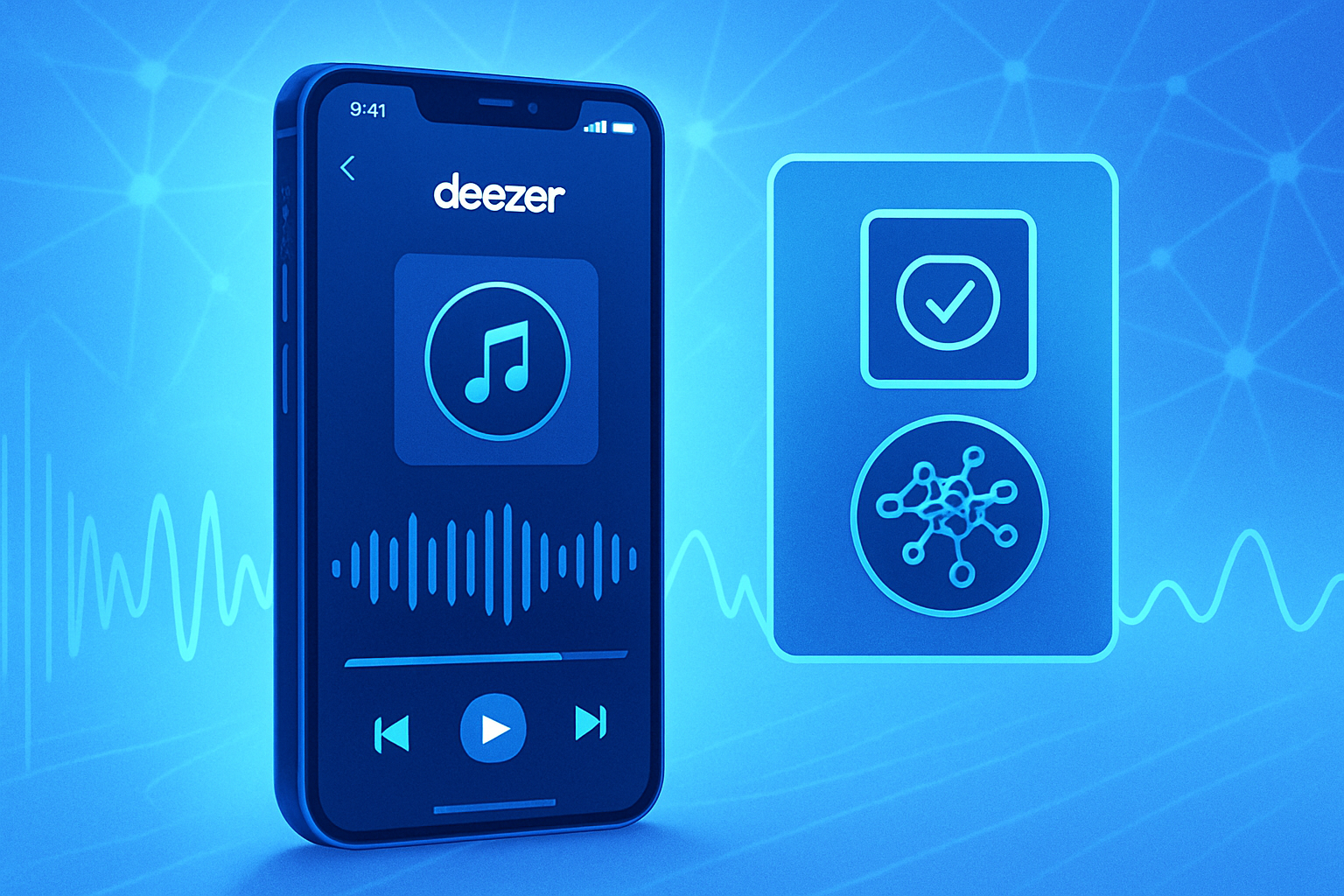
Every day, tens of thousands of tracks generated by artificial intelligence arrive on streaming platforms. To preserve the listener experience as well as artist compensation, Deezer has developed a tool capable of detecting them with remarkable accuracy. The French platform offers a tool to identify tracks entirely generated by AI and avoid false recommendations.
Deezer is currently offering three months of free trial to its new subscribers, and beyond the purely musical aspect, this might be the perfect time to discover one of its most original features. The French platform indeed provides a tool capable of identifying tracks entirely generated by artificial intelligence, to prevent our recommendations from turning into a grand festival of fake artists.
When AI Composes, Deezer Takes Steps to Recognize It
Artificial intelligence is now everywhere. While many of us have already used it to write a text, edit a photo, create a video, or even imagine an interior layout, it has also made its way into our playlists. With just a few clicks, tools accessible to everyone now allow the production of tracks in just a few minutes. A creative revolution, certainly, but one that also raises many questions for streaming platforms.
At Deezer, the phenomenon has taken on considerable proportions, to the point that every day, more than 75,000 AI-generated tracks are uploaded to the service, accounting for 44% of daily new imports. This rapid growth is no longer limited to a few experiments, and artificially generated music has now become part of the landscape.
The issue is not so much the existence of these creations but the uses made of them. Deezer estimates that up to 85% of listens to AI-generated tracks are fraudulent. This means they are driven by automated systems designed to artificially inflate statistics in order to capture a portion of streaming-related revenues.
In the face of this new reality, the French platform has chosen not to suffer and has developed its own AI detection scanner, a tool capable of automatically identifying tracks created by the main generators on the market.
A Functioning Based on Audio Signatures
Its operation is based on a simple idea, relying on the particular signatures in the audio signals left by generative AI tools. Inaudible to our human ears, these digital traces can, however, be recognized by specially trained models.
In terms of effectiveness, the detector developed by Deezer promises to achieve 99.8% accuracy. Specifically, this means it would miss only about 2 AI-generated tracks out of 1,000, while incorrectly flagging only one authentic track out of 10,000. A reliability level sufficiently high to automate a large part of the detection.
Better Identified AI for a More Transparent Platform
Deezer's goal is not to ban music generated by artificial intelligence but to ensure greater transparency while protecting its ecosystem. Since the beginning of 2025, nearly 13.4 million AI-generated tracks have already been identified on the service according to Deezer. These tracks remain accessible to users, but they are now labeled, making them immediately recognizable.
This identification also allows for adjustments in recommendations. Tracks detected as AI-generated are thus not included in Deezer's algorithmic recommendations or editorial selections, preventing them from artificially taking the place of works created by real artists.
This approach also meets a widely expressed expectation from users, as a study conducted by Deezer shows:
- 80% believe that AI-generated tracks should be clearly marked
- 73% want to know when their platform recommends this type of content
- 45% would even like an option to completely filter out AI-generated tracks
Thanks to this policy, AI-generated music today represents only 1 to 3% of listens on Deezer, despite its high publication volume.
Deezer also promises to act on the economic front. For this, listens identified as fraudulent, as well as various manipulation attempts, are removed from the calculation of royalties. A measure aimed at ensuring fairer compensation for artists and rights holders.
A Shared Innovation
Finally, Deezer does not reserve this innovation solely for its own catalog, as its AI scanner is now made available to its partners in the music industry, including other streaming platforms. This is a way to contribute to the establishment of common standards in the face of a technology (AI) that will undoubtedly continue to profoundly transform the music creation process.
For those who wish to discover the platform (or return to it), Deezer is currently offering three months of free trial on its Premium offer. This is an opportunity to enjoy a rich catalog of millions of titles, FLAC audio quality, a personalized recommendation algorithm, as well as features designed to provide an increasingly transparent listening experience. A 3-month free period allows for a concrete exploration of the vision that Deezer advocates today for music streaming.
Brief IA — L'actualité IA en français
L'essentiel de l'actualité de l'intelligence artificielle, décrypté et expliqué chaque jour.