Shein and AI: Fake Black Influencers Deceive TikTok
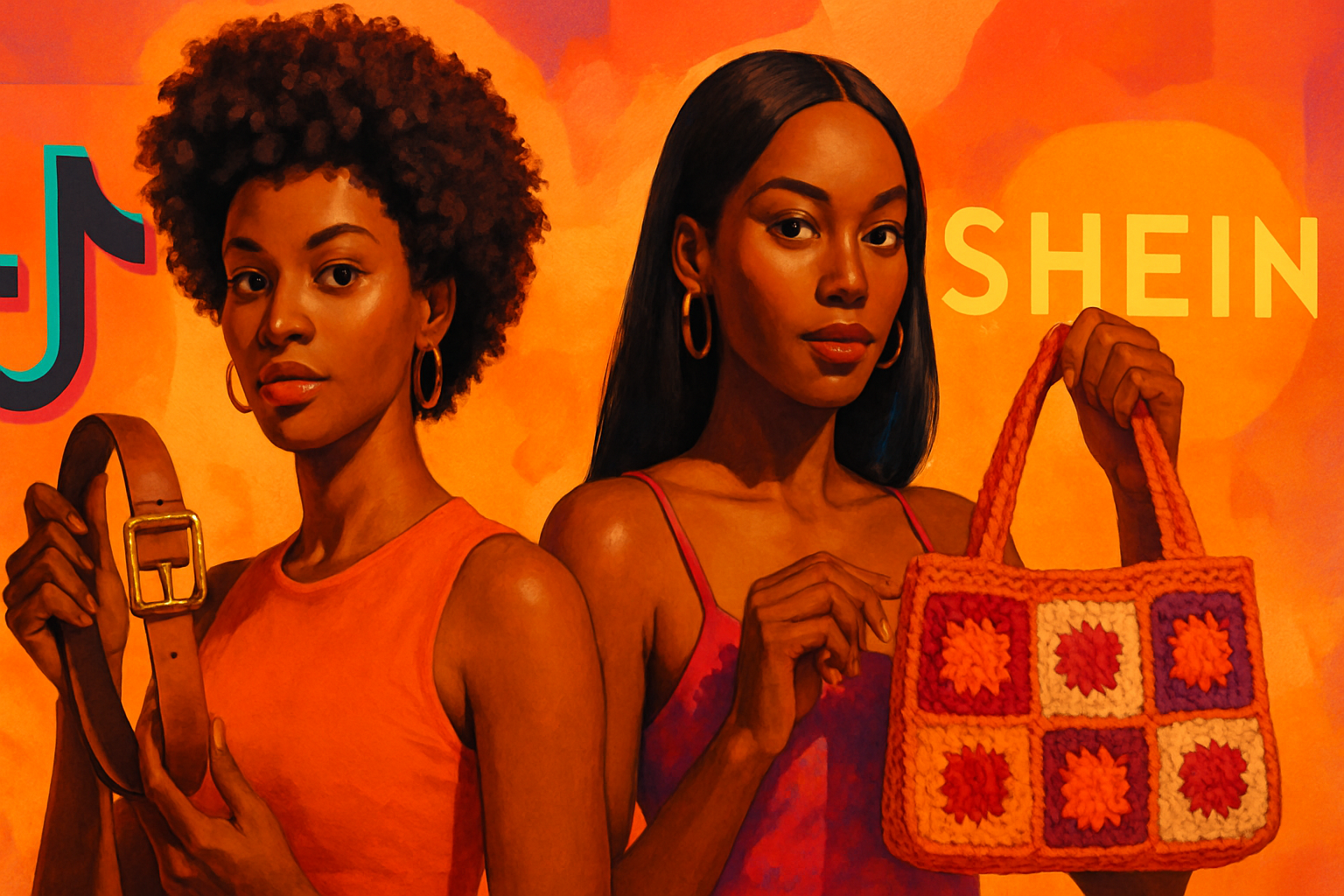
AI Avatars to Sell Shein Products
Aliyah, a light-skinned Black woman, appears in a TikTok video from March, dressed in a country-western style. She desperately tries to sell belt buckles that she claims to have handmade. In tears, she implores viewers to watch her video, hoping that even white women will stay for 13 seconds to save her business. However, Aliyah is not real. She is an artificial intelligence creation used to promote mass-produced products via dropshipping on platforms like TikTok, Facebook, and Instagram. The same belt buckles are available on the fast-fashion site Shein for a quarter of the price Aliyah claims.
The telltale signs of the digital origin of these videos are numerous. Aliyah's voice is robotic and emotionless, contrasting with her tear-streaked face. In one sequence, she sews a leather belt in a place where there should be no stitching. When she wipes away a tear, the liquid disappears under her finger. Moreover, dozens of similar videos featuring different AI-generated characters circulate on TikTok. An account named "Aliyahsbuckles" showcases videos with the same background, the same table, and the same spool of thread.
A Proliferation of Fake Accounts
The Verge discovered numerous accounts on TikTok sharing similar narratives and selling various dropshipped products, such as belt buckles, cowboy boot mugs, crochet bags, and cardigans. Some of these accounts are labeled as AI-generated. Similar accounts are also active on Instagram and Facebook. Almost every aspect of these accounts appears to be AI-generated, from the "person" in the video to the automated responses to comments, which sometimes mimic African American vernacular. Experts warn that this type of scam is growing every day.
Jeremy Carrasco, a researcher on AI-generated media and director of Riddance.ai, an organization focused on detecting AI videos, told The Verge that AI-generated videos related to e-commerce stores are a massive phenomenon. "Most of them are not coordinated. Some are. Often, they will run a single AI-generated actor, or a few actors will manage all sorts of shops," he explained. These AI-generated avatars claim to make the items, attend fairs to showcase their products, and "respond" to comments through automation. "What we are seeing right now are these retail scams where they link to Shopify sites."
Carrasco estimates that his research team finds up to 100 accounts attempting to sell products via AI-generated avatars every day. Most of the accounts found by The Verge were created in the last two months and contain videos about small businesses owned by marginalized individuals struggling to make sales; these videos are incredibly similar, with only slight variations in their scripts. While we also found Native American, Hispanic, and white characters, the most viewed and engaged AI-generated characters found by The Verge are Black women. Aliyah's account alone has 40,000 followers.
Manipulation of Empathy
"What we see here is manipulated empathy," Carrasco said. "If there is a popular dropshipping item that could be sold to some sort of niche community, they will find it and try [to use] a personality to do it." Carrasco explains that these trends are generally random opportunities to make money. "It's just an arbitrary opportunity, which is the case for a lot of AI-generated content — the platforms don't really care, and people don't notice."
Aliyah's most popular video, the one described at the beginning of this article, has 814,000 likes, 6.5 million views, and nearly 30,000 comments. Some comments identify the content as AI-generated, but many express a desire to help Aliyah's business, commenting on the video to increase its visibility on the platform. India Cater-Campbell was one of those commenters, expressing her desire to buy Aliyah's belt buckles. "I was trying to support an independent Black businesswoman," said Cater-Campbell, a real business owner working to open a café in Seattle. "[I felt] solidarity as I try to start a business myself."
Despite a lack of studies on the latest models of AI-generated videos, Carrasco believes these videos are "realistic enough to fool" most people. Users of short video content platforms have been trained to scroll mindlessly and not delve deeper into the content they create. Ironically, this may have saved Cater-Campbell from actually buying a belt buckle: she didn't immediately find a link to a shop, so she scrolled past and quickly forgot about Aliyah.
Le brief IA que les pros lisent chaque soir
Les 7 actus IA du jour, décryptées en 5 min. Gratuit.
Inclus dès l'inscription : notre sélection des meilleurs guides & comparatifs IA.
Choisis ton rythme
Gratuit · Pas de spam · Désabonnement en 1 clic
Celebrities Also Duped
But people are falling into the trap of these scams, and their prevalence is increasing: two weeks ago, Gizelle Bryant from The Real Housewives of Potomac admitted to buying two crochet bags after seeing a video in which an AI-generated Black boy said he was bullied by white boys for crocheting. "I thought, I want to help this little Black boy achieve his goal," Bryant said on her podcast Reasonably Shady, adding that other celebrities had also been in the comments section. "How was I fooled? Viola Davis was there too."
The Phenomenon of Digital Blackface
The trend is a form of digital blackface, according to communication researcher Cienna Davis from the University of Pennsylvania. "Digital blackface is a phenomenon where non-Black individuals can use the Internet and digital technologies to imitate Black cultural expression for personal, economic, or political purposes," Davis explained during a video call. Davis has previously written about digital blackface, highlighting the use of gifs of Black individuals as well as the imitation of Black people for political purposes. "It's rooted in the minstrelism of blackface, which is tied to the legacy of slavery," she explained.
Based on the idea that Blackness is "intrinsically exploitable" and "up for grabs," digital blackface is used to "extract value from Black bodies in the way that [non-Black people] deem appropriate," Davis stated. In this case, the videos imitate "a recognizable idea of Black struggle," she added.
Even without confirmation that the people behind the videos are not Black, Tempest M. Henning, an assistant professor of philosophy at Fisk University, confirms that the videos are digital blackface. "Blackface is any sort of caricatured representation of Black people, which can include Black people dressing up in a caricatured way as Black people," Henning said. She cites historical precedents of Black individuals sometimes being forced to perform in minstrel shows and the more recent example of Zoe Saldaña darkening her skin tone and wearing prosthetics to play Nina Simone in a biopic.
There is an inherent misrepresentation of Blackness that these avatars claim to embody. As Henning explained, "The names of the avatars are coded Black, like Aliyah or Amaya, but there is nothing else [that signals Black authenticity] other than the avatar itself." This is only reinforced by the reproduction of content across racial identities, which, according to Henning, leads to a flattening of those identities.
The Verge reached out to Aliyahsbuckles, as well as other stores selling similar products, but received no response.
Repetition of Scenarios
The videos posted on Aliyah's account are reproduced scene by scene across many similar accounts selling dropshipped items, with slight modifications to fit the character's identity or the item being sold. In one video featuring another Black female character, Amaya, a white woman mockingly throws coffee on belt buckles displayed at a fair. A slightly frustrated Amaya — the emotions are somewhat robotic and never seem quite right — sighs and returns to the honest work of making her buckles. A similar scene appears on an account called ChubbyKnots; this time, the avatar is a Black girl and the product is a butterfly-shaped crochet cardigan.
Henning stated that there is an appeal to virtue signaling in these videos, where the viewer is called to show kindness or even racial or class solidarity. "It's virtue signaling in the sense that 'Oh, this white lady did that, but I'm not that kind of white lady, so where can I buy that belt buckle?'" Henning said. "It's as if they are saying, 'I don't associate with those people.'"
However, Henning highlighted the superficiality of support based on race or class when users do not take the time to research who they are supporting in the first place.
This may be a broader social outcome of short video content and low-quality content consumption: solidarity is often achieved at a "superficial level," she explained, rather than through a coherent and multifaceted political prism. "I could be very invested in a Black-owned business, but that doesn't necessarily mean all Black businesses align with my political opinions and what I stand for," Henning stated.
This call for virtue signaling goes beyond the category of race, also relying on working-class markers and a simulation of people working hard to make a living in a declining economy. "It's not just Black struggle, because in other videos, we can observe working-class struggle, the struggle of small businesses," Davis said. "But it obviously uses this [narrative] to sell mass-produced goods. It's not creative at all. They are really just AI-generated models."
Brief IA — L'actualité IA en français
L'essentiel de l'actualité de l'intelligence artificielle, décrypté et expliqué chaque jour.