Object Detection: The Must-Have Models of 2026
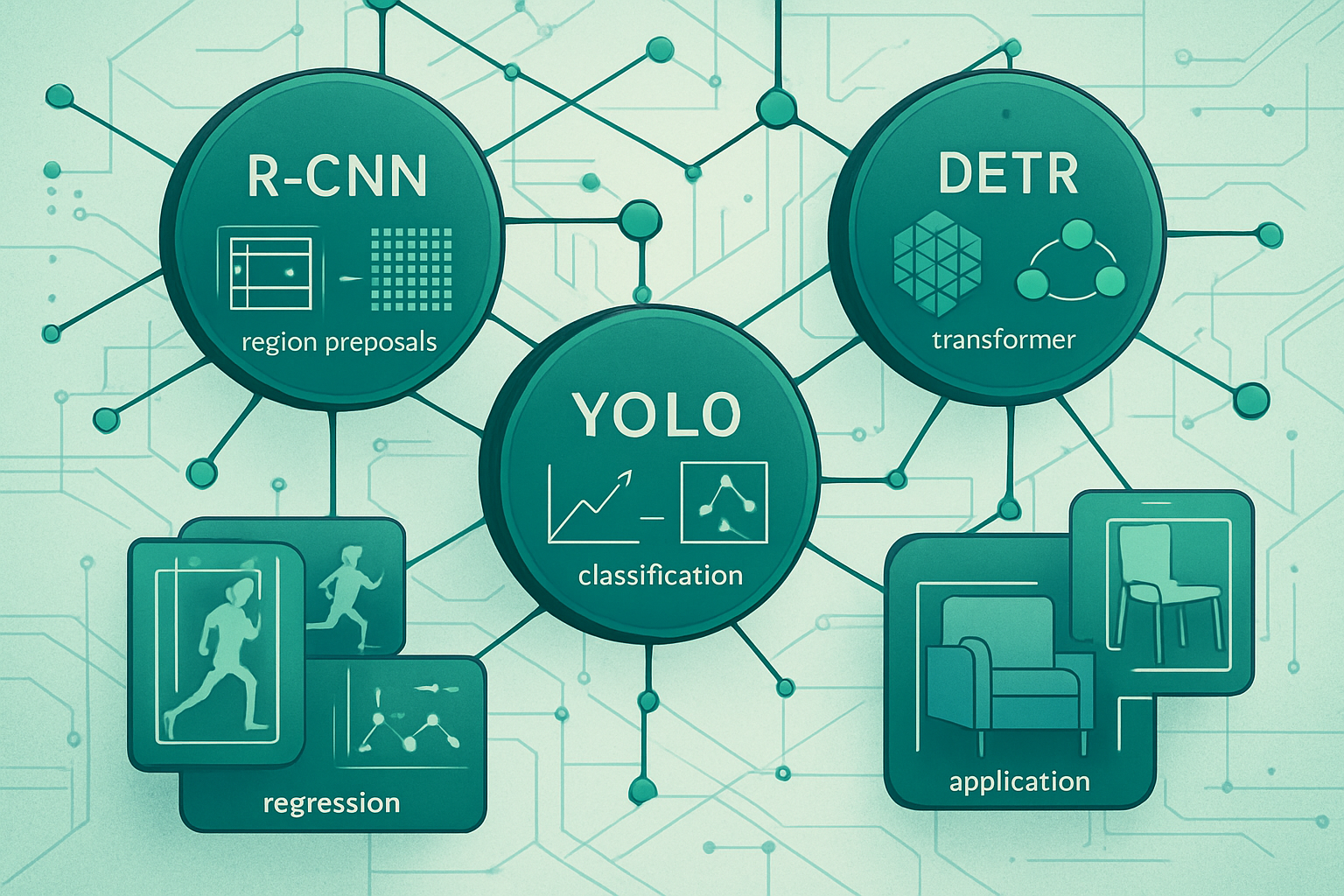
Object Detection Models to Watch in 2026
Object detection models play a crucial role in computer vision, enabling the classification and localization of multiple objects within an image. These models are divided into several distinct categories.
Two-Stage Detectors
Two-stage detectors include models such as R-CNN, Fast R-CNN, Faster R-CNN, and Mask R-CNN. These models are known for their accuracy, although they may be slower than other approaches.
One-Stage Detectors
Among one-stage detectors, we find SSD, various YOLO variants, RetinaNet, and EfficientDet. These models are often favored for their speed, although they may sometimes sacrifice a bit of accuracy.
Anchor-Free Approaches
Anchor-free approaches, such as CenterNet and FCOS, utilize keypoint-based methods to detect objects, offering an alternative to traditional approaches.
Le brief IA que les pros lisent chaque soir
Les 7 actus IA du jour, décryptées en 5 min. Gratuit.
Inclus dès l'inscription : notre sélection des meilleurs guides & comparatifs IA.
Choisis ton rythme
Gratuit · Pas de spam · Désabonnement en 1 clic
Transformer-Based Models
Transformer-based models, like DETR and its variants (Deformable DETR, DINO, and D-FINE), aim to reduce reliance on Non-Maximum Suppression (NMS), which can enhance processing efficiency.
Real-Time and Deployment Models
Models designed for real-time applications, such as RT-DETR, are optimized for low latency and are suitable for lightweight devices. These models incorporate strategies to reduce parameters and latency, which is crucial for applications requiring quick responses.
Open-Vocabulary Detection Systems
Open-vocabulary detection systems use linguistic prompts to generalize in a zero-shot manner. While they offer broader category coverage, they exhibit a higher error rate in zero-shot scenarios compared to fully supervised detectors. These systems also include foundation models, which play a key role in this approach.
Brief IA — L'actualité IA en français
L'essentiel de l'actualité de l'intelligence artificielle, décrypté et expliqué chaque jour.