Children and AI: An Educational Challenge for Today's Parents
Le brief IA que les pros lisent chaque soir
Les 7 actus IA du jour, décryptées en 5 min. Gratuit.
Inclus dès l'inscription : notre sélection des meilleurs guides & comparatifs IA.
Choisis ton rythme
Gratuit · Pas de spam · Désabonnement en 1 clic
Children and AI: An Educational Challenge for Today's Parents
Four years after the shockwave of ChatGPT, launched at the end of November 2022, AI has gradually infiltrated all our societies, propelled by informal user practices and has undergone intense legitimization efforts in many companies. It has crossed the barriers of school, forcing the national education system to integrate training on this technology into the secondary curriculum to educate students about its limitations.
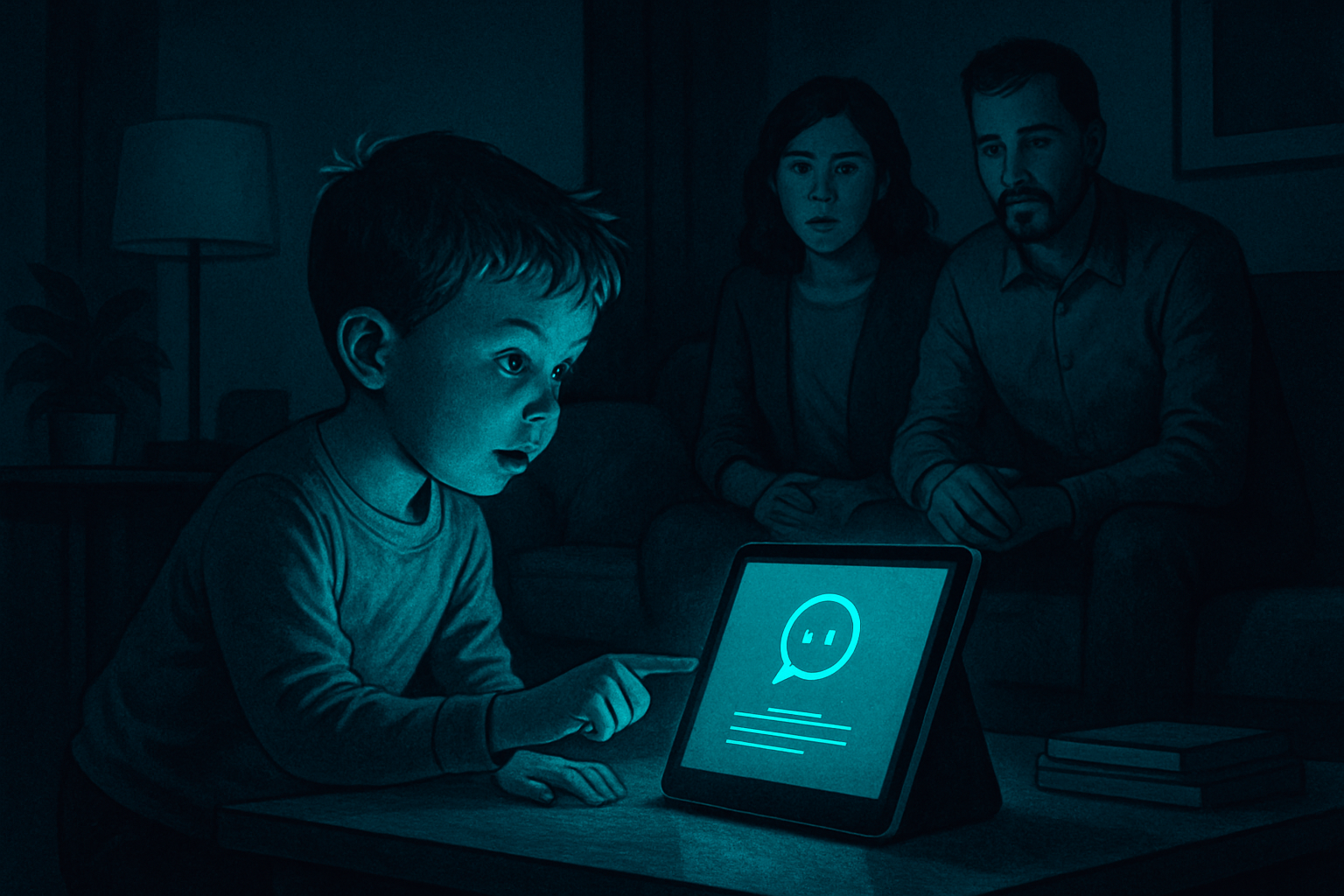
AI giants are already eyeing our children; it's a fact: talking plush toys equipped with LLM (Large Language Model) are already being sold on Amazon, the companion robot Miko, already distributed in Europe and powered notably by GPT-4, or the French plush toy Nyo, expected in France by summer 2026… The market is still marginal compared to the USA, but it is almost certain that this commercial offensive will succeed where passive screens have failed: capturing children's attention through interactivity and simulated reciprocity.
Dana Suskind, a pediatric surgeon at the University of Chicago and author of the excellent guide Human Raised: Nurturing Connection, Curiosity & Lifelong Learning in the Age of AI, invites us to take a step back. “All these academic skills we strive to develop in our children, AI now masters them. Overnight, it has integrated everything: math, logic, reasoning, and even a semblance of empathy. It can simulate everything. But what it cannot do, what it is incapable of, is to feel care,” she explains. What place should we leave for machines without them taking ours? Above all, how do we equip a child against a technology that mimics affection better than it will ever feel it?
Mistakes and Repetition: The Foundations of Child Development Trampled by AI
The bulk of a child's brain develops between birth and five years old: nearly 85% of its physical structure is formed in this short interval. A project that Suskind compares to assembling a PC: “These early years are the hard drive, the memory, the RAM; the rest of schooling consists of software updates.” The comparison has its limits, and Suskind knows it: unlike a computer assembled with inert parts, the brain only develops if it is in contact with another human being.
“Every second, a million new neural connections are formed,” she reminds us, but under a non-negotiable condition. Psychologist Patricia Kuhl has identified this filter, the “social gateway”: “Only reciprocal human interaction allows this to happen.” A television screen may pour out images and words, but it remains deaf to a child's solicitations, and the gateway remains closed. “Television does not wire the brain because it is not reciprocal,” summarizes Suskind. This requirement for reciprocity was long our best guarantee that no machine would replace a parent.
“But suddenly, these technologies can imitate human interaction and open the social gateway,” warns Suskind, speaking of AI. What protected the very young was the inability of devices to adapt to them: a cartoon unfolds the same way, whether the child watches, laughs, cries, or goes off to play elsewhere. The social gateway, on the other hand, requires a contingent response triggered by their behavior.
AI has long crossed this technological threshold: it can capture a child's expressions and respond to them in a personalized way, just as a parent would react to their baby's babbling. For a developing brain that does not yet distinguish consciousness from a program, the illusion is perfect, but it proves to be profoundly misleading, even harmful.
This is where the danger lies for Suskind, whom she calls “artificial attachment.” While it is undoubtedly an emotional bond, its role is much deeper and formative: “It is the biological system through which the brain learns to regulate its emotions, to trust others, to feel safe exploring the world,” she explains. It is calibrated through contact with imperfect adults, sometimes available, sometimes distracted; sometimes calm or angry: it is the friction of reality that shapes character.
AI, on the other hand, offers unwavering availability, and this is what worries the pediatrician: a child “partially raised by these perfectly reciprocal technologies” risks learning that the whole world must obey them instantly. This is a developmental trap in her eyes, as they do not learn to navigate a world populated by “unpredictable beings, with their own thoughts and feelings,” but to expect the impossible, an immediate submission from their environment. In short, through its perfection in responding too well, AI can render them unfit to live.
Chatbots are programmed to be smooth and ultra-polite, primarily to please the largest number and to flatter users' egos.
What Behaviors to Adopt to Protect Your Child?
Suskind recommends avoiding any AI that interacts directly with the child during the first three to five years, regardless of its form. This recommendation also extends to screens, as numerous studies have proven their harmful effects on the brain development of young children. “A resolutely human childhood remains the best way to prepare our children,” she asserts, even if it means embracing this paradox: “A low-tech childhood is almost the best way to prepare for a technology-saturated future.”
For later, the pediatrician has developed a method that invites you to question the purpose of a playful object designed for children that incorporates AI functionalities. Named DETECT (Design, Ethics, Trouble, Evidence, Confidentiality, Teaching), it is a framework you can apply before purchasing anything.
-
Design: For what purpose was the object designed, to educate, entertain, or provide companionship, and does it address the child or assist you?
-
Ethics: Was it trained on data representing diverse profiles, or on adult data later adapted for children?
-
Trouble: Have studies already identified harmful effects, and does the manufacturer provide best practice advice?
-
Evidence: Beyond its marketing packaging, does independent, peer-reviewed research prove its supposed benefits?
-
Confidentiality: What happens to the collected data, where is it stored, and for how long?
-
Teaching: What does your child learn from it? This allows you to immediately rule out toys that mimic affection, retaining (if any) only those that enrich family dynamics without ever substituting for human presence.
While the DETECT framework can be useful, trust your parental instinct first; if you understand the technology, AI, and its pitfalls, you already know how much to be wary of it. Without falling into blind technophobia, simply apply a golden rule: AI should never come between you and your child. Nothing obliges you to turn your back entirely, but even if you try, it is clear that the consumer tech market (with AI at the forefront) is designed to infiltrate your home, whether you want it or not.
Nonetheless, “dealing with” has never meant “relying on”: it is precisely when a technology is everywhere that it is necessary to maintain control over what we allow and what we prohibit. Your “parental GPS,” to borrow Suskind's words, is still intact, and now is the time to trust it.
Artificial intelligence is quickly integrating into children's lives, necessitating appropriate education to understand its limits. Human interactions are crucial for emotional development, and AI can create misleading and harmful attachments. It is recommended to avoid exposing young children to interactive AI to promote a human and healthy childhood.
Brief IA — L'actualité IA en français
L'essentiel de l'actualité de l'intelligence artificielle, décrypté et expliqué chaque jour.