Forma Reinvents Data Centers with a Sustainable Approach
An Innovative Vision for Data Centers
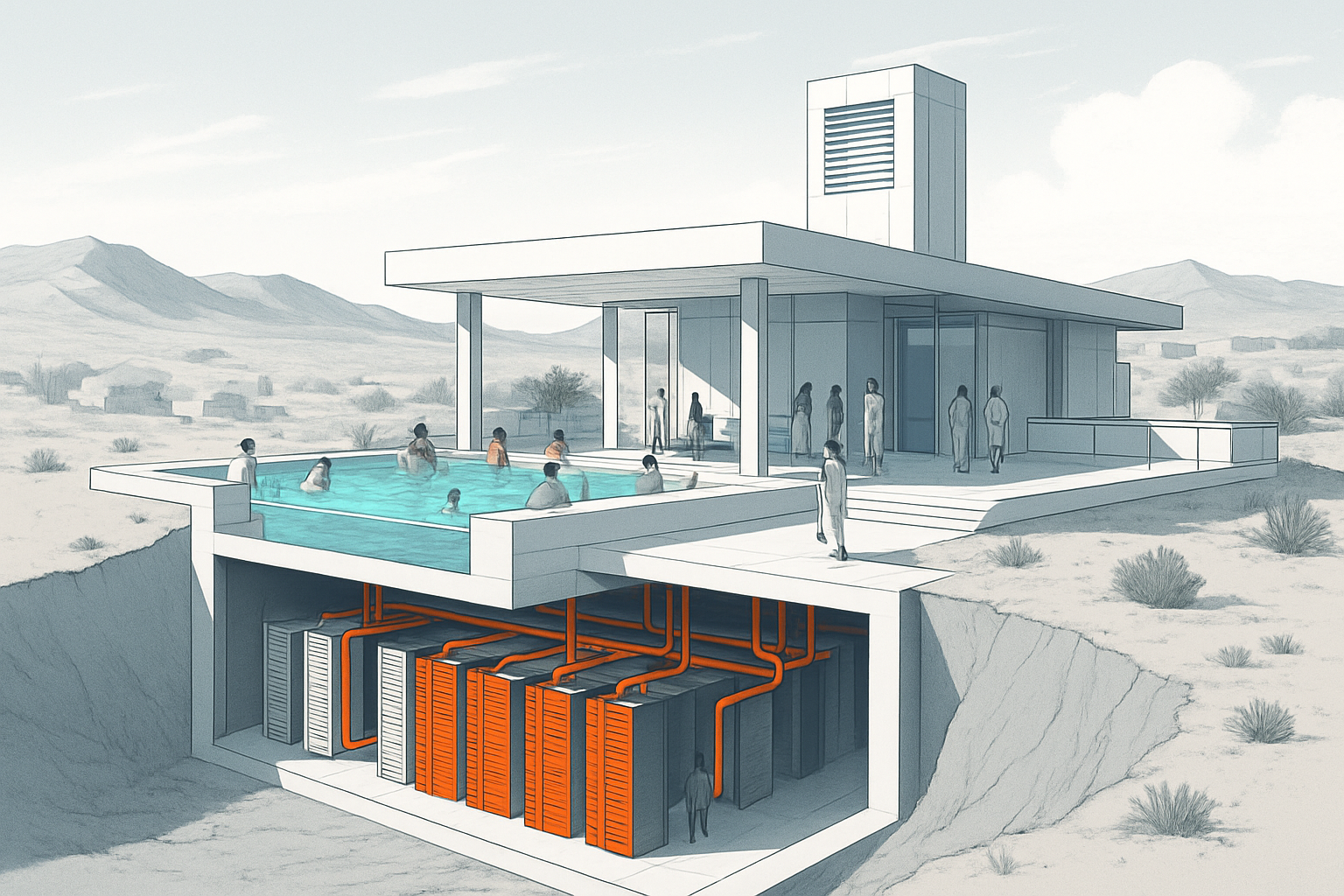
The New York-based architecture studio Forma has envisioned an innovative concept with its project "Pink Thermal Baths." This project proposes an underground data center that uses the heat generated by its servers to warm a public bathhouse located just above. This idea emerged before the rise of generative AI triggered a frenzy of data center construction across the United States. Miroslava Brooks, one of the founders of Forma, explained that this concept is not designed to turn these facilities into spas, but to pose a crucial question: how can a data center add value to the community that hosts it?
In the California desert, a data center could thus become a source of well-being for residents, offering a 32,000-square-foot bathhouse where the heat from the servers would warm the pools. This approach aims to transform the perception of data centers, often seen as imposing and energy-hungry structures, into facilities that positively contribute to their immediate environment.
The Rapid Expansion of Data Centers
Data centers are not a new phenomenon. They have long served as support for banks, websites, streaming services, and cloud storage. Thomas McGoldrick, managing director at Gensler, recalls a time when these facilities were considered mere support infrastructure for specific businesses. Today, with the exponential increase in data transfer, these centers have become strategic elements of our digital infrastructure.
According to an analysis by Business Insider, by the end of 2025, more than 1,400 data centers will have been built or approved across the United States. Virginia, in particular, has become a hotspot for these facilities, some of which are located in close proximity to residential areas. A study conducted in 2024 revealed that 29% of operational data centers in Virginia are situated less than 200 feet from residential properties. This proximity raises concerns among residents, particularly regarding constant noise, water consumption, and the impact on electricity bills. A Gallup poll from March showed that 71% of American adults opposed the construction of an AI data center in their neighborhood, with 48% expressing strong opposition.
Designs Tailored to Community Needs
In light of the scale of data centers and the concerns they raise, architects are questioning whether design can mitigate these impacts or merely mask them. Gensler, an architecture firm based in San Francisco, is collaborating with several hyperscale clients, including Microsoft, to develop data centers tailored for large cloud companies. McGoldrick emphasizes that these clients prioritize speed to market, scale, access to energy, and buildings capable of adapting to technological changes.
Le brief IA que les pros lisent chaque soir
Les 7 actus IA du jour, décryptées en 5 min. Gratuit.
Inclus dès l'inscription : notre sélection des meilleurs guides & comparatifs IA.
Choisissez votre rythme
Gratuit · Pas de spam · Désabonnement en 1 clic
In this context, Gensler strives to design data centers that go beyond mere industrial structures. One approach is to treat these facilities as "office buildings housing computers." For example, Gensler transformed an old call center campus into a 1 million-square-foot computing facility, demonstrating how intelligent reuse of existing spaces can meet the growing demands for digital infrastructure.
Urban Integration and Architectural Innovation
Arup, a UK-based architecture and engineering firm, is exploring how data centers can be integrated into the urban fabric. Rachel Atthis, a director at Arup, suggests that these traditionally long and low buildings may require a smaller footprint and rise several stories to better fit the urban environment.
Marco Mugnai, an associate director at Arup, proposes solutions to mitigate noise disturbances, such as installing acoustic screens, landscape buffers, and modifying site topography. Arup is also considering data centers that reuse existing structures, such as decommissioned offshore oil platforms, or that collaborate with tomato farms to utilize the waste heat from servers.
The Limits of Design
Marina Otero Verzier, an architect and lecturer at the Harvard Graduate School of Design, has explored alternative uses for the heat generated by servers. Her project "Computational Compost" uses this heat to power a vermicomposting system, where worms and microorganisms produce fertile compost for a local garden. However, Otero warns that reusing heat is not a complete solution.
She emphasizes that parks, low-carbon materials, and shared heating systems can improve the impact of data centers, but this remains insufficient. Otero questions the very design of data centers, pondering the necessity of making every type of data immediately accessible, and the impact of competitive business requirements on community resources. She proposes designing facilities for different "data ecologies," rather than following a one-size-fits-all model of high security and continuous operation.
According to her, the needs of tech giants like OpenAI, Google, and Meta do not necessarily reflect those of the majority of the global population. These companies and their owners often dictate priorities, but it is crucial to rethink how data centers are integrated into our communities.
Brief IA — L'actualité IA en français
L'essentiel de l'actualité de l'intelligence artificielle, décrypté et expliqué chaque jour.