GPT-5 Revolutionizes Immunology with Derya Unutmaz
Le brief IA que les pros lisent chaque soir
Les 7 actus IA du jour, décryptées en 5 min. Gratuit.
Inclus dès l'inscription : notre sélection des meilleurs guides & comparatifs IA.
Choisis ton rythme
Gratuit · Pas de spam · Désabonnement en 1 clic
The Impact of GPT-5 on Scientific Research
Artificial intelligence, and more specifically the GPT-5 model, has demonstrated its potential to transform scientific research by enhancing human expertise. This advancement could revolutionize critical fields such as cancer research, autoimmune diseases, and infections.
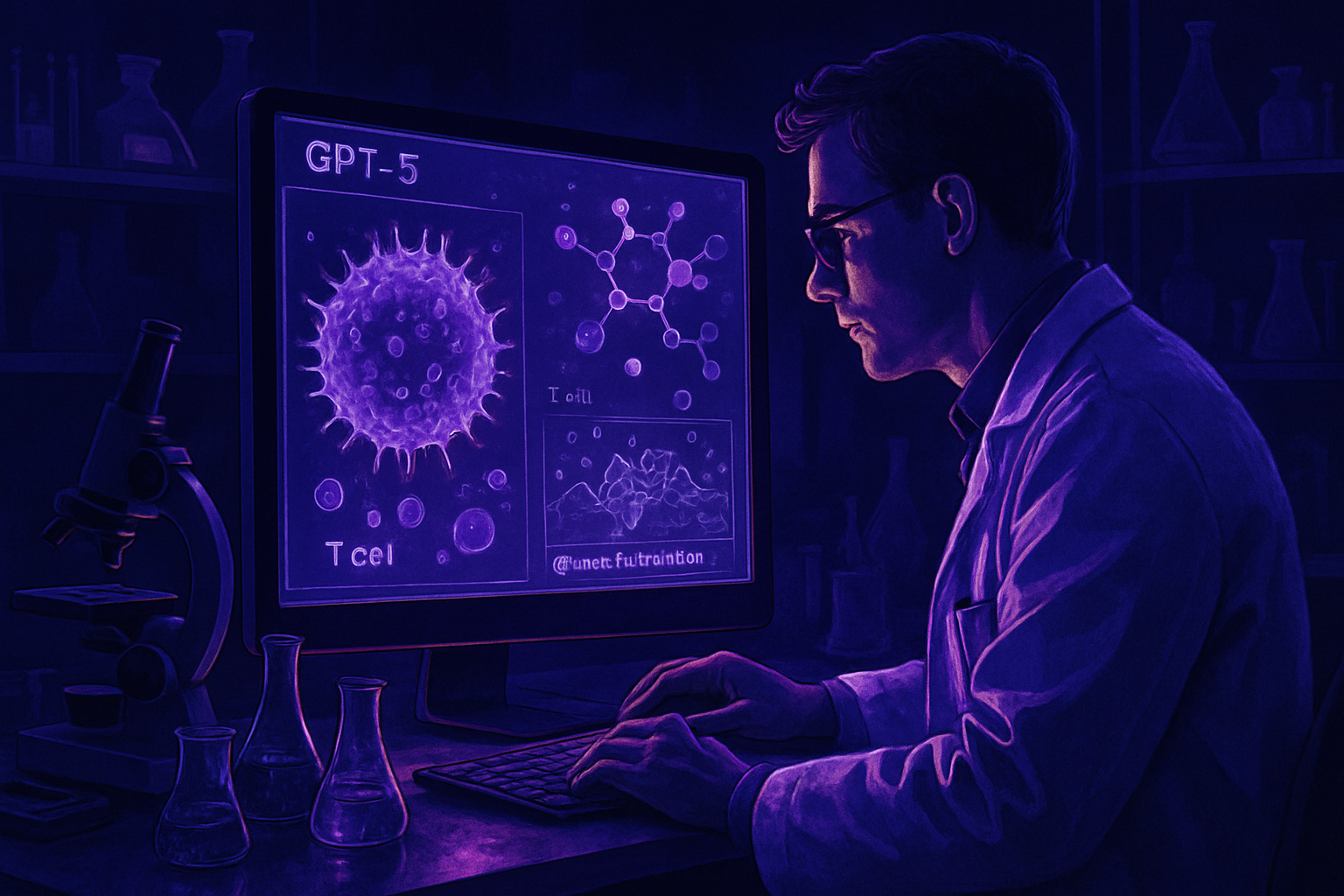
Derya Unutmaz, a renowned immunologist, has long been interested in AI. His interest materialized spectacularly at the end of 2025 when GPT-5 Pro enabled his laboratory to revisit and solve a three-year-old scientific puzzle. This puzzle concerned a particular type of immune cell, crucial for fighting cancer and other diseases.
A Mystery Surrounding T Cells and Glucose
The mystery in question revolved around the effect of glucose on the development and specialization of T cells. These immune cells play a vital role in defending the body against viruses, cancer cells, and other threats. They specialize during their development, which can influence their ability to combat various diseases. Understanding what determines their specialization is therefore essential for improving treatments.
Derya Unutmaz, who is a professor at the Jackson Laboratory and the University of Connecticut, emphasized the importance of AI in his daily work. He compared the absence of this technology to losing both hands or half of his brain, as it has become central to his research.
A Complex Experiment Revisited
The puzzle began in 2022 when Unutmaz conducted an experiment to explore how glucose influenced the development of T cells. Glucose, used by cells as an energy source, is also crucial for protein synthesis and other cellular functions.
The results of this experiment could have major implications for the treatment of cancer, autoimmune diseases, and infections. However, at the time, Unutmaz and his team were unable to interpret the data they had collected.
The Intervention of GPT-5 Pro
Previous research had already shown that glucose metabolism played a role in the specialization of T cells. To delve deeper into this relationship, Unutmaz's team exposed these cells to a low-glucose environment and another containing deoxyglucose, a molecule similar to glucose. Deoxyglucose disrupts the use of glucose by cells, thereby affecting their energy production and protein synthesis.
The team expected similar results in both environments, but the observations were surprising. The cells exposed to deoxyglucose produced a large number of cells involved in the inflammatory response. In contrast, those exposed to low concentrations of glucose did not specialize in the same way.
This difference could not be explained solely by a lack of energy. Something else was influencing the process, but Unutmaz and his team could not identify the cause at the time and thus set the experiment aside.
A New Perspective Thanks to AI
With the arrival of GPT-5 Pro at the end of 2025, Unutmaz decided to re-examine the experiment. By uploading the results into the model, he asked the AI to analyze the data.
GPT-5 Pro suggested that deoxyglucose interfered with the construction of a protein called IL-2. This protein plays a crucial role in preventing T cells from transforming into Th17 cells, which are involved in the inflammatory response. Deoxyglucose suppressed this barrier, allowing a greater number of T cells to become Th17 cells.
Unutmaz described this idea as "remarkable," emphasizing that it was just outside his area of expertise enough that he did not make the connection himself. No member of his team had identified this link either.
Predictions and Simulations with GPT-5
Encouraged by these results, Unutmaz decided to test GPT-5's ability to predict the outcomes of experiments. He began with an experiment he had already conducted on T cells targeting a type of lymphoma. The results had shown that these cells, called CD8+, had an increased ability to destroy lymphoma cells.
When he asked GPT-5 Pro to simulate this experiment, the model correctly predicted the enhanced ability of CD8+ cells to kill lymphoma cells. These results were not available online, as Unutmaz had not yet published them.
"It was the moment I felt that these models had reached a point where they truly understand," he said.
The Future of Research with AI
According to Unutmaz, models like GPT-5 Pro now act as collaborators in scientific research. They can streamline literature reviews, process hundreds of new academic articles each week, and help scientists identify unanswered questions.
These models can also help refine hypotheses, thereby reducing the time needed to identify the most relevant experiments to conduct. This could significantly accelerate the field of biology, reducing research time by several weeks, months, or even years.
However, human expertise remains essential. AI can generate ideas, but researchers must still assess their significance and plausibility. For example, without Unutmaz's expertise, it would have been difficult to determine the importance of the mechanistic idea proposed by GPT-5 Pro.
Ethical and Safety Implications
The ability of AI to generate ideas and accelerate scientific work must be managed responsibly. While AI can help advance biology and medicine, it could also be misused, particularly by malicious actors seeking to design or use biological or chemical weapons.
OpenAI's Preparedness Framework outlines an approach to track these risks and build safeguards against AI capabilities that could cause serious harm.
Unutmaz remains optimistic about the future of AI. He views this technology as something radically different from anything that has existed before, not like the Internet or the industrial revolution. Recently, he has experimented with advanced AI tools, including Codex and GPT-5.2 Deep Research, to help compile datasets on cancer mutations and generate research materials.
Unutmaz feels fortunate to live in an era of such discoveries. "Not only being able to witness it historically, but also to participate a little, I feel really lucky and privileged to do so."
Brief IA — L'actualité IA en français
L'essentiel de l'actualité de l'intelligence artificielle, décrypté et expliqué chaque jour.