AI Agents: 5 Free Resources to Get Started
Understanding AI Agents: A Challenge for Developers
In the world of artificial intelligence, creating intelligent agents has become a common activity. However, many struggle to explain why their agent is not functioning as expected, whether it be due to infinite loops or ignored tools. This gap between implementation and understanding is bridged by five free resources, each offering a unique perspective on the subject.
These resources vary in terms of difficulty and content. They range from a practical course that can be completed over a weekend to more in-depth academic texts for those looking to solidify their knowledge after the initial excitement. By exploring even a portion of these resources, you will be able to design agents with a clear understanding of what is happening behind the scenes, rather than merely manipulating prompts without a real strategy.
Microsoft: AI Agents for Beginners
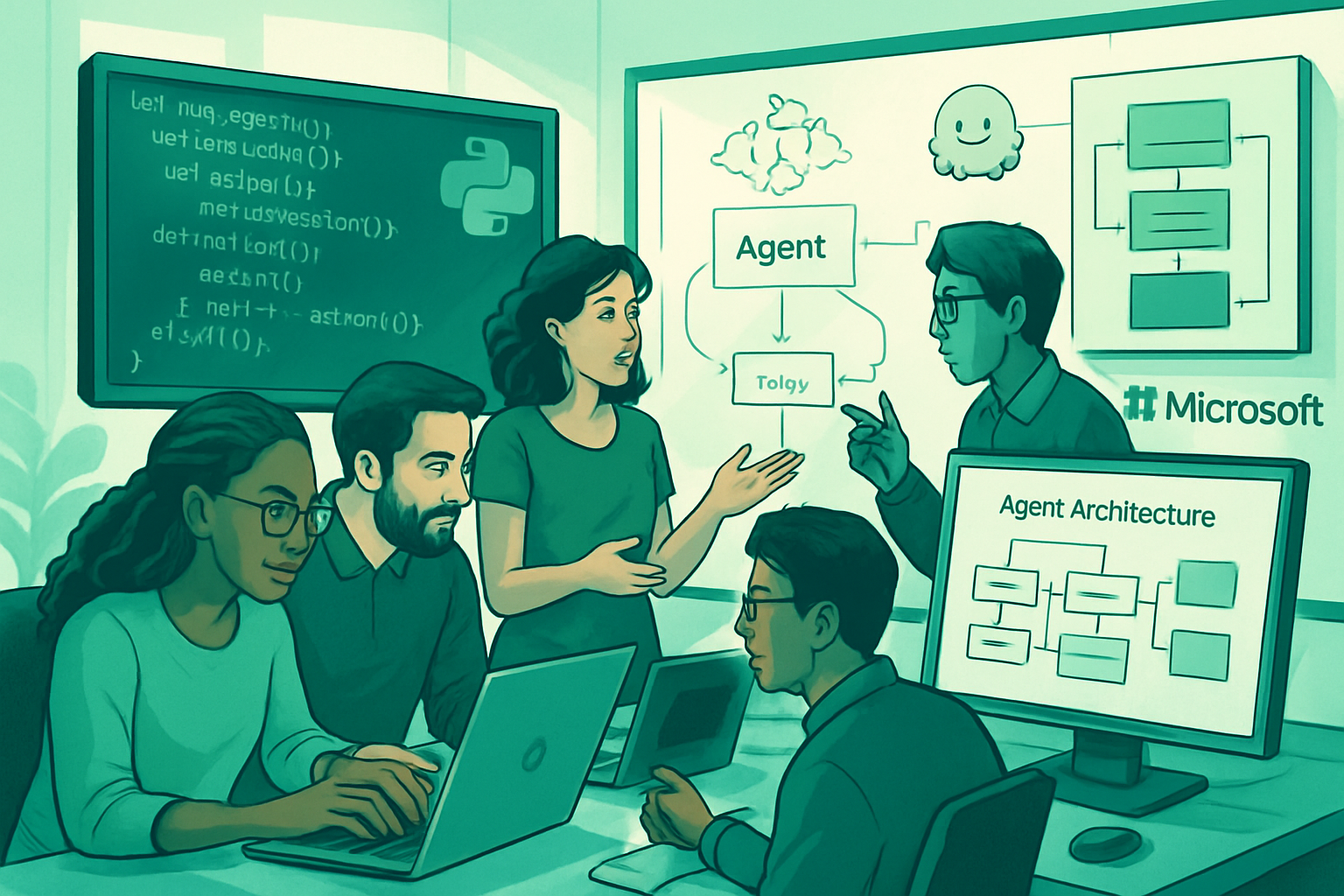
For those seeking a solid structure, Microsoft’s AI Agents for Beginners course is an excellent starting point. Available on GitHub under an MIT license, this course includes over fifteen lessons accompanied by explanatory videos and ready-to-use Python code. It covers essential fundamentals, such as defining an agent and the situations in which its use is relevant. The course also explores recurring design patterns, such as the use of tools, planning, and retrieval-augmented generation (RAG).
One of the most valuable aspects of this course is its continuous updates, making it relevant in the face of rapid developments in the field. It addresses recent standards like the Model Context Protocol (MCP), often overlooked by other contemporary documents. Furthermore, the course discusses multi-agent configurations and memory and context engineering, crucial elements for transitioning from a simple demonstration to a usable product.
Hugging Face: A Practical and Comparative Approach
The Hugging Face Agents Course perfectly complements Microsoft’s offering by adopting a decidedly practical approach. This course guides you in building agents through various frameworks such as smolagents, LlamaIndex, and LangGraph. This diversity allows you to compare different options before committing to a specific tech stack.
Completely free, this course concludes with a graded project and the issuance of a certificate, providing additional motivation to see it through to the end. While Microsoft’s course teaches you the concepts, Hugging Face equips you with the practical skills needed to apply them.
Le brief IA que les pros lisent chaque soir
Les 7 actus IA du jour, décryptées en 5 min. Gratuit.
Inclus dès l'inscription : notre sélection des meilleurs guides & comparatifs IA.
Choisissez votre rythme
Gratuit · Pas de spam · Désabonnement en 1 clic
Anthropic: A Caution on Agents
Anthropic’s guide Building Effective Agents stands out for its conciseness and pragmatic approach. It establishes a crucial distinction between workflows and agents, and presents models worth knowing, such as prompt chaining, routing, and parallelization.
One of the major contributions of this guide is its warning about the high costs and potential errors associated with agents. It advises prioritizing simple and effective solutions, adding autonomy only when necessary. The guide also catalogs models such as orchestrator-workers and evaluator-optimizer loops, providing clear explanations of encountered bugs.
Multiagent Systems: Academic Rigor
For those looking to deepen their understanding of multi-agent systems, the book Multiagent Systems by Yoav Shoham and Kevin Leyton-Brown is an essential resource. Available for free in electronic format with the permission of their publisher, this text offers a solid theoretical foundation on game theory, distributed decision-making, and the logical underpinnings of agents.
Although it predates the era of large language models, this book remains relevant by addressing timeless concepts such as coordination and negotiation among agents. The authors request linking to the source for download, which saves valuable time by avoiding the rediscovery of already well-established theories.
Google & Kaggle: A Series of White Papers
The series of five white papers on agents published by Google on Kaggle is a comprehensive and current resource. These papers cover a variety of topics, ranging from agent architectures to interoperability with the MCP, as well as context engineering and agent quality assessment.
Evaluation is often a neglected but crucial aspect, and this series emphasizes the necessity of measuring agent effectiveness. Understanding whether an agent is truly functioning is essential for transitioning from a simple demonstration to a viable product. Among these resources, the volume on evaluation is particularly recommended for enhancing your agents. The series also addresses the transition from prototype to production, an essential aspect for turning an idea into a finished product.
Conclusion: A Structured Learning Path
These five resources offer a structured learning path for anyone looking to embark on the development of intelligent agents. Starting with Microsoft and Hugging Face to acquire the basics and practical skills, moving on to Anthropic to refine your judgment, and grounding your knowledge in theory with Shoham and Leyton-Brown, you will be well-prepared. Finally, Google’s series will teach you how to evaluate your agents, an essential skill for success in this field. These resources are free, but they require an investment of time, the only true currency of learning.
Brief IA — L'actualité IA en français
L'essentiel de l'actualité de l'intelligence artificielle, décrypté et expliqué chaque jour.