Mistral AI: Energy, the Key to French Digital Sovereignty
Le brief IA que les pros lisent chaque soir
Les 7 actus IA du jour, décryptées en 5 min. Gratuit.
Inclus dès l'inscription : notre sélection des meilleurs guides & comparatifs IA.
Choisis ton rythme
Gratuit · Pas de spam · Désabonnement en 1 clic
Based on an op-ed by Edouard Roblot, Director at IDEX énergie solaire.
Arthur Mensch, co-founder of Mistral AI, recently highlighted an essential yet often overlooked aspect of artificial intelligence: electricity. According to him, the problem does not lie in a shortage of electricity production, but rather in the inability of networks to transport this energy where it is needed to power AI technologies. This reality underscores that artificial intelligence is fundamentally a matter of electricity.
Behind every AI model, every query, and every data center, there is a colossal energy consumption. Mensch summarizes this situation by stating that data centers transform electricity into intelligence. This statement speaks volumes about the economic future of France, as in the global AI economy, competition will not be limited to models, software, or talent. It will also extend to the ability of states to produce abundant, competitive, and ideally decarbonized electricity. France, thanks to its engineers and low-carbon electricity, possesses a rare advantage in this field.
Historically, digital sovereignty has been considered from the perspective of semiconductors, cloud, or technology platforms. However, the rapid rise of artificial intelligence is changing this perspective. The energy needs of digital infrastructures are skyrocketing, and future AI data centers will consume massive amounts of electricity, to the point of becoming energy infrastructures as much as digital ones.
This transformation is not just a theory. In the United States, it is already causing a genuine supply crisis. In Northern Virginia, which has become the world's leading data center hub, server consumption accounts for about 26% of the state's total electricity. In response to this pressure, local operators have had to slow down the awarding of new contracts to avoid risks of outages for residents. Other states like Oregon, Iowa, or Nebraska are facing similar tensions on their networks.
To circumvent these limits, tech giants are now developing their own energy production capabilities directly on-site, outside the public electricity grid, a concept known as "behind the meter." They are mobilizing a variety of energy mixes, ranging from gas to renewables, and sometimes even nuclear.
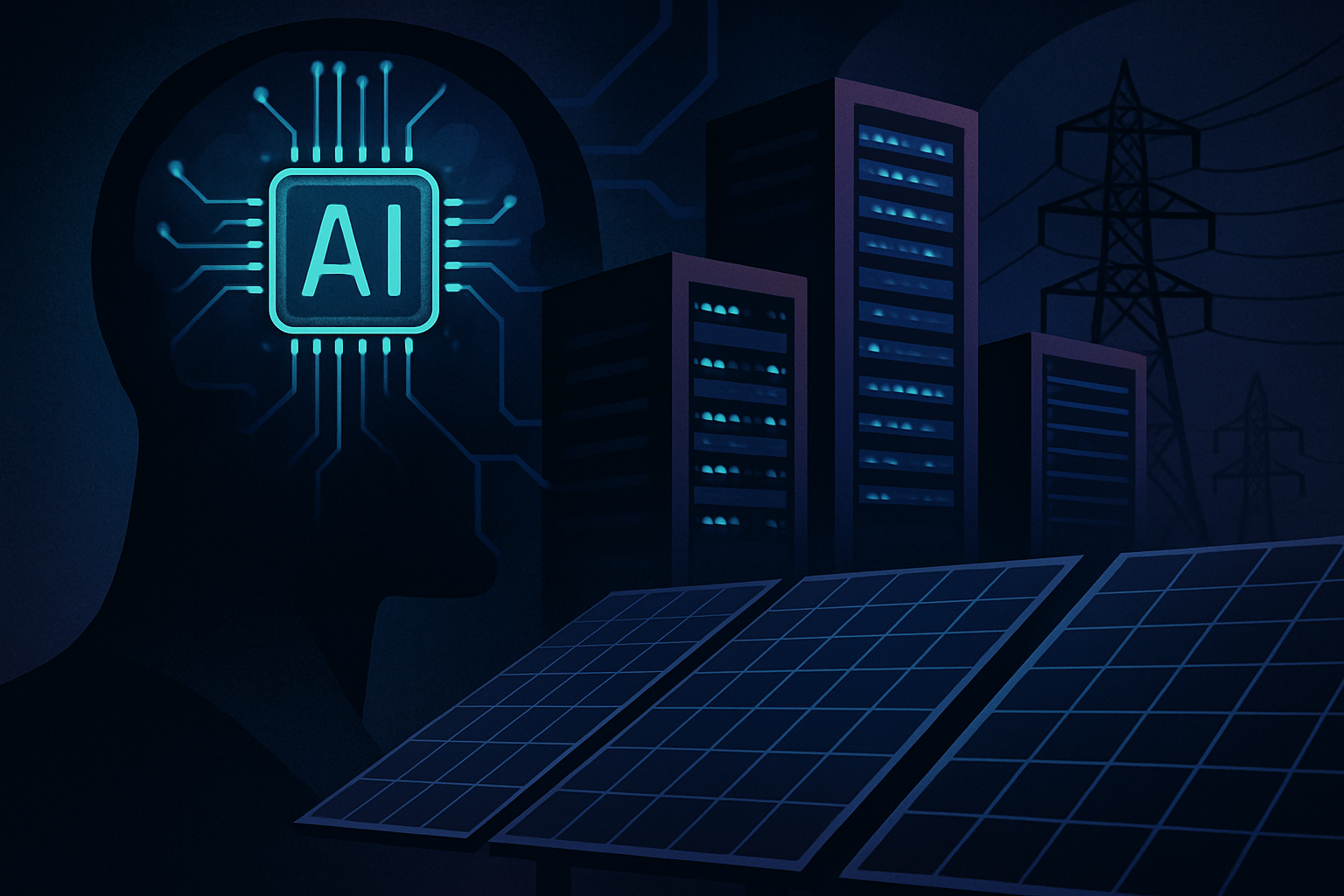
In the face of these challenges, a major issue arises: how to power this technological revolution without further saturating our national electricity grid? The answer may lie in the development of local solar energy. By multiplying points of solar, green, and local energy production close to needs, France could not only relieve its grid but also build the energy foundations of its digital sovereignty.
Photovoltaic canopies, industrial rooftops, and battery storage could become strategic infrastructures for the AI economy. What was once considered commercial development or local energy transition could tomorrow become a matter of national technological competitiveness. The rise of AI could thus accelerate the transformation of parking lots, warehouses, and commercial zones into true micro-sites of energy production capable of powering critical digital uses.
Proximity energy infrastructures could very well become one of the invisible yet essential links in France's competitiveness in artificial intelligence. One thing is certain: the battle for AI will not be won solely in algorithms. It will also be fought in our ability to produce enough electrons to fuel this new industrial revolution. France may have a historic opportunity: to converge energy transition, industrial sovereignty, and the development of artificial intelligence. Provided that it invests quickly in the electrical infrastructures capable of powering this new digital economy.
Brief IA — L'actualité IA en français
L'essentiel de l'actualité de l'intelligence artificielle, décrypté et expliqué chaque jour.