AI: Why Inaction is Already Costing More Than Investment
Le brief IA que les pros lisent chaque soir
Les 7 actus IA du jour, décryptées en 5 min. Gratuit.
Inclus dès l'inscription : notre sélection des meilleurs guides & comparatifs IA.
Choisis ton rythme
Gratuit · Pas de spam · Désabonnement en 1 clic
The AI Cost Dilemma
The question of the cost associated with artificial intelligence (AI) is at the heart of corporate concerns. Paradoxically, it is also this question that hinders their transformation. In seeking to quantify the impact of AI, organizations risk falling behind in its adoption.
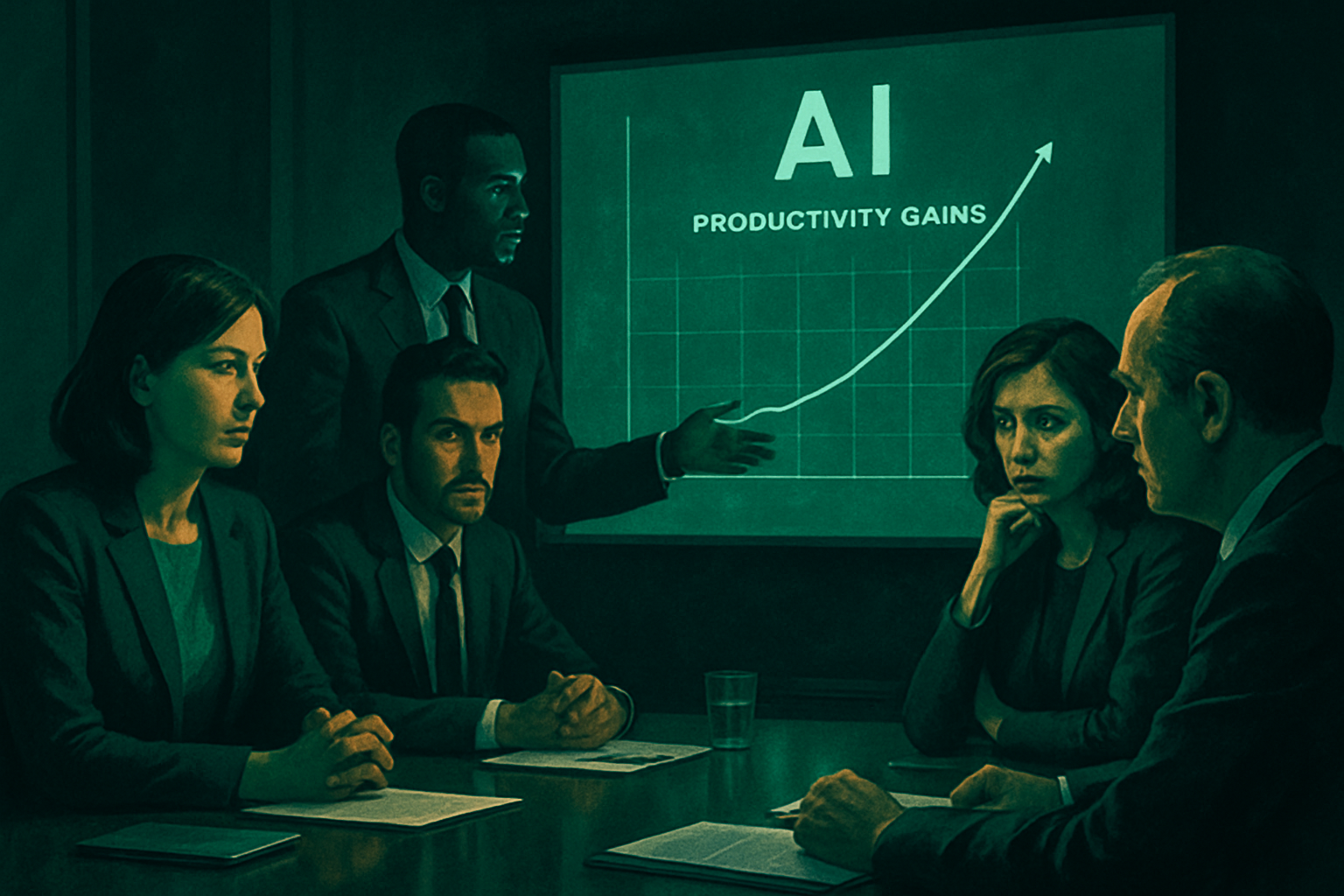
According to OpenAI's "State of Enterprise AI 2025" report, users of ChatGPT Enterprise manage to save between 40 and 60 minutes of active work per day. Meanwhile, McKinsey estimates that automation could increase global productivity by 0.5 to 3.4% per year between 2023 and 2040. These figures are often highlighted in presentations to executive management. However, only 39% of companies report an improvement in their operational results due to AI, and this impact rarely exceeds 5%.
The gap between the promises of AI and the measured results does not lie in the technology itself, but in the evaluation method. Applying traditional accounting tools, such as return on investment (ROI), to a transformation as complex as that of AI proves to be inadequate.
The Challenge of Measuring the Immeasurable
To rigorously assess the ROI of AI, one would need to track each employee in their daily tasks, before and after the implementation of AI, continuously. AI models evolve at an unprecedented speed, with improvements of 20 to 30 points on reasoning benchmarks in just a few weeks. Thus, traditional analyses often arrive too late compared to reality.
The most significant gains from AI are not captured in Excel spreadsheets. For example, a lawyer who reduces the time spent analyzing a contract from two days to two hours does not create a visible accounting line. A sales director who prepares a pitch in twenty minutes instead of three hours does not appear in reporting tools. Similarly, a marketing director who cuts her team's editorial production time in half does not show up in performance indicators. These gains, while substantial, remain invisible in traditional measurement systems.
The Concrete Impact for Decision-Makers
AI is not merely a tool with a fixed yield. It acts as a multiplier whose effect varies depending on the user, the task, and the mastery of the tool. For instance, a Chief Financial Officer (CFO) who reduces his monthly reporting from two days to four hours will not have the same ROI as a Human Resources Director (HRD) who prepares his annual reviews in twenty minutes. Seeking a single figure for such a contextual tool is akin to trying to quantify the value of reading in monetary terms.
This productivity differential does not translate into a traditional ROI calculation. It manifests in results, visible six months later, when teams that have adopted AI have already transformed their way of working, while others are just beginning to develop their business case.
The Essential Question to Ask
Organizations that progress rapidly do not wait for a perfect business case. They have understood that the crucial question is no longer "Is it worth it?" but "Can we afford not to do it?"
While a finance department develops its Excel model to justify the investment, its sales teams are losing opportunities to competitors who use AI to prepare their presentations. Its lawyers spend two days on analyses that their counterparts complete in two hours. Its managers manually write their reports, while others dictate them from their cars.
Productivity, although not always measurable, accumulates and composes discreetly. These gains do not necessarily validate executive committees, but they allow for market share growth. The impact of AI is not measured upstream but is observed downstream. Those who wait for tangible proof risk discovering the obvious too late.
Brief IA — L'actualité IA en français
L'essentiel de l'actualité de l'intelligence artificielle, décrypté et expliqué chaque jour.