Europe Must Redefine Its Rules to Dominate AI
Le brief IA que les pros lisent chaque soir
Les 7 actus IA du jour, décryptées en 5 min. Gratuit.
Inclus dès l'inscription : notre sélection des meilleurs guides & comparatifs IA.
Choisis ton rythme
Gratuit · Pas de spam · Désabonnement en 1 clic
Europe Must Leverage Its Strengths to Stand Out in AI
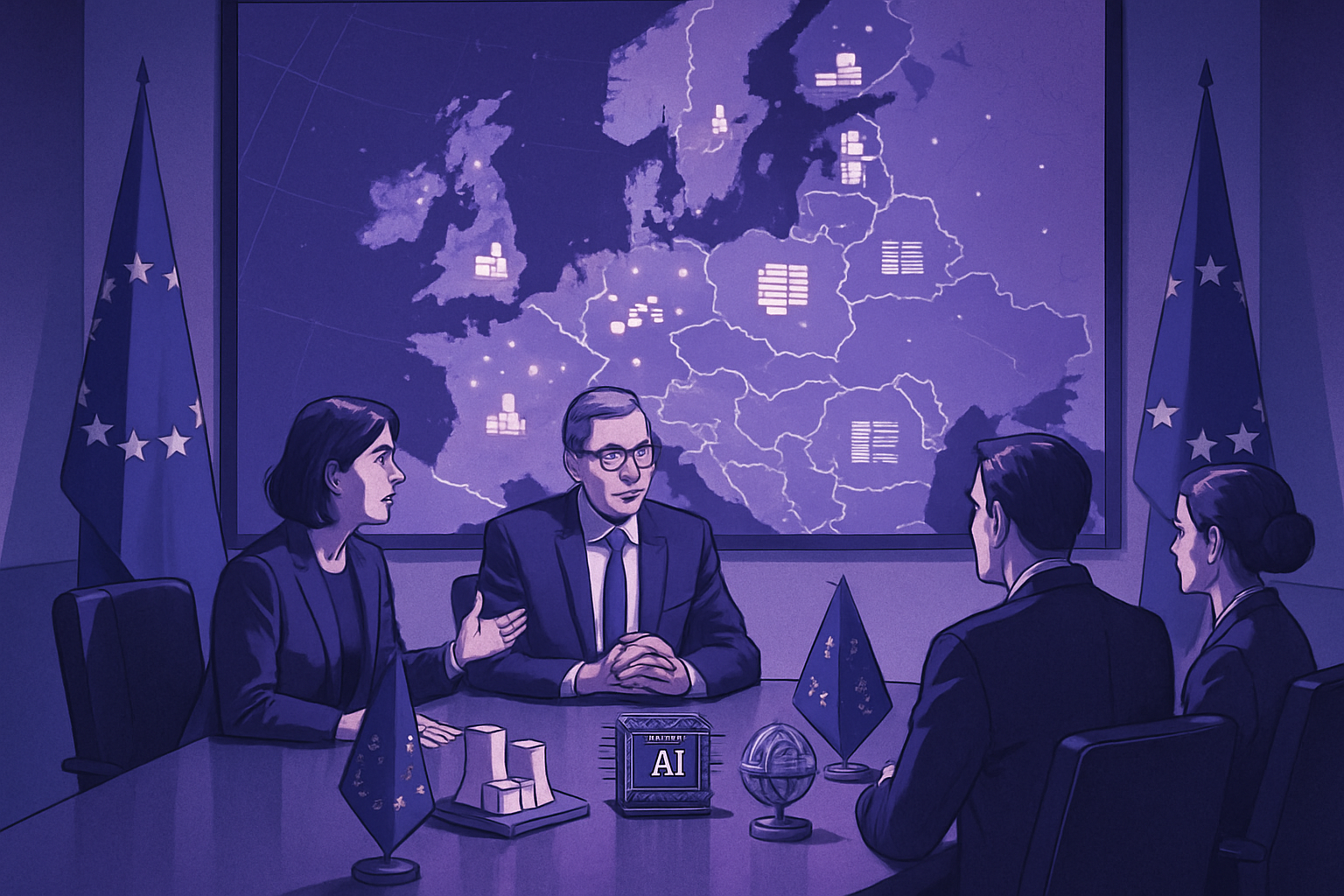
Artificial intelligence (AI) has become an essential lever of power in the modern world. For Europe, the goal is not to blindly follow the strategies of other powers, but rather to capitalize on its own unique resources and skills, such as energy, trusted data, and quantum technologies.
The recent restrictions imposed by the United States on access to certain strategic technologies are not merely a chapter in trade tensions. They symbolize a much deeper paradigm shift.
For decades, globalization has relied on the idea that innovations would flow freely, that economic interdependencies would foster prosperity, and that technology would serve as a bridge for international cooperation. This era seems to be coming to an end.
Semiconductors, cloud infrastructures, computing capabilities, AI models, and soon quantum technologies have become instruments of power. They now determine states' ability to generate wealth, protect their interests, and, more fundamentally, maintain their decision-making autonomy.
The nature of power is evolving. As the next elections in France approach, a notable shift is emerging. For the first time in a long while, technological sovereignty is at the heart of a relatively broad consensus. Most policymakers now recognize that Europe cannot indefinitely depend on infrastructures, platforms, and technologies developed elsewhere.
This is progress, but a consensus does not constitute a strategy. The real question is no longer whether more sovereignty is needed, but rather what model of power Europe wishes to build in the 21st century to ensure its independence.
Energy: A Strategic Asset for Europe
We often talk about graphics processing units (GPUs), but we frequently overlook their true raw material. Each new generation of AI models requires ever-greater computing capabilities, which are directly linked to the availability of abundant, stable, and competitive energy.
In this context, France has an exceptional advantage. Its nuclear fleet is likely one of Europe's main strategic assets in the field of artificial intelligence. This advantage should no longer be seen merely as an economic opportunity. It must become a lever for industrial policy.
Access to this energy can no longer be viewed as just a commercial service. When a foreign company chooses to establish a mega data center in Europe to benefit from this energy competitiveness, it is legitimate to expect certain concessions:
- Technology transfers
- Establishment of research centers
- Opening computing capacities to European companies
- Participation in funding sovereign infrastructures
- Talent training
- Creation of intellectual property in Europe
This is not protectionism, but rather applying the same clarity to our strategic assets that other major powers are now practicing.
Trust: A Pillar of the European Strategy
Since the advent of generative AI, global competition has largely relied on a quantitative logic: ever more GPUs, more data, and more parameters. This trajectory, unsustainable in the medium term, is not the only possible path.
In fields such as health, industry, energy, research, justice, or administration, the quality of an AI system depends less on the volume of knowledge it absorbs than on the quality of the information it relies on. Europe possesses a unique heritage: some of the richest scientific, industrial, administrative, medical, and cultural data in the world.
Thus, the real challenge may not be to build the largest model, but to build the best knowledge. This requires European data spaces governed collectively, documented, anonymized when necessary, legally usable, versioned, audited, and regularly enriched. In other words, transforming data protection into a competitive advantage.
Europe is unlikely to win the battle for the most powerful model. However, it can become the continent that develops the artificial intelligence that the world will trust the most.
The Revolutionary Potential of Quantum Computing
Most analyses assume that advancements in artificial intelligence will continue to depend primarily on the accumulation of computing power. This assumption deserves scrutiny. Quantum computing opens up another perspective. It could accelerate certain optimization calculations, improve scientific simulations, transform the discovery of new materials or drugs, enhance learning capabilities, and profoundly alter the algorithmic architectures of tomorrow.
The true breakthrough may not come from ever-larger models. It may come from smarter, more specialized, and more efficient models. Europe already has leading research in the quantum field. By articulating this scientific advance with high-quality data and competitive energy, it could propose a radically different approach: shifting from a brute-force logic to a precision logic.
Towards a European Strategic Knowledge Complex
None of these ambitions can be realized without a comprehensive vision. Europe does not lack talent. It already has champions in semiconductor production equipment, electronic components, research, cloud computing, artificial intelligence, and cybersecurity. What it lacks is a common architecture.
Just as states built military-industrial complexes in the last century, Europe must now build a strategic knowledge complex. This would bring together energy infrastructures, semiconductors, computing capabilities, sovereign clouds, data spaces, open software, cybersecurity, artificial intelligence, quantum computing, research, training, and the funding necessary for the hypergrowth of its companies.
It is no longer about thinking of each sector separately; it is about viewing the whole as a system because sovereignty never results from an isolated technology. It arises from mastering an entire value chain.
A Unique European Vision of Power
Ultimately, Europe would make a mistake by simply trying to replicate American or Chinese models. Its history shows that its greatest successes have emerged when it has proposed a different vision.
- Airbus has never been a copy of Boeing.
- CERN has never sought to replicate American laboratories.
Europe has always succeeded when it has transformed its singularities into competitive advantages. Artificial intelligence today offers a comparable opportunity: not to become the continent of the largest models but the one of the most reliable models. Not the one of unlimited resource consumption, but the one of efficiency. Not the one of opacity, but the one of trust. Not the one of dependence, but the one of autonomy.
Technological sovereignty is not an end in itself. It becomes the condition for exercising all other sovereignties: economic, energy, scientific, democratic, and political. It is likely on this ground that the true competition between great powers will unfold in the coming decades. And it is here that Europe can still choose not to play by others' rules but to invent its own.
Brief IA — L'actualité IA en français
L'essentiel de l'actualité de l'intelligence artificielle, décrypté et expliqué chaque jour.