Europe Strengthens Its Sovereignty with Local AI
Le brief IA que les pros lisent chaque soir
Les 7 actus IA du jour, décryptées en 5 min. Gratuit.
Inclus dès l'inscription : notre sélection des meilleurs guides & comparatifs IA.
Choisis ton rythme
Gratuit · Pas de spam · Désabonnement en 1 clic
Europe Strengthens Its AI Infrastructure for Technological Sovereignty
Artificial intelligence (AI) infrastructure has become a strategic priority in Europe, where countries are striving to develop their own hardware capabilities. This initiative is part of a broader quest for technological sovereignty, aimed at reducing dependence on foreign suppliers.
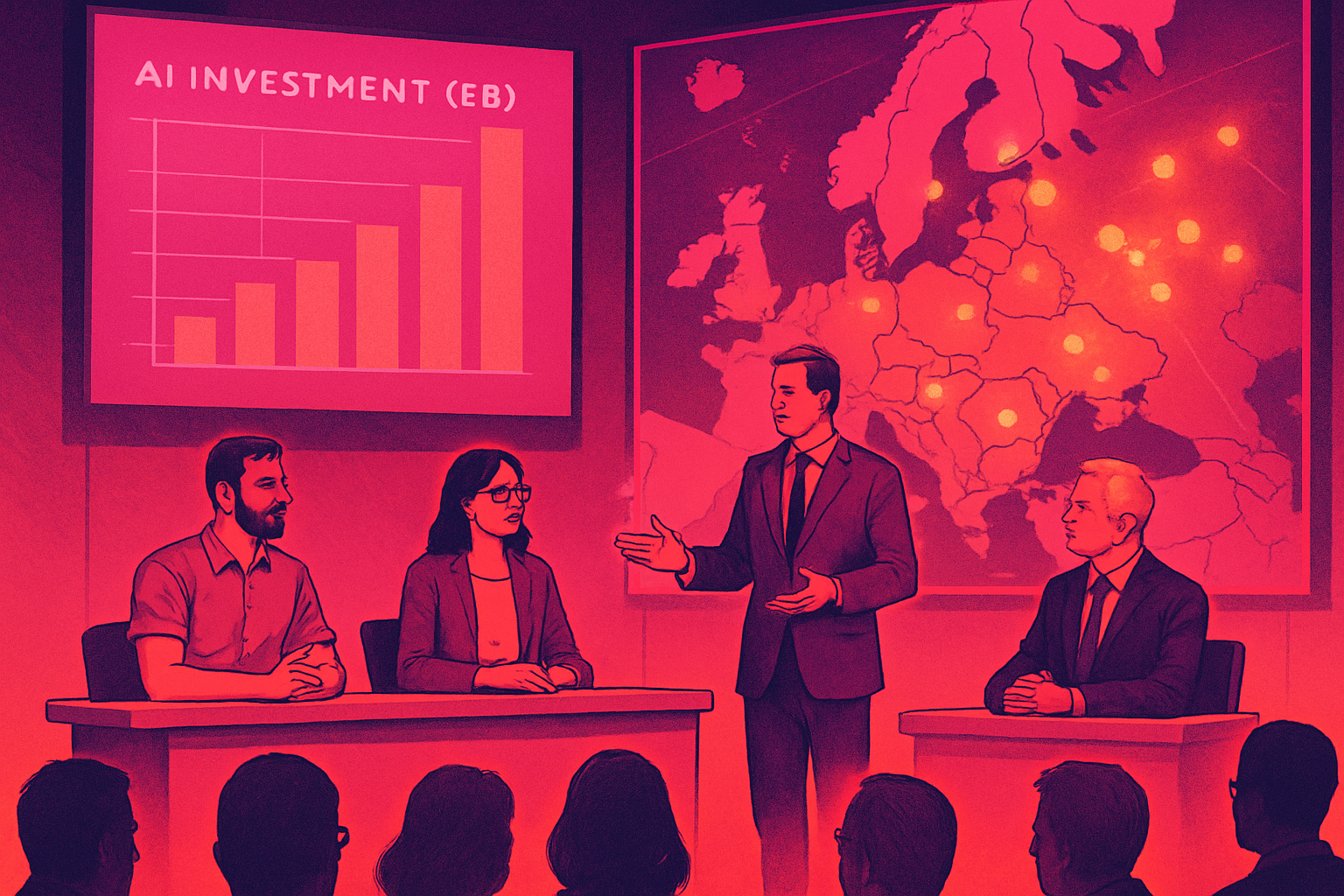
Venture capital investors have quickly responded to this trend. European startups specializing in AI hardware and computing have managed to raise €1.9 billion this year. This amount is nearly equivalent to the €2 billion projected for the entire year of 2025, according to data provided by Sifted.
Among the companies standing out in this dynamic is Nscale, an AI infrastructure company based in London. It recently raised $2 billion in a Series C funding round, achieving an impressive valuation of $14.6 billion. Meanwhile, Nebius, a Dutch company specializing in neo-cloud solutions, closed a funding round of approximately $4.3 billion around the same time.
Sifted met with Ben Tickler from the Innovation Economy U.K. and Kim Larsson Nyheim from the Innovation Economy Nordics at a J.P. Morgan event to analyze this push towards sovereignty in European infrastructure and understand why the Nordic countries offer a strategic advantage to Europe.
The Quest for Technological Sovereignty
Currently, the European cloud services market is dominated by three American giants: Amazon Web Services (AWS), Microsoft Azure, and Google Cloud. Together, these companies control 70% of the European market.
However, the source of computing power is increasingly seen as a critical resource, akin to the national electrical grid, according to Kim Larsson Nyheim. This awareness is prompting many sectors, particularly those subject to heavy regulation such as government, finance, and healthcare, to realize that they can no longer afford total dependence on foreign infrastructure.
In the event of geopolitical tensions, access to data centers based in the United States could be restricted. Such a situation could paralyze the economy of a region lacking its own AI infrastructure, warns Larsson Nyheim.
For governments and regulated sectors, owning and controlling the entire AI supply chain is crucial for ensuring national security and long-term economic resilience. This necessity has led to a significant increase in funding for local startups that design chips and develop data centers.
In the UK, for example, the government recently announced an investment plan of £1.1 billion to enhance the country's ability to build and develop AI infrastructure. This plan includes a budget of £750 million for a new AI supercomputer, with £400 million allocated for the purchase of semiconductors and inference chips.
The European Commission has also unveiled its Technological Sovereignty Package, a set of proposals aimed at reducing the continent's excessive dependence on foreign technology suppliers. These proposals include increasing AI cloud capabilities in Europe and developing national data centers, as well as a new sovereignty framework designed to help public sector organizations assess the extent to which a cloud provider is "sovereign."
Ben Tickler highlighted the rise of British companies raising funds to challenge American giants like Nvidia, citing Fractile's $220 million raise in May as an example. The current priority is to build chips locally and strengthen ownership of the end-to-end supply chain.
The Advantages of Nordic Countries
According to Larsson Nyheim, Nordic countries are increasingly attracting capital for the development of AI infrastructure. This region offers unique advantages for companies looking to reduce their carbon footprint while building data centers and sustainable infrastructure.
The Nordic countries present a winning combination of efficiency, sustainability, and state stability. Companies like Evroc in Sweden and Verda in Finland exemplify this trend by developing data centers that provide flexible and affordable computing solutions.
Non-local companies are also benefiting from these advantages. Google, for example, has begun construction on its first self-developed data center in Horndal, Sweden. Similarly, Nebius has announced the construction of a new AI factory in Lappeenranta, Finland.
The cooler Nordic climate is particularly suited for reducing energy costs associated with cooling high-density AI servers. Additionally, the region offers an abundance of renewable energy, which is crucial for companies seeking to meet their climate goals.
Meanwhile, Meta has been operating in Sweden for 15 years, with its first infrastructure project launched in 2011.
According to Larsson Nyheim, it is no longer just about pursuing AI companies, but about solving bottlenecks where energy and power determine access and the supply chain. Tickler adds that the expansion of infrastructure in Europe is growing rapidly, with companies like Nscale leading this effort in response to the increasing demand for technological sovereignty.
While investment in application AI remains strong, the development of infrastructure in Europe is experiencing rapid growth, underscoring the importance of technological sovereignty for the continent's economic future.
Brief IA — L'actualité IA en français
L'essentiel de l'actualité de l'intelligence artificielle, décrypté et expliqué chaque jour.