AI Seeking Funding: A Colossal Economic Challenge for 2026
Le brief IA que les pros lisent chaque soir
Les 7 actus IA du jour, décryptées en 5 min. Gratuit.
Inclus dès l'inscription : notre sélection des meilleurs guides & comparatifs IA.
Choisis ton rythme
Gratuit · Pas de spam · Désabonnement en 1 clic
The Era of Private AI Funding is Coming to an End
Funding for artificial intelligence, once dominated by private capital, is entering a new phase. Companies must now turn to bond and equity markets to support their ambitious growth. This transition marks a historic turning point, as the stakes are unprecedented.
Exponential Growth in Investments
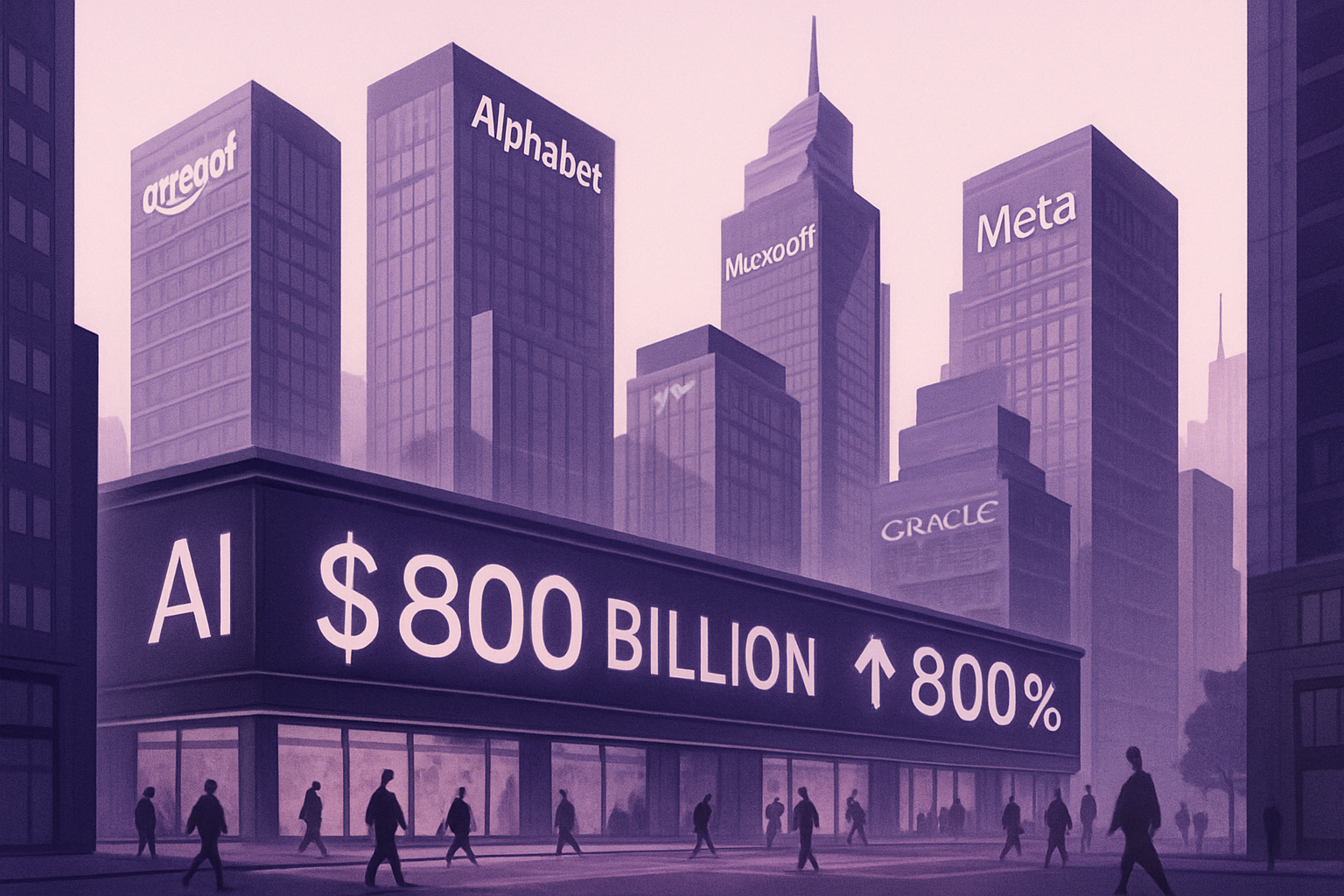
The enthusiasm surrounding artificial intelligence continues to grow, leading to a spectacular increase in investments. This acceleration explains much of the current economic growth in the United States. According to Goldman Sachs, between 2026 and 2031, approximately $7.6 trillion could be invested to develop the AI ecosystem. To put this into perspective, the telecommunications bubble of the 1990s, considered one of the largest capital investments of that era, mobilized $500 billion between 1996 and 2000. The scale of investments in AI is therefore expected to be 15 times greater.
Hyperscalers at the Forefront
American tech giants, often referred to as hyperscalers, are at the heart of this dynamic. Amazon, Alphabet, Microsoft, Meta, and Oracle are expected to invest $6 trillion during this period, accounting for 80% of these investments. By 2027, their spending is projected to reach $1.1 trillion, six to seven times more than five years ago, representing 3% of the U.S. GDP.
A Changing Financial Equation
Until now, these companies have been able to finance their expenditures through their annual cash surpluses. However, this situation is rapidly evolving. In 2025, hyperscalers had an annual surplus of $200 billion, but this figure is expected to approach zero in 2026. The deterioration of their financial equation has significant implications for the dynamics of bond and equity markets. To continue rewarding their shareholders, these companies will need to issue more debt. Since the beginning of 2026, they already account for 18% of new net issuances in the investment-grade market in the U.S., while the tech sector only represents 4% of this market. Such concentration destabilizes historical balances and is already a source of fragility for major U.S. stock indices, such as the S&P 500, and could also affect the bond market.
Reducing Share Buybacks: A Partial Solution
To limit the scale of new issuances, hyperscalers are considering reducing or canceling share buybacks. Already, these buybacks have decreased from $130 billion in 2022 to $90 billion in 2025. At the same time, equity issuances for employee compensation have increased, halving the net effect compared to 2022. The natural support that these buybacks represented is therefore declining.
The Impact of IPOs
This phenomenon coincides with an increase in initial public offerings (IPOs). The IPOs of SpaceX, OpenAI, and Anthropic, scheduled for 2026-2027, could represent around $200 billion in new shares, four to five times the average annual size of the U.S. IPO market. The cash flows from hyperscalers and private capital are no longer sufficient, making it essential to turn to public markets.
Attracting Foreign Investors
The United States is leveraging the supremacy of its financial markets to attract foreign investors, thereby financing its AI infrastructure at a lower cost and reinforcing its global economic dominance. They are even relaxing index rules so that passive management can quickly participate in these IPOs. This ensures them a significant additional source of funding, as the U.S. accounts for nearly 75% of global indices like the MSCI World. Thus, asset managers cannot afford to be wrong about the future profitability of AI, as their capital allocation is heavily concentrated in this sector and this country.
Brief IA — L'actualité IA en français
L'essentiel de l'actualité de l'intelligence artificielle, décrypté et expliqué chaque jour.