AI and Employment: A Major Warning from 200 Experts
AI and Employment: A Major Warning from 200 Experts
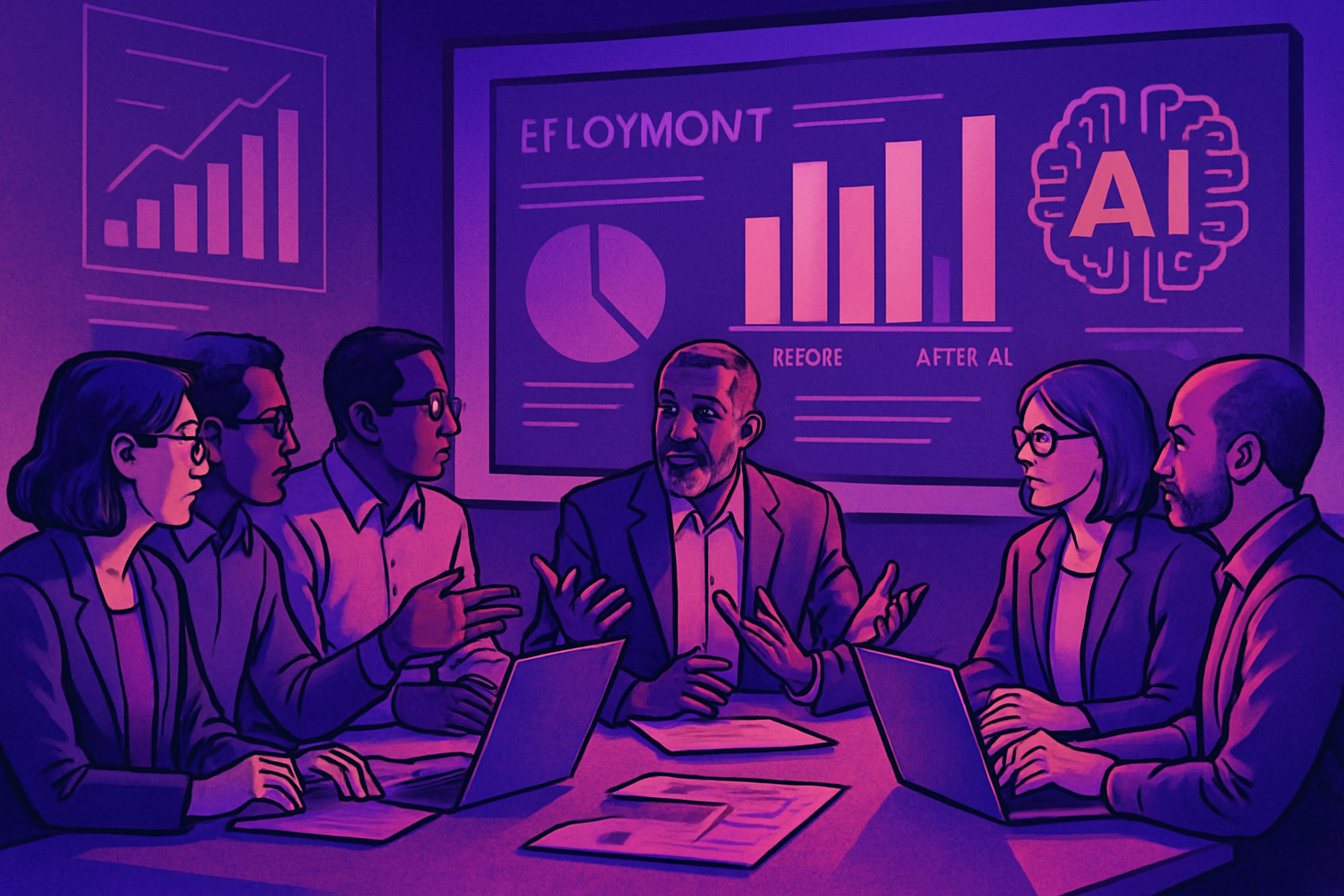
This year, one of the dominant concerns is the potential impact of artificial intelligence on the labor market, both in the short and long term. As part of our Platformer podcast series, we interviewed seven experts with varied perspectives on this crucial issue. While the debate concluded on a relatively optimistic note, with most participants doubting a prolonged mass unemployment scenario, they unanimously acknowledged that AI will lead to significant transformations across many professional sectors.
Discussions about AI and employment are often complex, partly due to the poor quality of available data. Jobs typically do not disappear for a single reason, and companies may have motivations to conceal the true reasons behind job cuts. Furthermore, the data collected this year sometimes appears contradictory, making analysis even more challenging.
It is in this context that I came across a statement this morning titled "We Must Act Now," signed by over 200 economists, AI researchers, and Nobel laureates. Among the signatories are leaders from major tech companies like Anthropic, Google, and OpenAI. The statement, while concise, deserves to be reproduced in full:
AI could become radically more powerful over the next ten years.
This could lead to an unprecedented transformation of our economy, greater than the Industrial Revolution, but occurring over a much shorter period. It could create risks, including massive job displacement, as well as opportunities such as significant gains in living standards.
Economists, policymakers, and tech leaders must act now to understand the economy of transformative AI and establish the incentives, safeguards, and institutions necessary to steer AI in a direction that complements humans and benefits society.
Although this statement may seem innocuous, it represents, as Ben Casselman highlights in the New York Times, a growing awareness among economists that the risks of large-scale disruption are increasing. Notably, long-time AI skeptics such as Daron Acemoglu and Simon Johnson from the Massachusetts Institute of Technology, who won the Nobel Prize in Economics in 2024, are among the signatories.
"There has been a notable shift in the profession," said Erik Brynjolfsson, a Stanford economist who helped organize the statement. His goal was to raise awareness among economists and policymakers about the disruptive potential of AI.
"I still see a big gap, a big disconnect, and I'm a bit worried that we are not ready for the tsunami that is coming," he added.
This statement comes a month after a Wall Street Journal survey of 16 leading economists revealed that half of them believed AI would not lead to any net change in jobs; five said it would result in net losses, and only three said it would lead to net growth. Notably, China chose last week not to set a numerical target for the number of urban jobs it would create over the next five years — a first since the 1990s.
Le brief IA que les pros lisent chaque soir
Les 7 actus IA du jour, décryptées en 5 min. Gratuit.
Inclus dès l'inscription : notre sélection des meilleurs guides & comparatifs IA.
Choisis ton rythme
Gratuit · Pas de spam · Désabonnement en 1 clic
In moments like this, it is helpful to pause and assess what we know for certain, what is contested, and what we might do about it.
Let’s start with what we know.
-
There is no employment crisis to date. According to the Yale Budget Lab, a nonpartisan policy research center, "the occupational mix is not yet changing in a way that clearly aligns with the introduction of AI into the workforce." Measures of AI usage show no connection with changes in employment or unemployment.
-
There is increasing evidence that AI is beginning to erode work — particularly entry-level jobs. This month, Stanford's Canaries Dashboard — another project by Brynjolfsson — provided two relevant data points. (The data comes from ADP, a major payroll services provider.)
-
The first is that jobs considered most "exposed" to AI have decreased by 0.5%, while those less exposed have increased by 0.2%.
-
The second is that jobs for beginners have decreased by 2.7% this year, while jobs for mid-career workers (aged 35 to 40) have increased by 1.6%.
-
These effect sizes are obviously small — but directionally interesting. They also help me understand the seemingly contradictory data we sometimes see about jobs.
Take, for example, an apparently positive story about AI and jobs from last week: job postings in the U.S. related to software development have increased by 15% since the launch of Claude Code in February 2025. Among these postings, 71% of the increase concerns senior-level positions.
The implication is clear and concerning: employers are increasingly turning to AI systems to perform the entry-level work that their junior employees once did. For now, this seems to be creating jobs for more experienced workers. But what will happen if AI systems are also capable of performing those tasks?
Job losses often have multiple causes, and economists have cited rising interest rates, over-hiring during the pandemic, and remote work as reasons why hiring is slow in certain parts of the economy. Economists are also puzzled about how AI could significantly contribute to job losses when we do not yet have measurable productivity gains.
So when the signatories of this new letter say we "must act now," what do they mean?
The letter does not include any specific demands. Brynjolfsson told the Times that one of his priorities is to obtain better data. "The lack of reliable data has been a major obstacle for researchers in recent years," notes Casselman, "with different measures telling contradictory stories about whether AI is causing job losses and which workers will be most affected."
The good news is that the U.S. government has begun to consider some solutions: there is now bipartisan support for a sovereign fund financed by AI companies, for example.
But it may be wise to develop an action plan before job losses due to AI become even more tangible. Labor economist Kathryn Anne Edwards has called for unemployment insurance reform and funding for worker relocations when they lose their jobs. Molly Kinder from the Brookings Institution has suggested ideas such as wage insurance and government incentives for employers to hire younger workers.
All of these suggestions deserve consideration. Earlier this month, I wrote that there is not yet a crisis of jobs related to AI — but that the warning signs are flashing yellow. This should be more than enough reason to do what economists suggest and develop a plan for what happens when those signs start turning red.
Brief IA — L'actualité IA en français
L'essentiel de l'actualité de l'intelligence artificielle, décrypté et expliqué chaque jour.