Ubiquitous AI, but Business Productivity Stalls
Le brief IA que les pros lisent chaque soir
Les 7 actus IA du jour, décryptées en 5 min. Gratuit.
Inclus dès l'inscription : notre sélection des meilleurs guides & comparatifs IA.
Choisis ton rythme
Gratuit · Pas de spam · Désabonnement en 1 clic
The Rapid Innovation of AI and Its Challenges for Businesses
The rise of artificial intelligence is undeniable, with new models emerging almost every week. However, companies are struggling to convert these innovations into tangible productivity gains. The useful life of these models is estimated to be between 12 and 18 months, complicating their effective integration.
Take the example of market leaders in 2026. At Anthropic, several major versions have been launched within a few months: Claude Opus 4.6 in February, Claude Sonnet 4.6 in mid-February, Opus 4.7 in April, Opus 4.8 at the end of May, and Claude Fable 5 / Mythos 5 in early June. Mistral is following a similar pace with releases like Mistral Small 4 in March and Voxtral TTS in the first half of the year.
Even if a company adopts the most advanced model immediately, the integration, training, and deployment process can take 6 to 12 months. This leaves little time before a new version renders the model obsolete, thus limiting the return on investment.
The Productivity Paradox and AI
This phenomenon echoes Solow's paradox from 1987: "You can see the computer everywhere except in the productivity statistics." Today, AI seems to be following the same path. Although it is omnipresent in discussions and professional events, productivity and profitability gains remain modest in many sectors.
At the same time, Jevons' paradox also applies: the improvement in the efficiency of AI models leads to increased resource consumption, as it enables new applications. Companies are multiplying experiments, raising costs without profitability following suit.
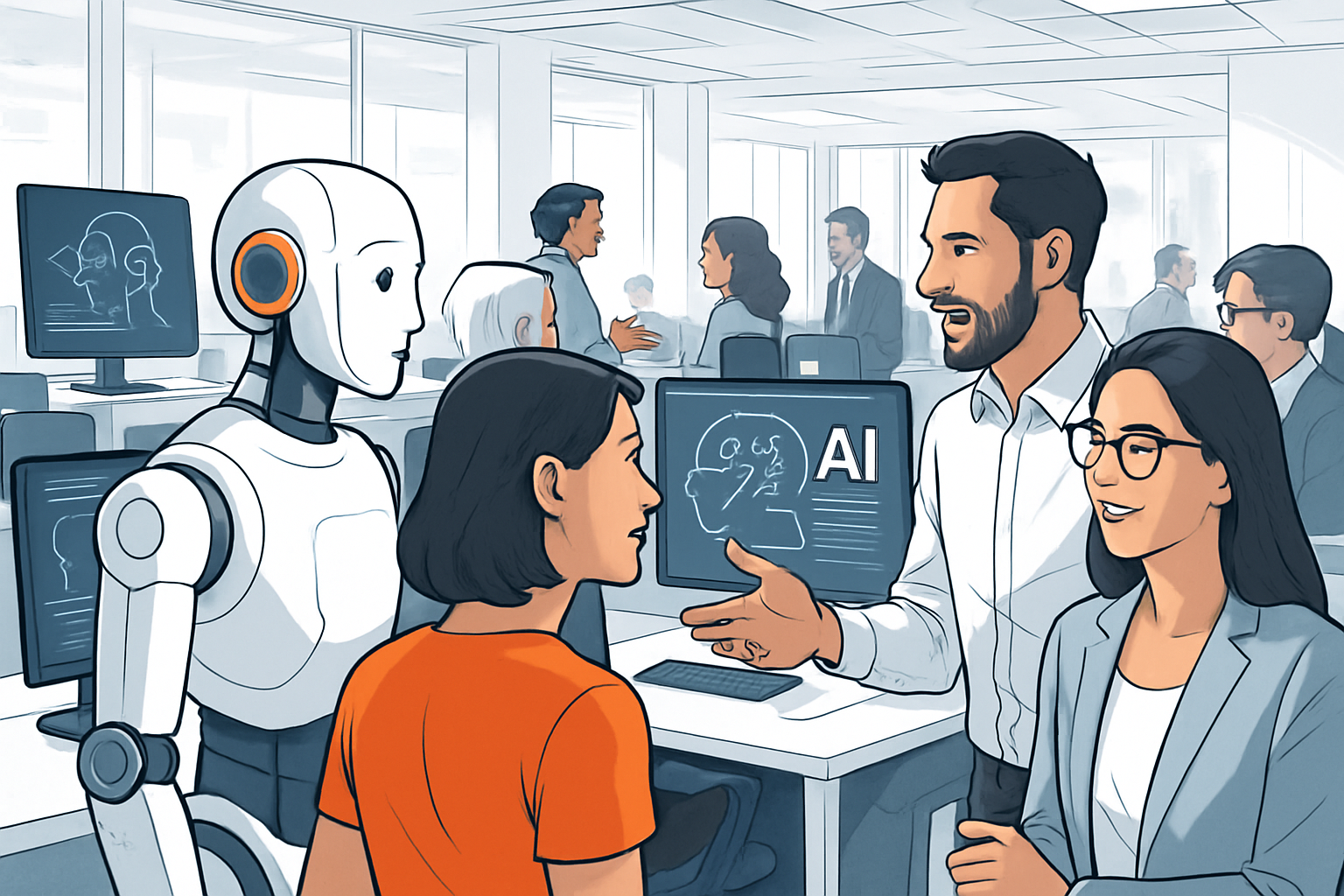
The Importance of AI + Human Collaboration
AI alone is not enough to create sustainable value. Its true strength lies in its complementarity with humans. The models produce impressive results but require human validation and contextualization. Profitability emerges from a hybrid AI + Human process, which takes time to develop.
A pace of renewal that is too rapid hinders this maturation. Projects struggle to reach industrial scale, as soon as they are ready for deployment, a new version renders the previous work obsolete. Companies often find themselves in a loop of Proofs of Concept or partial deployments.
Why Companies Persist with AI
Despite these paradoxes, companies continue to adopt AI for several reasons. On one hand, leaders are convinced of AI's enormous potential to create value. Prototypes, often impressive, reinforce this belief.
On the other hand, AI is seen as a lever for economic growth in a context of slowing productivity. Inspiring examples, such as those from Elon Musk, demonstrate how AI can transform processes on a large scale.
Companies can also achieve quick and visible gains through applications like automating repetitive tasks or coding assistance. The novelty effect and fear of missing out (FOMO) also drive rapid adoption of AI.
Finally, competitive pressure and investor expectations encourage companies to adopt an AI-first posture. The cost of licenses and the ease of launching low-risk use cases, such as copilots, content generation, and internal chatbots, are also factors that promote AI adoption.
The Need for AI Governance
In the face of these challenges, AI governance becomes crucial. Companies that succeed in leveraging AI will be those that adopt a "process-first" approach, stabilizing a mature process before moving on to the next version.
It is essential to implement rigorous governance of value, measuring business KPIs rather than just technical ones. Investing in human factors, such as ongoing training and defining responsibilities, is also crucial.
Finally, designing modular architectures will facilitate transitions without requiring a complete rebuild. The double Solow-Jevons paradox is not a fatality but a call for thoughtful organizational transformation. AI will only become omnipresent when it translates into concrete operational results.
Brief IA — L'actualité IA en français
L'essentiel de l'actualité de l'intelligence artificielle, décrypté et expliqué chaque jour.