AI Transforms Entry-Level Jobs: A New Era
Le brief IA que les pros lisent chaque soir
Les 7 actus IA du jour, décryptées en 5 min. Gratuit.
Inclus dès l'inscription : notre sélection des meilleurs guides & comparatifs IA.
Choisis ton rythme
Gratuit · Pas de spam · Désabonnement en 1 clic
AI and Recent Graduates: A Promising Coexistence
According to a joint study by Cognizant and Pearson, artificial intelligence (AI) and entry-level jobs are not in direct opposition. In fact, the study reveals that 94% of human resources managers expect the creation of new junior positions in the next five years. This outlook is encouraging in a context where automation has often been perceived as a threat to entry-level jobs.
For a long time, AI has been accused of taking over repetitive and unfulfilling tasks, often assigned to newcomers. This has led to a less welcoming job market for recent graduates. However, the study suggests that this impact may be temporary or partial, hinting at new opportunities.
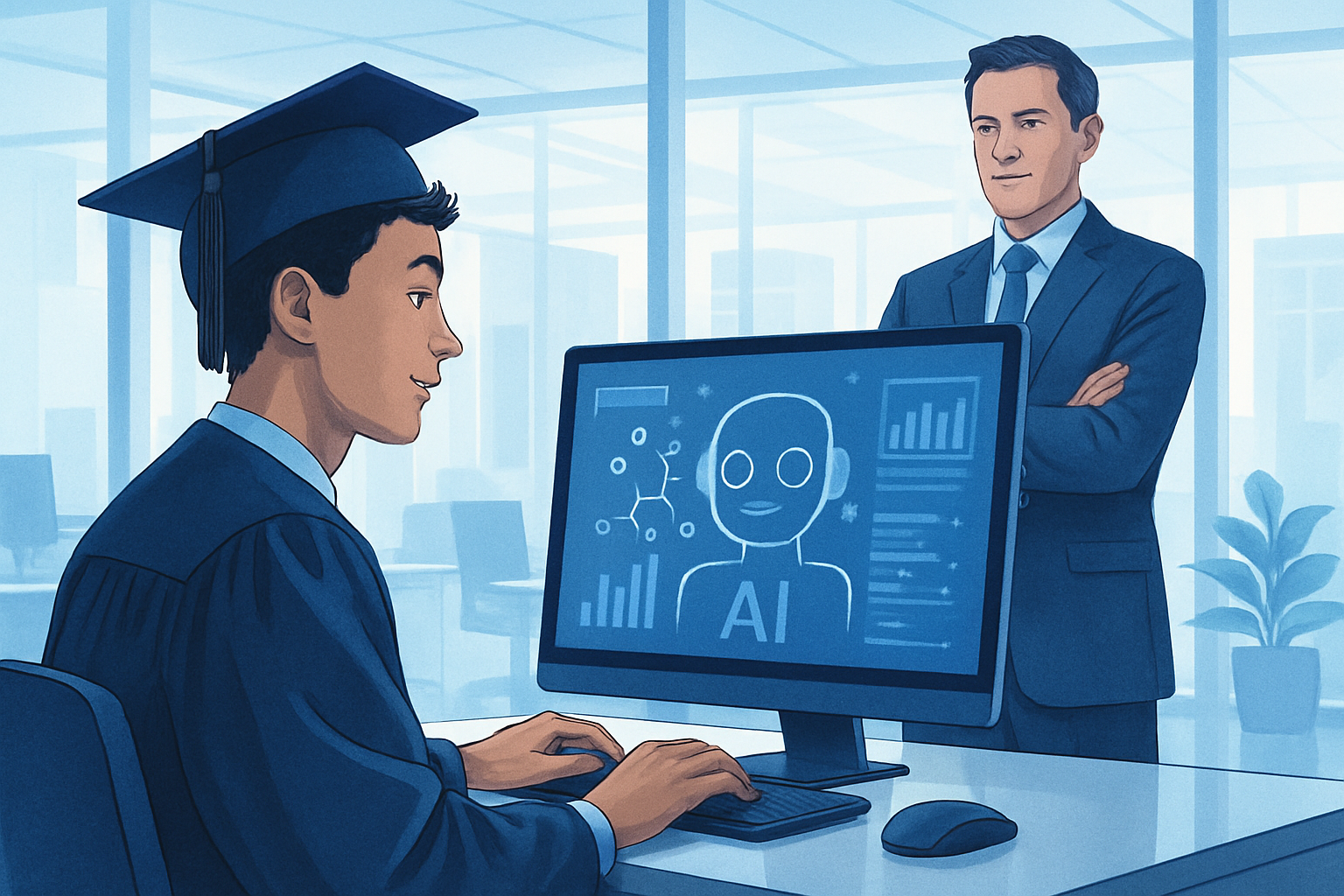
A Transformation of Junior Roles by AI
The report highlights a central idea: junior positions will not disappear but will be transformed by AI. Thus, 96% of HR managers believe that these jobs will evolve into roles involving more supervision. Young employees will no longer be confined to menial tasks but will need to learn to manage, verify, and correct automated systems. For example, an intern tasked with sorting files could evolve into an AI supervisor role. While this may seem rewarding, proper training is crucial for successfully making this transition.
Furthermore, over 90% of HR managers consider middle management to be essential. These managers will need to turn the promises of AI into concrete jobs and avoid operational pitfalls. Poorly managed AI can produce quickly but not necessarily accurately. Therefore, the role of management becomes less administrative and more strategic, requiring a reorganization of teams and daily support for juniors.
An Urgent Need for AI Training
The study underscores a common paradox in the professional world: companies want employees ready for AI but do not train them sufficiently. Thus, 91% of HR managers report an increase in training requests. Young workers want to master AI tools rather than be subjected to them. However, only 54% of organizations currently offer dedicated AI training, creating a gap between expectations and reality.
This gap is exacerbated by the fact that 60% of companies admit their training programs are outdated. AI is evolving rapidly, while training plans are progressing slowly. The sought-after skills are no longer solely technical or academic. Now, 97% of recruiters prioritize adaptability, judgment, and problem-solving.
Ali Bebo, HR Director at Pearson, succinctly summarizes the situation: “The most successful organizations will focus less on replacing tasks.” They will invest in capabilities that allow humans and AI to collaborate effectively. This corporate-sounding quote highlights a crucial issue. Recent graduates should not wait for their company to take charge of their training. They must proactively educate themselves, experiment, and understand the limitations of the tools. AI does not close the door on entry-level jobs; it changes the terms, and it is essential to find the key to adapt.
Brief IA — L'actualité IA en français
L'essentiel de l'actualité de l'intelligence artificielle, décrypté et expliqué chaque jour.