AI: A Performance Tool That Threatens Workplace Cohesion
Le brief IA que les pros lisent chaque soir
Les 7 actus IA du jour, décryptées en 5 min. Gratuit.
Inclus dès l'inscription : notre sélection des meilleurs guides & comparatifs IA.
Choisis ton rythme
Gratuit · Pas de spam · Désabonnement en 1 clic
AI: A Performance Tool That Threatens Workplace Cohesion
The rise of generative AI in businesses is undeniable, promising to significantly enhance individual productivity. However, this technological advancement could also harm the collective dynamics within organizations. Indeed, the increased reliance on AI may encourage a retreat into oneself, a phenomenon that could prove detrimental in the long run.
In February 2026, MIT published the results of an in-depth study on the impact of AI on collaboration in the workplace. This research involved 2,234 participants, divided into pairs of either human-human or human-AI, tasked with creating advertising campaigns. The results are striking: human-AI pairs produced 50% more content per person, with superior text quality. This increased efficiency suggests that each employee, equipped with a capable AI assistant, could potentially replace an entire team.
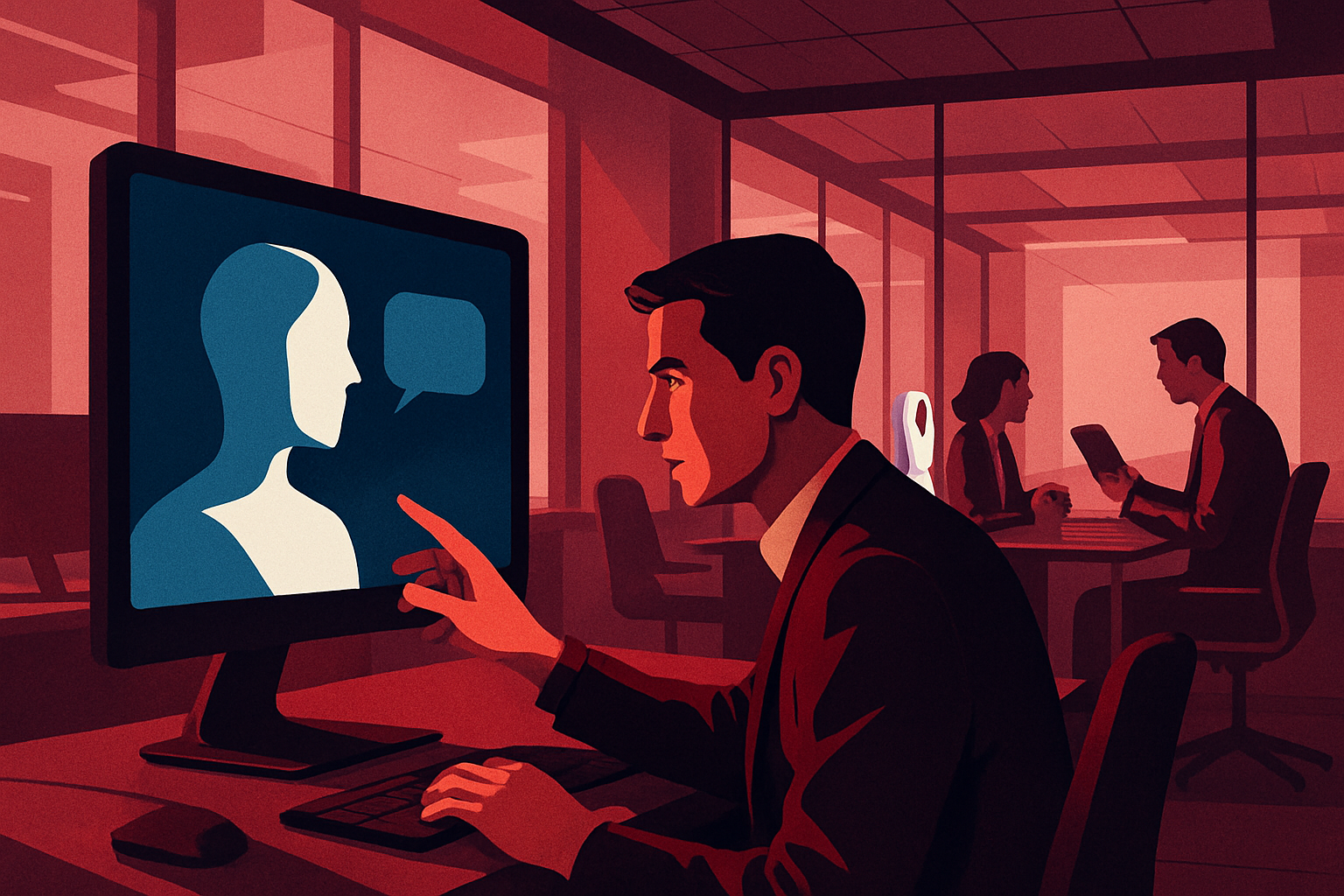
While this prospect of enhanced performance is appealing, it raises questions about work dynamics. Why seek a colleague's input when a quick, judgment-free response can be obtained from an AI assistant in 10 seconds? This trend of preferring AI for even the simplest questions could lead to a decrease in human interactions, with employees opting to address a machine rather than risk revealing a gap in knowledge to a peer.
The Growing Isolation Linked to AI Use
This phenomenon is not limited to the professional sphere. A joint study by MIT Media Lab and OpenAI analyzed the impact of intensive use of ChatGPT on 1,000 participants and examined nearly 40 million interactions with the tool. The results show a correlation between heavy AI usage and an increase in loneliness, heightened emotional dependence, and a decrease in socialization. Although these findings do not prove direct causation, they raise significant concerns, especially considering that nearly 1 billion people use this tool each week.
The Cost is Paid at the Collective Level
The MIT study also reveals that interactions with an AI companion tend to become more transactional. Task-oriented exchanges increase by 25%, while interpersonal interactions decrease by 18%. Moreover, tasks are more frequently delegated to AI than to a human partner. This shift towards more functional and less diverse communication could undermine the richness of exchanges within teams.
In the daily operations of businesses, this phenomenon manifests as a proliferation of AI-generated content, often sent without prior proofreading. This type of content, referred to as workslop in English, has become commonplace. A recent survey in the United States found that 40% of employees received workslop in the previous month, with each piece of content requiring an average of nearly 2 hours of corrections. Thus, the apparent productivity masks a workload shifted to the recipient, eroding the trust necessary for effective collaboration.
Each decision to consult AI rather than a colleague may seem rational individually, as it is often quicker and more straightforward. However, when accumulated, these decisions can weaken the robustness of a collective by reducing the exchange of ideas, constructive disagreements, and informal knowledge sharing. These interactions are essential for maintaining team cohesion and performance.
AI Does Not Destroy the Collective; It Tests It
It would be premature to conclude that AI destroys the collective. The MIT study highlights that, in certain aspects, human pairs retain an advantage. AI has the potential to broaden individual horizons, democratize access to expertise, and accelerate learning. However, to build a shared vision, exchanges and the confrontation of ideas remain indispensable. No AI model can replace these essential human interactions.
Organizations must therefore engage in three key areas to make the most of AI while preserving team cohesion. First, it is crucial to measure the impact of AI not only in terms of productivity but also in terms of communication among teams. Second, it is essential to govern the use of AI by establishing guidelines that specify when AI should be used and how to avoid workslop. Finally, it is important to reinstate communication rituals to energize exchanges and encourage collective use of AI.
Ultimately, the sense of individual omnipotence that AI can confer is not enough to build a solid business strategy. The organizations that will succeed the most will be those that manage to maintain the desire and opportunity to collaborate and build together, despite the rise of AI technologies.
Brief IA — L'actualité IA en français
L'essentiel de l'actualité de l'intelligence artificielle, décrypté et expliqué chaque jour.