Voice AI: Revolution or Illusion in Customer Relations?
Le brief IA que les pros lisent chaque soir
Les 7 actus IA du jour, décryptées en 5 min. Gratuit.
Inclus dès l'inscription : notre sélection des meilleurs guides & comparatifs IA.
Choisis ton rythme
Gratuit · Pas de spam · Désabonnement en 1 clic
The Rise of Voice in Artificial Intelligence
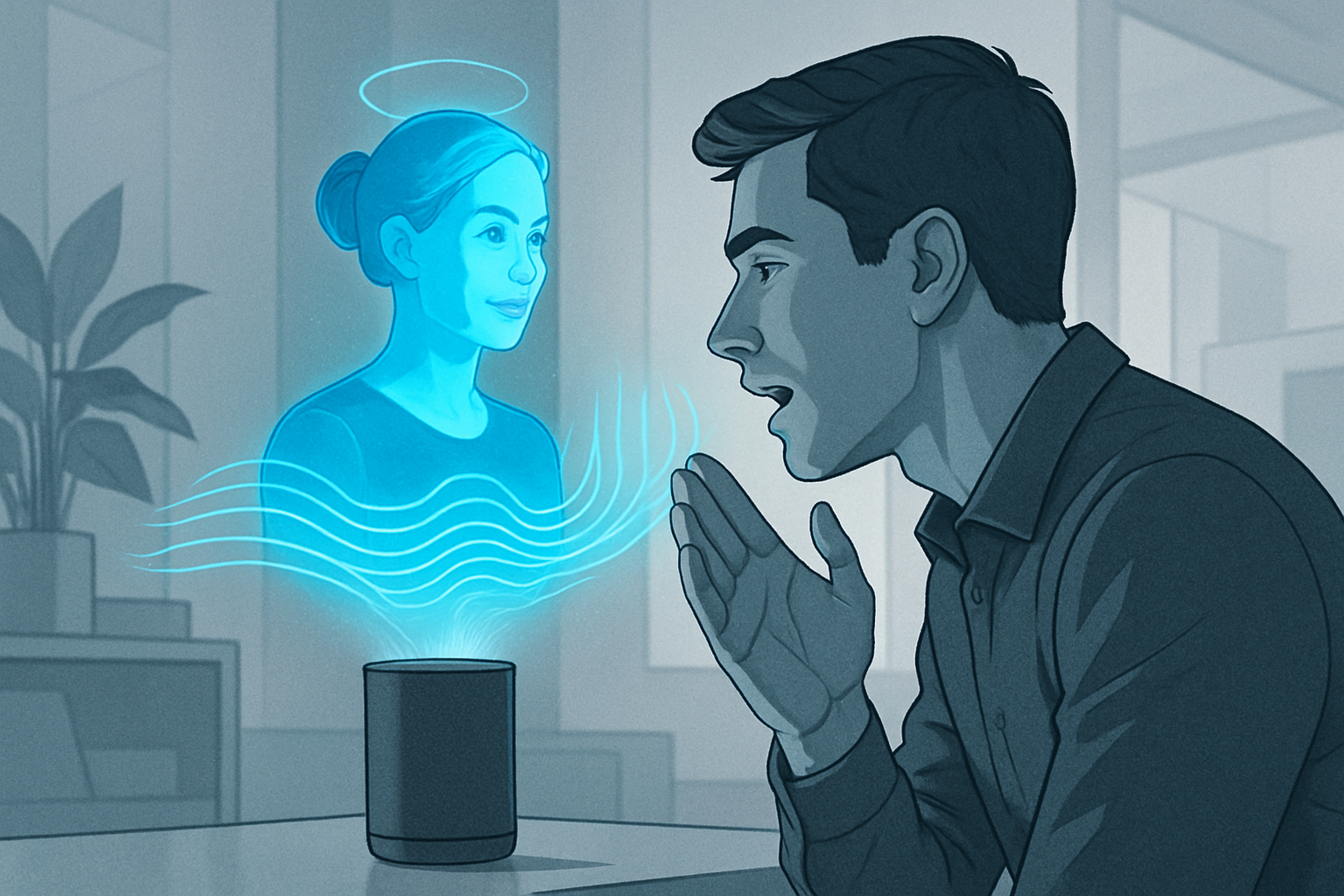
Artificial intelligence, after transforming our interactions with text-based chatbots, is poised to take a new step: that of voice conversation. This evolution could open up unprecedented perspectives, but it remains to be seen in which contexts this new interface could truly add value.
A Voice Technology in Search of Maturity
Although voice technologies are not new, their adoption has long been hampered by technical limitations. Voice assistants, for example, have existed for several years, but their use has remained limited due to an experience often deemed unnatural. "For a long time, machine voices were very robotic, and it was clear that you were talking to a robot," emphasizes Julien Lesaicherre.
The real challenge was not only in the machines' ability to speak but in their capacity to engage in authentic conversation. The first crucial step in this direction was the improvement of automatic speech transcription. Recent advancements have significantly increased the accuracy of speech-to-text conversion systems. "Not long ago, some models had error rates of 8% to 15%. Today, our latest models at ElevenLabs show error rates of 2.3% to 2.5%, which is lower than human capabilities," Lesaicherre points out.
These advancements are accompanied by developments in other technological areas, such as managing interruptions and pauses in conversation. The goal is no longer just to understand words, but to reproduce the subtleties that make a conversation feel more "human": silences, interruptions, a controlled rhythm, and the ability to detect a change of subject.
Voice AI goes even further by integrating the recognition of the interlocutor's emotions. "We will gradually be able to add descriptors around the spoken words. Does the person seem hesitant? Angry? Happy?" explains the expert. Thus, a person interacting with an AI after a bad experience might receive a different response than someone simply seeking information.
Customer Service: A Prime Testing Ground
"This is an interesting context because it involves managing a large number of human interactions, which are relatively structured," justifies Julien Lesaicherre. Requests for order tracking, billing, or product assistance often follow well-defined scenarios. At Klarna, the use of a voice agent developed by ElevenLabs has allowed for resolving certain requests up to ten times faster than before.
In the commercial sector, voice could also transform customer journeys and enhance their experience. Deutsche Telekom, for example, is testing a voice AI integrated into its network to translate conversations in real-time.
Instead of filling out a series of forms, a user could directly converse with a voice agent. Take the example of a call to a home insurance company. "This could be an oral dialogue. Where do you live? How many children do you have? Is this your first home? All of this could be done in a much smoother manner," illustrates our interlocutor. In Ukraine, ElevenLabs is collaborating with the Ministry of Digital Transformation on several projects aimed at making certain public services accessible via conversational agents.
The operational interest is also significant. Where a company must train numerous teleoperators on new procedures, a voice agent can be updated with new instructions or knowledge. Deliveroo uses voice agents from ElevenLabs to communicate at scale with its delivery personnel and restaurant partners across multiple countries and languages.
The Challenge of Hallucinations: Framing AI
As with text-based AIs, the question of reliability remains crucial. A conversational AI used in a professional context must avoid inventing information or deviating from the intended framework. To mitigate these risks, ElevenLabs proposes an approach based on specialized agents. "When we talk about a 'support agent' for a customer, we need to understand that there are several agents, each specialized in a particular area," details Julien Lesaicherre.
One agent can handle refunds, another can manage address changes, and yet another can deal with commercial inquiries. The goal is to reduce errors by limiting the scope of the AIs' actions. "We need extremely precise and restrictive instructions, and to ensure that the agent cannot access data outside its defined perimeter." Numerous technical safeguards are in place to prevent certain manipulations or out-of-scope requests.
Voice AI Will Not Replace Humans
A central question remains: will users accept talking to an AI? For Julien Lesaicherre, the issue is less about the acceptance of technology than the quality of the experience offered. "If the service is not of high quality, we can expect user rejection," he confirms. However, when the alternative is to wait several minutes for a response, perceptions can quickly change: "If tomorrow you have the choice between waiting 15 minutes to speak to a human or speaking immediately to a machine, 95% of users will choose the latter option."
The goal is not to systematically replace humans, Lesaicherre reminds us. The scenario that is emerging is rather one of complementarity: AI handles simple and recurring requests before passing the baton when the situation requires more context or empathy.
For him, companies today have the necessary technological building blocks. The main change must now come from their way of thinking about customer relationships. For years, many have sought to reduce points of contact, particularly because each human interaction represented a cost: limited call centers, online forms, automated journeys.
"The business world has been incentivized, or at least has followed a misguided incentive: to think that ROI is unclear, so we will reduce the scope of possible connections between our customers and ourselves," he analyzes. Voice AI could change this equation by allowing the reintroduction of conversation into journeys that have gradually been deprived of it: support accessible outside of traditional hours, exchanges in more languages, or smoother processes than a succession of pages to fill out...
Brief IA — L'actualité IA en français
L'essentiel de l'actualité de l'intelligence artificielle, décrypté et expliqué chaque jour.