Computer Vision Revolutionizes Productivity in Retail
Le brief IA que les pros lisent chaque soir
Les 7 actus IA du jour, décryptées en 5 min. Gratuit.
Inclus dès l'inscription : notre sélection des meilleurs guides & comparatifs IA.
Choisis ton rythme
Gratuit · Pas de spam · Désabonnement en 1 clic
Computer Vision: An Asset for the Retail Sector
In the retail sector, computer vision is emerging as a crucial lever for improving productivity. Retailers are turning to this technology to automate the monitoring of physical shelves, an essential strategy to protect their declining margins. Indeed, in-store execution errors, which cost the industry billions, are at the heart of this technological transformation.
A study conducted by Coresight Research, in collaboration with technology providers Simbe and RELEX Solutions, has quantified the financial impact of these inefficiencies. The sector is currently losing 6.4% of its gross sales due to these operational gaps. Forecasts indicate that by 2026, losses in the categories of hardware, mass retail, and grocery could reach $196.4 billion, a 21% increase from the previous year. This trend far exceeds the projected sales growth, estimated at only 3%.
The Operational Challenges of Retailers
The majority of retailers, 90%, face difficulties in managing their sales floors. Empty shelves and pricing errors directly affect their operating margins, with erosion exceeding 5% for 89% of companies. To counter these challenges, in-store intelligence platforms are being deployed on a large scale, now covering 60% of enterprise surfaces, an increase of 18 percentage points from the previous year.
Pilot programs, on the other hand, account for only 18% of current activity, with most leading companies having already adopted these technologies. In fact, 73% of retailers generating more than $5 billion in annual revenue have implemented large-scale deployments. However, mid-sized companies, with revenues below $1 billion, struggle to keep up, with only 42% achieving similar maturity.
Case Studies: BJ’s Wholesale Club and Albertsons
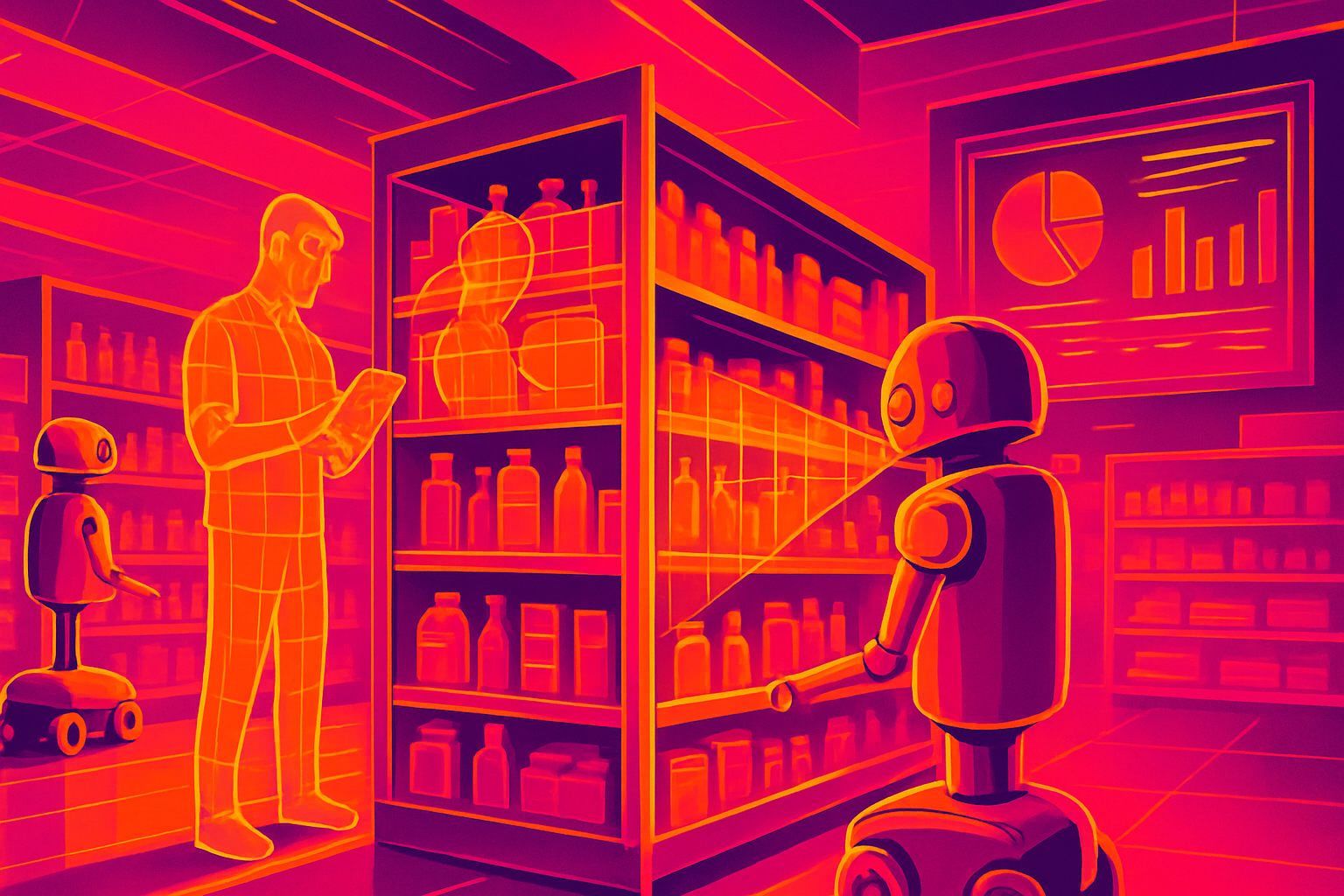
BJ’s Wholesale Club exemplifies the impact of shelf digitization. By deploying Simbe robotic platforms, the company has been able to monitor inventory and pricing accuracy in its stores. This approach has enabled the creation of digital twins for each warehouse club, providing real-time visibility that was previously lacking.
Thanks to these digital models, BJ’s has optimized route planning for online orders and curbside pickup, improving picking efficiency by 40% year-over-year. CEO Bob Eddy emphasized that this technology has raised quality standards in fresh product categories.
Meanwhile, Albertsons is leveraging AI to automate complex retail operations. The goal is to achieve $1.5 billion in productivity gains over three fiscal years. CEO Susan Morris stated that the company equips its merchants with AI-driven insights to optimize pricing, promotions, and assortment decisions, thereby transforming category management and improving margins.
The Challenges of Sequencing Deployments
Despite advancements, many organizations make the mistake of prioritizing pricing software at the expense of essential sensor infrastructure. According to a survey, 43% of technology leaders primarily invest in pricing optimization software. Supplier collaboration platforms follow, attracting 36% of investments, while only 33% of organizations invest in shelf-scanning hardware.
This hardware, including sensors and cameras, is crucial for verifying the physical availability of stock. A rigorous sequencing is necessary for in-store intelligence deployments to function correctly. Retailers must first digitize the shelves, then deploy data analytics, install inventory tracking software, and finally automate pricing.
The absence of this sequence creates data failures. For example, price reduction algorithms may process outdated inventory counts if physical tracking sensors are absent, leading to mispricing rates expected to reach 13% by 2026, an increase of four points since 2024.
Workforce Reallocation and Efficiency Gains
Lowe’s illustrates the financial impact of workflow automation with its "Perpetual Productivity Improvement" initiative. Under the leadership of Joseph McFarland, Executive VP of Stores, the company has deployed workforce management tools and inventory solutions to eliminate redundant tasks. The result: an 80-hour reduction in unproductive work per store each week.
Lowe’s has also introduced AI-powered shelf replenishment technologies to track stock depletion in real-time. Productivity gains have been rewarded with financial bonuses, including $5,000 paid to store managers and varied payments to hourly staff.
Industry data confirms these results, showing an average 14% reduction in time spent on manual in-store tasks due to artificial intelligence. Approximately 86% of organizations report significant decreases in manual assignment hours.
Maintaining Competitiveness Through Technological Innovation
In-store intelligence technologies do not operate in isolation but as an interconnected ecosystem. To maximize their effectiveness, retailers must establish real-time visibility at the shelf level before deploying downstream software. Price automation, supplier collaboration platforms, and stock forecasting applications require verified physical data to be accurate.
Correct operational improvements directly influence customer behavior. Appropriate deployments increase customer lifetime value by 11% across the sector, and conversion rates improve for 50% of operators using physical automation frameworks.
Nearly 48% of companies have seen an increase in sign-ups for their loyalty programs after integrating these systems. Accurate pricing and consistent stock availability also enhance online ratings for 47% of operators.
Retailers that effectively integrate hardware and software capabilities possess a distinct competitive advantage over those that accumulate disconnected applications.
Brief IA — L'actualité IA en français
L'essentiel de l'actualité de l'intelligence artificielle, décrypté et expliqué chaque jour.