OpenAI: Mathematics, the Key to AGI According to Its Researchers
Le brief IA que les pros lisent chaque soir
Les 7 actus IA du jour, décryptées en 5 min. Gratuit.
Inclus dès l'inscription : notre sélection des meilleurs guides & comparatifs IA.
Choisis ton rythme
Gratuit · Pas de spam · Désabonnement en 1 clic
The Importance of Mathematics for AGI According to OpenAI
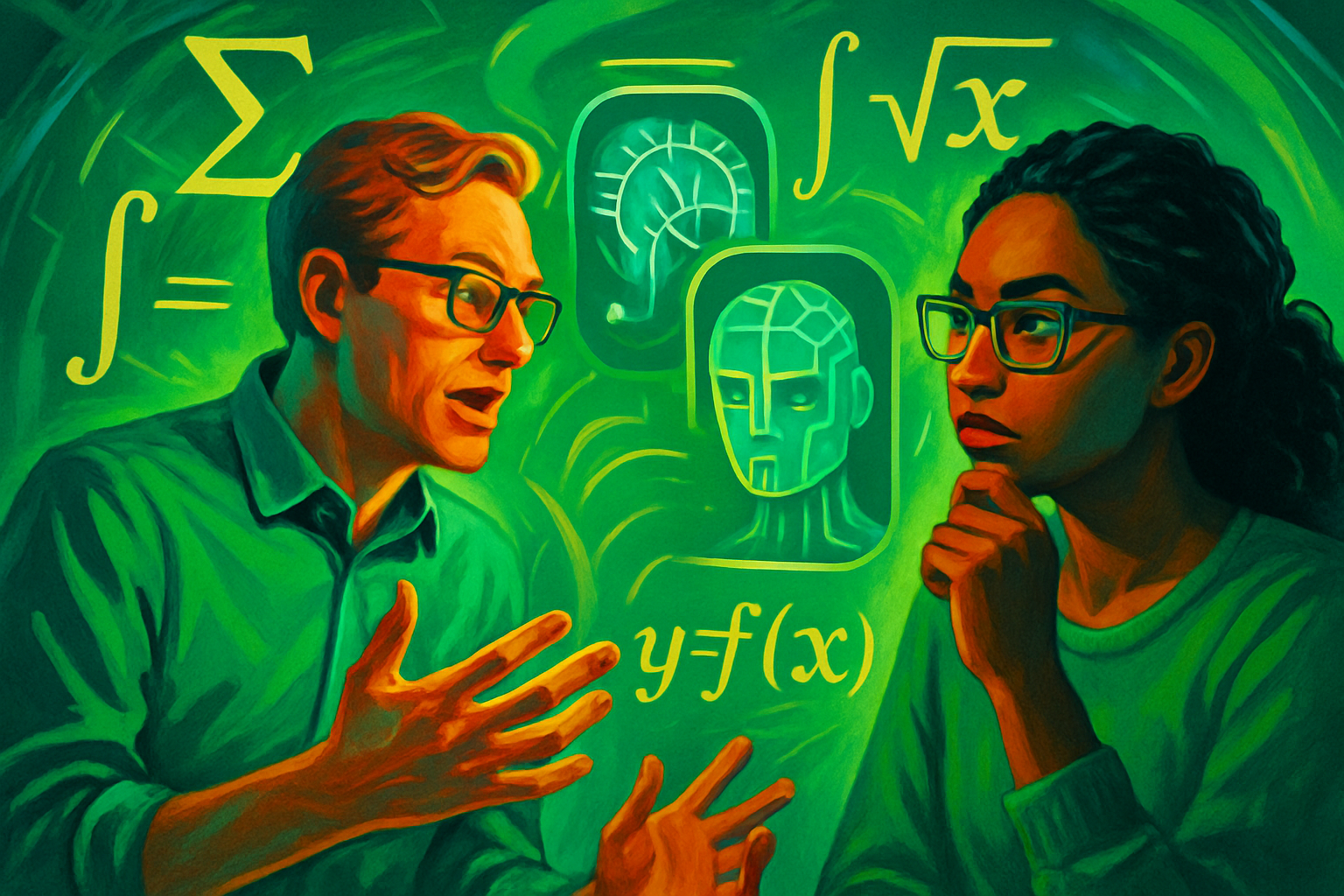
Artificial intelligence models have seen a spectacular advancement, evolving from simple arithmetic calculations to Olympic-level mathematics in just two years. In an OpenAI podcast, researchers Sebastian Bubeck and Ernest Ryu discussed how mathematics has become a crucial benchmark on the road to artificial general intelligence (AGI).
Four years ago, Bubeck was impressed by Google's Minerva model, which could draw a line through points on a coordinate system. Today, he claims that these systems even assist Fields Medal winners in their daily work. At a conference 18 months ago, 80% of the mathematicians present believed it was impossible for large language models to solve research problems.
Reasoning models did not exist two years ago, highlighting the extent of the progress made. OpenAI's training methods are not specific to mathematics but are general, meaning that advancements in other sciences should follow. Researchers are building an "automated researcher" capable of working on problems autonomously over long periods.
A Mathematical Feat with ChatGPT
Ernest Ryu, a former mathematics professor at UCLA, used ChatGPT to solve a 42-year-old open problem in optimization theory concerning Nesterov's method. In just twelve hours spread over three evenings, he succeeded where he had failed after more than 40 hours of work without the help of AI. Ryu acted as a verifier, correcting errors and guiding the AI toward promising solutions.
Mathematics as a Benchmark for AGI
For Bubeck, mathematics has become a benchmark for AGI because it requires long and coherent reasoning. A single mistake can invalidate an entire proof, forcing systems to identify and correct their own errors. This rigor is transferable to other scientific fields, from biology to materials science.
Mathematics also offers practical advantages: problems are clearly stated, answers are verifiable, and results are indisputable. Bubeck speaks of "AGI time," where models can simulate human thought over extended periods. The next goal is to extend this capability to weeks or even months.
The Challenges of Erdős Problems
Bubeck and Ryu have also looked into the Erdős problems, a collection of open questions left by the Hungarian mathematician. Bubeck initially tweeted that internal models had found solutions to ten problems marked as open, which sparked a public dispute with Google's CEO, Demis Hassabis. Many interpreted this as a claim that OpenAI had produced new proofs. Bubeck now clarifies that ChatGPT and the internal models have actually produced more than ten new publishable solutions.
What once seemed like an unrealistic claim is now a reality, and the pace is accelerating. Bubeck sees this as evidence that models are making the leap from recombining existing knowledge to producing new mathematics.
The Risks of Superficial AI Use
Researchers warn against a superficial use of these tools. Human expertise is more important than ever, as only trained mathematicians can use the models productively. Non-mathematicians who publish lengthy AI-generated proofs on social media are often mistaken. Ryu observes the same pattern in programming, where an entire generation is losing the ability to use debuggers.
Bubeck asserts that claims suggesting scientists are no longer needed are dangerous. Academic institutions must actively reclaim their role. At the same time, AI can accelerate the verification of proofs—a process that currently takes years—and flag issues in published papers.
Brief IA — L'actualité IA en français
L'essentiel de l'actualité de l'intelligence artificielle, décrypté et expliqué chaque jour.