Small AI Models Dethrone Giants: A Revolution in 2026
Le brief IA que les pros lisent chaque soir
Les 7 actus IA du jour, décryptées en 5 min. Gratuit.
Inclus dès l'inscription : notre sélection des meilleurs guides & comparatifs IA.
Choisis ton rythme
Gratuit · Pas de spam · Désabonnement en 1 clic
A Transition to Smaller, More Efficient Models
The artificial intelligence industry, long dominated by a frantic race towards ever-larger models, is undergoing a transformation. In 2026, a new trend is emerging: small AI models are gaining efficiency, prompting companies to rethink their strategies. This evolution marks a significant turning point, as businesses begin to favor smarter architectures rather than relying on massive frontier models.
Until recently, the prevailing idea was that the larger a model, the better its performance. This belief led to massive investments, as evidenced by Jensen Huang's announcement at GTC 2026, where he revealed colossal orders for models like Blackwell and Vera Rubin. However, three major factors are challenging this approach: advancements by researchers, innovations from publishers, and new market dynamics.
Notably, the recent suspension of frontier models such as Mythos and Fable, deemed too powerful or dangerous, has highlighted the risks associated with these AI giants. This decision underscores the need to reassess reliance on these large-scale models.
Researchers Challenge the Paradigm
At the ACM FAccT 2025 conference in Athens, renowned researchers such as Gaël Varoquaux, Sasha Luccioni, and Meredith Whittaker presented a revealing study. Their work demonstrates that computing costs are rising faster than the performance gains achieved by large models. Furthermore, for the majority of tasks, a frontier model is not necessary.
Their study also highlights the negative consequences of this obsession with size: an increasing environmental impact, excessive concentration of computing resources, and the marginalization of more modest yet potentially more effective approaches. Gaël Varoquaux, along with Lihu Chen, also explored the role of small models in the era of large language models, emphasizing that the "bigger-is-better" paradigm is more of an economic bias than an absolute truth. Their publication, titled "What is the Role of Small Models in the LLM Era," maps out configurations where small models match or surpass large ones.
Small Models Compete with Large Ones
On the publisher side, notable progress has been made. In October 2025, Claude Haiku 4.5 achieved an impressive score of 73.3% on SWE-bench Verified, competing with the frontier models of the previous generation, but at a much more advantageous cost and speed. In Europe, Mistral launched the Mistral Small 4 on March 16, 2026, a Mixture-of-Experts model with 119 billion parameters, but only 6 are activated per token, significantly reducing inference costs.
Alibaba, for its part, released the Qwen3.5 series, which, with only 9 billion parameters, outperforms much larger models on key benchmarks. These advancements illustrate a continuous narrowing of the gap between small models and frontier models, demonstrating that small models can cover 80 to 90% of companies' AI needs at significantly lower costs.
The Hardware Market Adapts
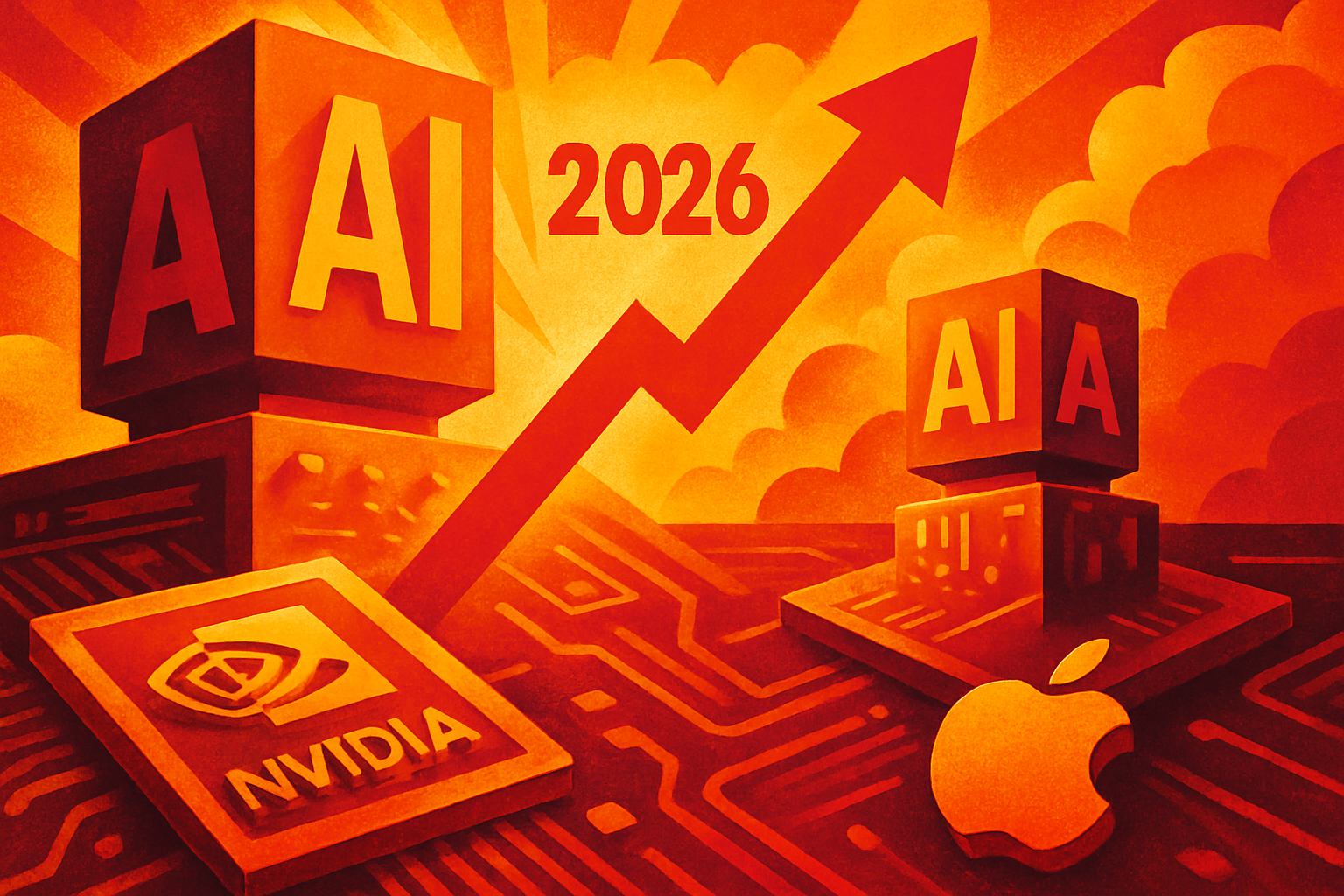
Nvidia signed a $20 billion deal with Groq to acquire strategic assets and unveiled a new chip, the Groq 3 LPX, dedicated to agent inference at GTC 2026. This chip significantly reduces the cost per token and introduces a new metric, "tokens per watt," reflecting a more nuanced and diverse approach to the market.
Apple, on the other hand, has chosen a different strategy by betting on a model with 3 billion parameters, optimized to run directly on its devices. This approach allows for local inference, ensuring enhanced privacy and reduced computing costs. By combining these strategies, companies are redefining what it means to be the "best model" in 2026.
Orchestrating Models: The Future of AI
In 2026, the question is no longer about choosing the best model, but about orchestrating the most suitable models for specific needs. This approach is based on three key principles: multi-model routing, total cost evaluation per use case, and the adoption of edge and privacy-by-design solutions.
Multi-model routing allows for optimizing inference costs by sending simple requests to local models, complex requests to cloud models, and requests requiring regulation to sovereign models. This strategy can reduce costs by 50 to 80% without compromising user experience quality.
Evaluating the total cost per use case, rather than relying solely on benchmark scores, allows for selecting the most appropriate model based on economic, latency, and compliance criteria. Finally, bringing the model closer to the data through edge solutions simultaneously addresses issues of cost, latency, sovereignty, and privacy.
In conclusion, the value in 2026 no longer lies in the model itself, but in the ability to orchestrate different models according to needs. This flexible and adaptive approach enables companies to maximize their added value while minimizing their dependence on costly and often oversized frontier models. Publishers who adopt this strategy gain their clients' trust, while those who refuse risk selling a costly and uncontrolled dependency.
Brief IA — L'actualité IA en français
L'essentiel de l'actualité de l'intelligence artificielle, décrypté et expliqué chaque jour.