Meta Challenges OpenAI with Discounted Muse Spark 1.1 API
Le brief IA que les pros lisent chaque soir
Les 7 actus IA du jour, décryptées en 5 min. Gratuit.
Inclus dès l'inscription : notre sélection des meilleurs guides & comparatifs IA.
Choisis ton rythme
Gratuit · Pas de spam · Désabonnement en 1 clic
Meta Challenges OpenAI with the Cut-Price Muse Spark 1.1 API
Meta has launched Muse Spark 1.1, a multimodal reasoning model designed for agent-based tasks, programming, and computer usage, capable of orchestrating multi-agent systems and managing a context window of one million tokens.
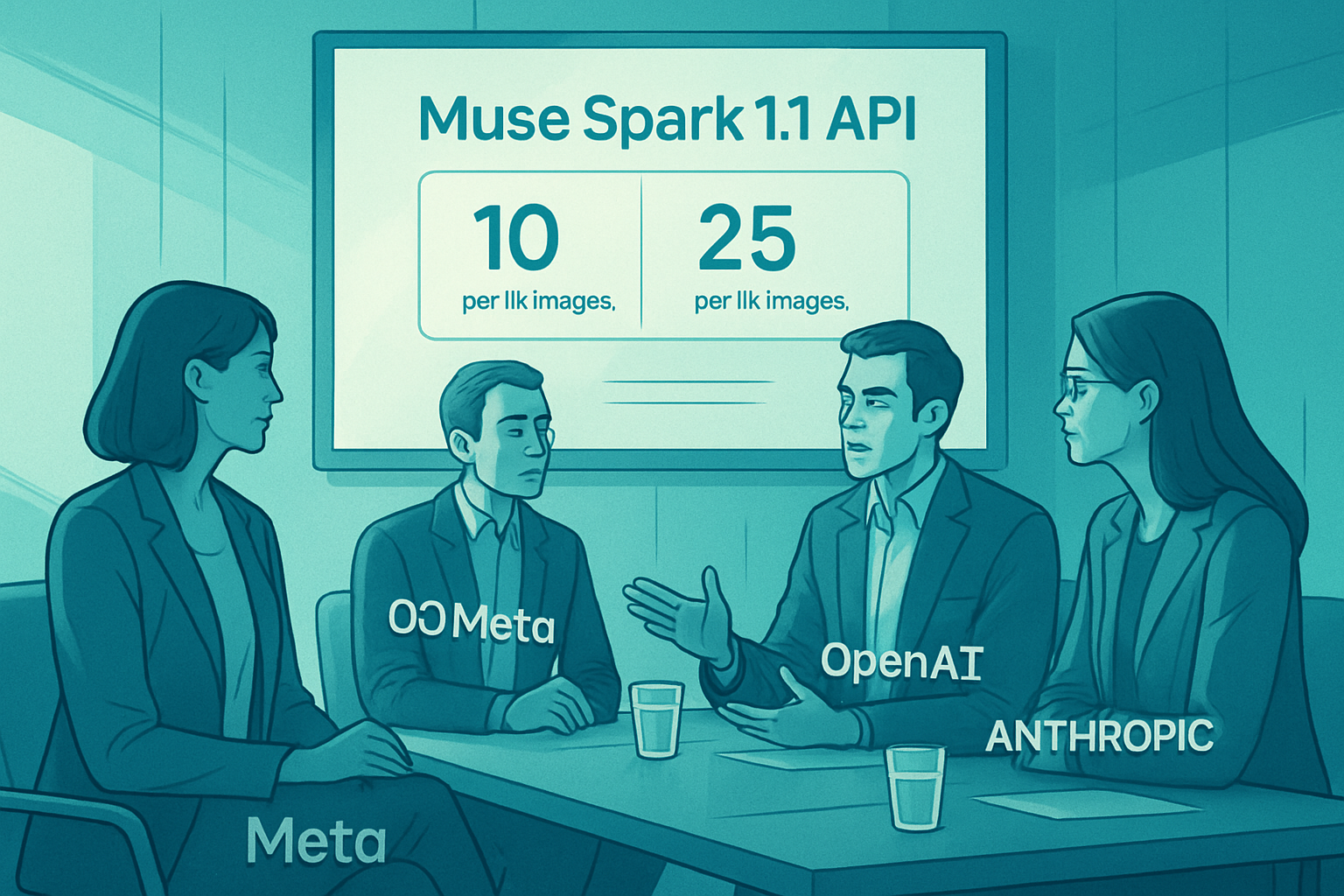
The developer API is priced at $4.25 per million output tokens, positioning it well below established competitors like OpenAI and Anthropic, and also lower than the brand-new and already very affordable xAI Grok 4.5.
This aggressive pricing strategy could put serious pressure on specialized AI labs like OpenAI and Anthropic, which rely on high margins but now find themselves squeezed between well-funded tech conglomerates on one side and low-cost Chinese models on the other.
A Multimodal Model for Complex Tasks
Meta has presented Muse Spark 1.1 as a "significant upgrade" over the original Muse Spark, launched in early April 2026. The model is available in "Thinking" mode within the Meta AI app and on meta.ai. Like its predecessor, Muse Spark 1.1 is offered without open weights, suggesting that Meta has abandoned the open-source Llama strategy that once earned it acclaim in the AI community.
At the same time, Meta is launching a public preview of the new Meta Model API, providing developers with direct access for the first time. This move places Meta in a market previously dominated by OpenAI, Anthropic, Google, and several Chinese providers. The new image model, Muse Image, is not yet available via the API.
Multi-Agent Orchestration to Accelerate Complex Projects
Meta claims that Muse Spark 1.1 is trained to orchestrate multi-agent systems. As the main agent, the model gathers context, develops a plan, and delegates execution to parallel sub-agents. As a sub-agent, it stays focused on the task and knows when to escalate information. The model generalizes to new native tools, MCP servers, and custom skills without specific training. It actively manages its one million token context window, remembering actions, retrieving, and compressing information from previous work without losing critical steps, according to Meta.
Muse Spark 1.1 dominates the MCP Atlas benchmark (88.1) and Humanity's Last Exam (62.1), outperforming Opus 4.8, GPT 5.5, and Gemini 3.1 Pro. On SWE-Bench Pro, whose validity is contested by OpenAI, Opus 4.8 leads with 69.2, followed by Muse Spark 1.1 at 61.5.
Performance Improvements in Programming
Meta indicates that coding performance has also significantly improved on real-world tasks involving large codebases. The model can now diagnose complex bugs, add new features to enterprise systems, and manage large-scale code migrations.
A comparison of Muse Spark 1.1's benchmarks with its predecessor, Google's Gemini 3.1 Pro, Anthropic's Claude Opus 4.8, and OpenAI's GPT 5.5 shows that Muse Spark 1.1 leads in four of the twelve tests (MCP Atlas, JobBench, Humanity's Last Exam, Finance Agent v2), while Opus 4.8 leads in five and GPT 5.5 in three.
Advantages in Multimodality and Safety
In the independent benchmark VALS-AI, Muse Spark 1.1 ranks fourth overall while being particularly fast and cost-effective. In the coding benchmark Vibe Code Bench, it climbed 36 places compared to its predecessor.
Meta also highlights its multimodal strengths in perception, reasoning, and tool usage. The model can interact with real-world environments and produce results based on actual observations, particularly in computer usage workflows spanning multiple applications. Instead of clicking through each desktop step individually, the model decides when automation is relevant. It writes scripts when faster, clicks when direct interaction is easier, and generates batches of actions step by step.
Meta claims to have conducted thorough safety assessments in accordance with the Advanced AI Scaling Framework before deployment. In all leading risk categories, including chemical and biological risks, cybersecurity, and loss of control, Muse Spark 1.1 operates within safe parameters.
Increased Pressure on Specialized AI Labs
Muse Spark 1.1 alone might not generate much interest. However, the Meta Model API and its pricing will certainly attract attention, particularly at the headquarters of OpenAI and Anthropic. Meta charges $1.25 per million input tokens, $4.25 per million output tokens, and $0.15 for cached inputs. Web search costs $2.50 for 1,000 queries. Although there is not yet a search feature on Instagram or Facebook, Meta could add one in the future as a differentiating factor, similar to what Grok does on X.
These prices are even lower than those of xAI Grok 4.5, which was launched yesterday and held the title of the lowest-priced model for a few hours. Models like Opus 4.8, GPT-5.5, and Fable 5 charge between $25 and $50 per million output tokens, several times Meta's $4.25 rate. Chinese models like GLM 5.2 are also much cheaper, but Meta's API sets a new price floor among major American providers.
An Accelerating Price War
The price war could hit OpenAI and Anthropic harder. Both are burning billions and depend on high margins on tokens and rapid growth to cover losses and justify their valuations. Meta, a company with over $60 billion in annual profits, is now offering a competitive model at a fraction of those prices. Both Meta and Google can operate their APIs as gateways to their ecosystems without needing to achieve immediate profitability.
Chinese open-source models are also putting pressure on prices from the other direction. Snowflake has shown that GLM 5.2 costs a fraction of what Opus 4.8 charges while delivering comparable coding performance. Companies like Coinbase and Lindy have significantly reduced their AI spending by switching to Chinese models.
Thus, leading AI labs find themselves squeezed from both sides: Google and Meta exert pressure with corporate resources, while Chinese open-source models drive prices down with very low rates.
Meta's ability to maintain this price advantage also depends on token efficiency. The number of tokens a model consumes per task can significantly vary actual costs, as recently demonstrated by Databricks in its own benchmark. And the performance promised by Meta's benchmarks still needs to be validated in production. If not, even the lowest prices represent a waste of money.
Brief IA — L'actualité IA en français
L'essentiel de l'actualité de l'intelligence artificielle, décrypté et expliqué chaque jour.