Microsoft Reveals the Lack of Humanity in Current AIs
Le brief IA que les pros lisent chaque soir
Les 7 actus IA du jour, décryptées en 5 min. Gratuit.
Inclus dès l'inscription : notre sélection des meilleurs guides & comparatifs IA.
Choisis ton rythme
Gratuit · Pas de spam · Désabonnement en 1 clic
Microsoft Reveals the Lack of Humanity in Current AIs
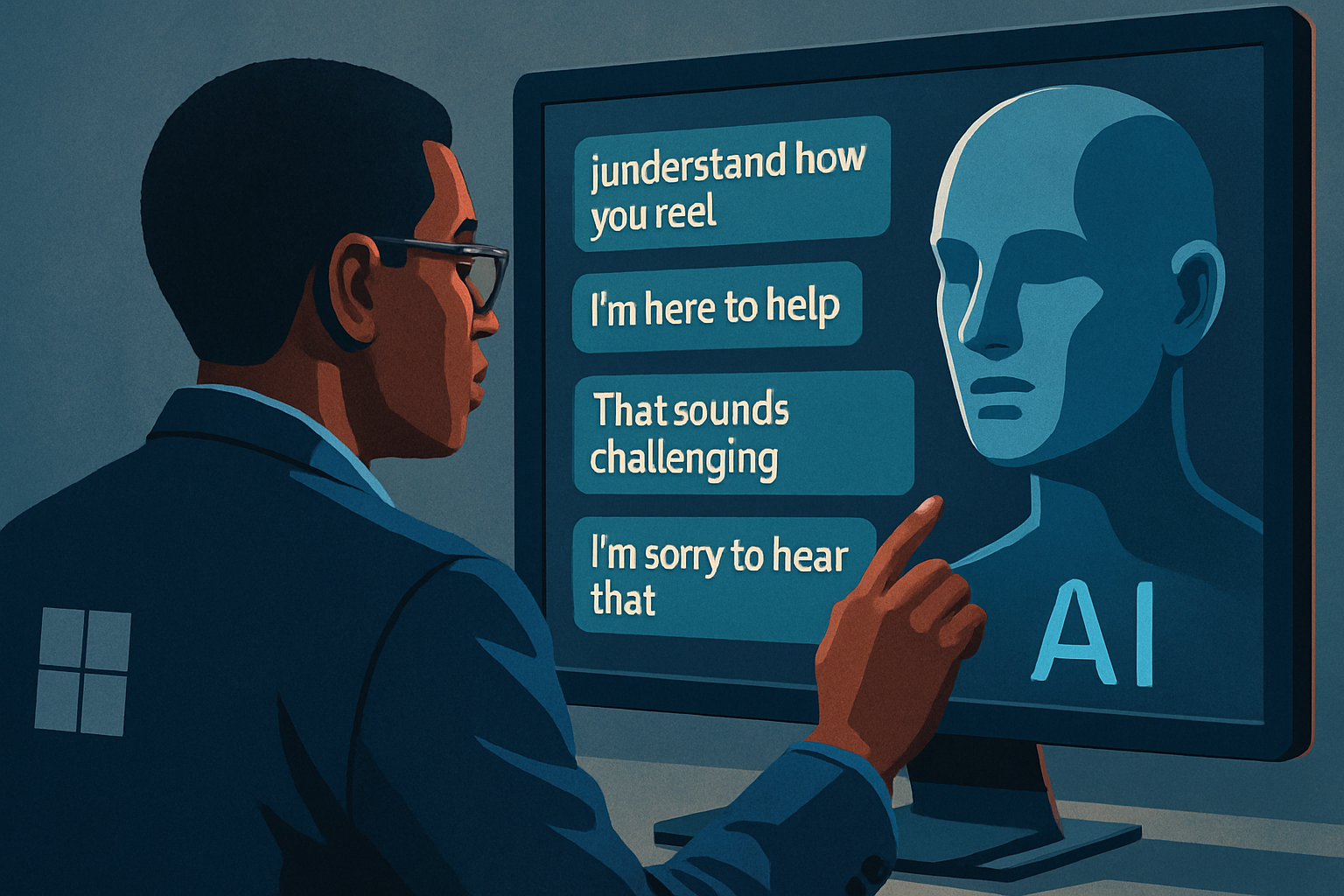
Making friends with an AI doesn’t work. Although these systems can use expressions like "I understand your concern" or "I am wholeheartedly with you," they actually understand nothing. They are designed to provide responses to humans, but current language models have absolutely no human characteristics. A researcher from Microsoft aims to prove that AIs are not our friends.
To demonstrate that large language models lack human attributes, a Microsoft researcher replicated the basic functions of a neural network in the famous strategy game, using virtual goats as a medium.
Adrian de Wynter is an artificial intelligence researcher at Microsoft and the University of York. He is also a long-time gamer, having played Age of Empires II since 1999. In a recently published study, he combined these two worlds to challenge a widespread idea in AI research: that large language models (LLMs) exhibit human characteristics.
Goats Instead of Neurons
The title of his study, "If LLMs Have Human Attributes, Then Age of Empires II Does Too," summarizes its purpose. To build his argument, de Wynter used the scenario editor built into the game. In his reconstruction:
- Grass tiles represent the value 0,
- Bridges represent 1,
- Virtual goats act as bits, transporting signals between these two states.
The result is a functional neural network, however rudimentary, entirely constructed within a real-time strategy game released in the 1990s. The technical details of how it works are available on the study's GitHub page.
LLMs Do Not Possess Human Qualities
Adrian de Wynter is not trying to settle the question of whether LLMs possess human qualities. His goal is different: to show that the reasoning leading to this conclusion is based on fragile foundations.
According to him, several researchers working on LLMs and so-called "agentic" systems attribute forms of moral reasoning to these technologies, even a conscious understanding of natural language. However, if the basic functions necessary for models like ChatGPT to perform semantic tasks can be replicated in Age of Empires II, these supposed human characteristics are not unique to LLMs.
The choice of Microsoft’s game is not incidental. It is intended as a demonstration by absurdity. If a strategy game from the 1990s can replicate the same basic mechanisms, it becomes difficult to continue seeing neural networks as something human.
Brief IA — L'actualité IA en français
L'essentiel de l'actualité de l'intelligence artificielle, décrypté et expliqué chaque jour.