Mistral and AMI Labs: France Challenges OpenAI and Google in 2026
Le brief IA que les pros lisent chaque soir
Les 7 actus IA du jour, décryptées en 5 min. Gratuit.
Inclus dès l'inscription : notre sélection des meilleurs guides & comparatifs IA.
Choisis ton rythme
Gratuit · Pas de spam · Désabonnement en 1 clic
Mistral, AMI Labs, and the State: France Takes Control of AI
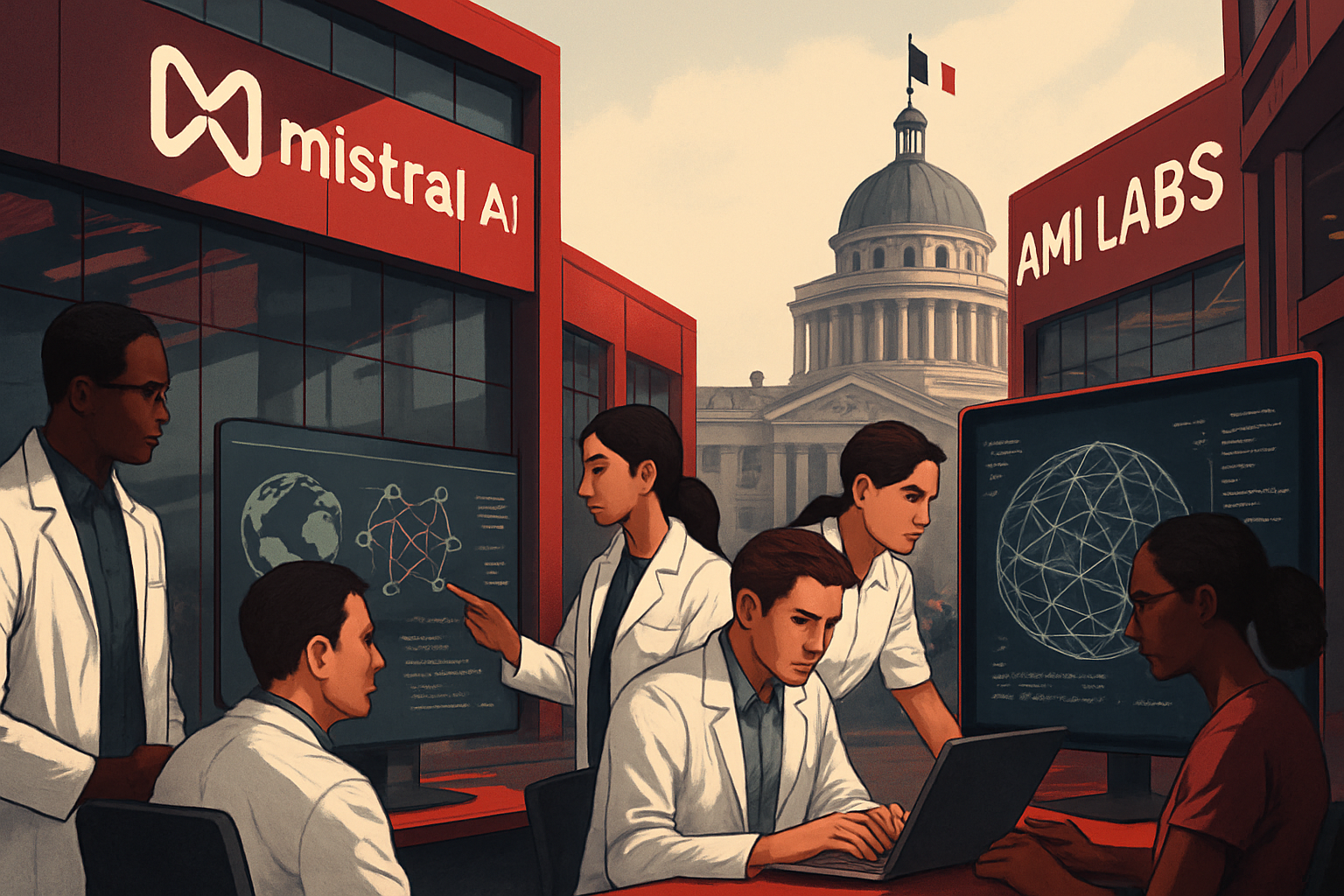
In just three years, France has achieved a feat that many considered out of reach: it has created technological leaders in the field of artificial intelligence capable of competing with giants like OpenAI and Google. Mistral AI, now valued at €11.7 billion, has established itself as the undisputed European leader in the sector. Meanwhile, AMI Labs has managed to raise $1.03 billion even before launching a product on the market, illustrating the growing interest of investors in breakthrough innovations. The French government has also taken decisive steps by integrating Mistral into the work systems of one million civil servants, marking a significant turning point in its digital strategy.
A Technologically Awakening Europe
Ten years ago, Europe seemed doomed to remain a spectator of the digital revolution orchestrated from California. Cloud giants and AI pioneers were almost exclusively American, relegating Europe to the role of mere observer. However, this scenario, long perceived as inevitable, has been disrupted by France's determination to regain control. In three years, Mistral AI has become the first French "decacorn" in the field of generative AI, competing with models like GPT-4, Claude, or Gemini. The startup has introduced a new logic based on auditable open-source models and strict compliance with GDPR. Additionally, Yann LeCun, after leaving Meta, founded AMI Labs in Paris, convinced that the future of AI lies in "world models," systems capable of understanding the physical world far beyond the textual capabilities of current language models.
The French state, long on the sidelines, has also changed course. By integrating Mistral into public procurement criteria and signing strategic agreements with the Ministry of the Armed Forces, France clearly displays its ambition to refuse technological dependence. This is not about digital nationalism, but rather a demand for strategic autonomy. At a time when 86% of French companies still entrust their sensitive data to American AIs subject to the Cloud Act, this sovereignty becomes an imperative for economic and security survival for 2026 and 2027.
Mistral: From Idea to Industrial Reality
Founded in April 2023, Mistral AI has positioned itself as a credible and sovereign alternative. Its strategy is based on open-weight models, a strong focus on B2B, and guaranteed European infrastructure. After raising €1.7 billion led by ASML in September 2025, the company has forged strategic partnerships with major players like Airbus, EDF, BMW, and SAP. Although Mistral is not a miracle solution, particularly due to its current dependence on NVIDIA GPUs and cloud infrastructures, it remains the option most aligned with the requirements of European sovereignty. For decision-makers, especially for AI CMOs, Mistral represents a clear choice: a high-performing, audited AI that complies with European standards.
AMI Labs and the Innovation of "World Models"
The project led by Yann LeCun with AMI Labs represents a major scientific gamble. By raising over a billion dollars, the company is equipping itself to transform fundamental research into technology capable of reasoning through physical understanding, opening up prospects in industrial robotics, autonomous driving, and medical diagnostics. Although this technology is not yet ready for immediate production, it is a priority for organizations anticipating the standards of 2028-2030.
Strategy for Sustainable Adoption
However, the success of these French champions should not overshadow structural risks: dependence on American components, vulnerabilities related to the Cloud Act, and new constraints from the European AI Act. For organizations, the solution does not lie in an illusory quest for total sovereignty, but in a strategy of hybridization. It is crucial to map uses according to their criticality:
- Use Mistral Enterprise or on-premise deployments for sensitive data
- Reserve generic solutions for non-critical uses
This approach, which is less costly and more flexible, allows for compliance with regulatory requirements while maintaining operational efficiency. In 2026-2027, the question for a decision-maker will no longer be whether to choose an American or French provider, but how to ensure data governance capable of withstanding geopolitical turbulence. Those who have built this architecture now will be the only ones able to navigate the complex ecosystem that is emerging on the horizon of 2028.
Brief IA — L'actualité IA en français
L'essentiel de l'actualité de l'intelligence artificielle, décrypté et expliqué chaque jour.