Moonshot AI and Kimi: Chinese AI Raises Concerns on Wall Street
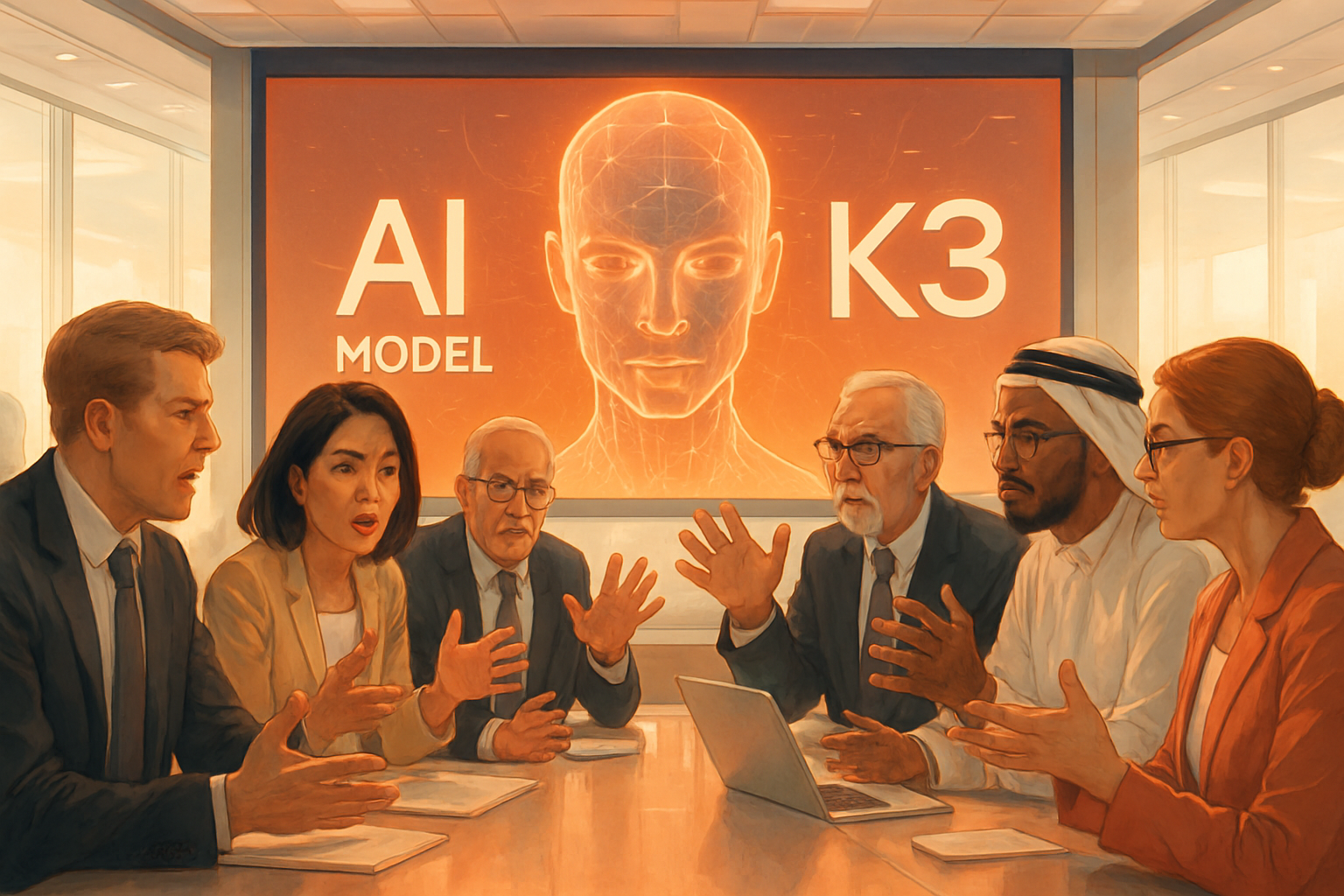
Moonshot AI and Kimi: A Controversial Model
The Chinese company Moonshot AI recently unveiled a new version of its artificial intelligence model, named Kimi K3. This announcement has reignited discussions about China's position in the open-source AI domain. While Moonshot AI acknowledges that Kimi K3 has not yet reached the level of the most advanced proprietary models, such as Claude Fable 5 and GPT 5.6 Sol, the company claims that its model has demonstrated remarkable performance during evaluation tests. These results have been corroborated by independent analyses conducted by Arena.ai and Vals AI, which concluded that Kimi stands as a serious competitor against leading models.
Economic and Political Implications
Moonshot AI's announcement coincided with a speech by Chinese President Xi Jinping at the World AI Conference in Shanghai, which had notable repercussions on financial markets. The Nasdaq recorded a decline of about 1% on Friday, as investors decided to sell their shares in semiconductor companies like Nvidia. This reaction reflects growing concerns about China's technological advancements in the field of AI.
A Context of International Tensions
Current discussions around Kimi echo those that followed the release of the open-source model R1 by DeepSeek, another Chinese company, in January 2025. However, the context today is more tense due to trade conflicts between the United States and China, exacerbated by the tariff policies of the Trump administration. Additionally, concerns regarding national security, particularly concerning Anthropic, add a layer of complexity to the situation as major AI companies prepare to go public.
Le brief IA que les pros lisent chaque soir
Les 7 actus IA du jour, décryptées en 5 min. Gratuit.
Inclus dès l'inscription : notre sélection des meilleurs guides & comparatifs IA.
Choisissez votre rythme
Gratuit · Pas de spam · Désabonnement en 1 clic
Criticism and American Concerns
David Sacks, former head of AI under the Trump administration and current co-chair of the President’s Council of Advisors on Science and Technology, expressed his concerns about the progress made by Kimi. He criticized the American management of AI, emphasizing that restrictions on data centers and new regulations could cause the U.S. to lose its lead in the AI race. Sacks also took the opportunity to criticize Anthropic, labeling its Claude model as "woke lobotomized."
The Issue of Distillation
Travis Kalanick, former CEO of Uber, raised concerns about the practice of distillation, where Chinese AI models are trained on the outputs of American models. He suggested that if this practice is not regulated, it could disadvantage American models. However, he acknowledged that American models have also benefited from Chinese innovations, including those from Kimi.
Future Perspectives and Challenges
Dean Ball, head of strategic futures at OpenAI, recognized the quality of the Kimi model, stating that its performance cannot simply be attributed to distillation. He expressed surprise that China still allows the open sourcing of such advanced models, given the potential risks. Ball mentioned the possibility of a future where AI is considered a public good, managed by the state, a perspective he views as dystopian.
Regulation and Security
Ball suggested that the Trump administration might be inclined to create regulatory risks around the use of Chinese open-source models. He proposed that laws be enacted to instill fear, uncertainty, and doubt (FUD) regarding these models, without necessarily banning open source. The idea would be to create enough risks to deter regulated companies from using them.
An Overstated Debate?
However, Shakeel Hashim, editor-in-chief of the publication Transformer, downplayed these concerns, stating that Kimi likely does not possess dangerous cyber capabilities. He added that the Chinese government might be compelled to restrict its own open-source models if they developed such capabilities, due to incentives similar to those of other governments.
Brief IA — L'actualité IA en français
L'essentiel de l'actualité de l'intelligence artificielle, décrypté et expliqué chaque jour.