NVIDIA unveils an AI deepfake detector with 92% accuracy
Le brief IA que les pros lisent chaque soir
Les 7 actus IA du jour, décryptées en 5 min. Gratuit.
Inclus dès l'inscription : notre sélection des meilleurs guides & comparatifs IA.
Choisis ton rythme
Gratuit · Pas de spam · Désabonnement en 1 clic
NVIDIA Unveils AI Deepfake Detector with 92% Accuracy
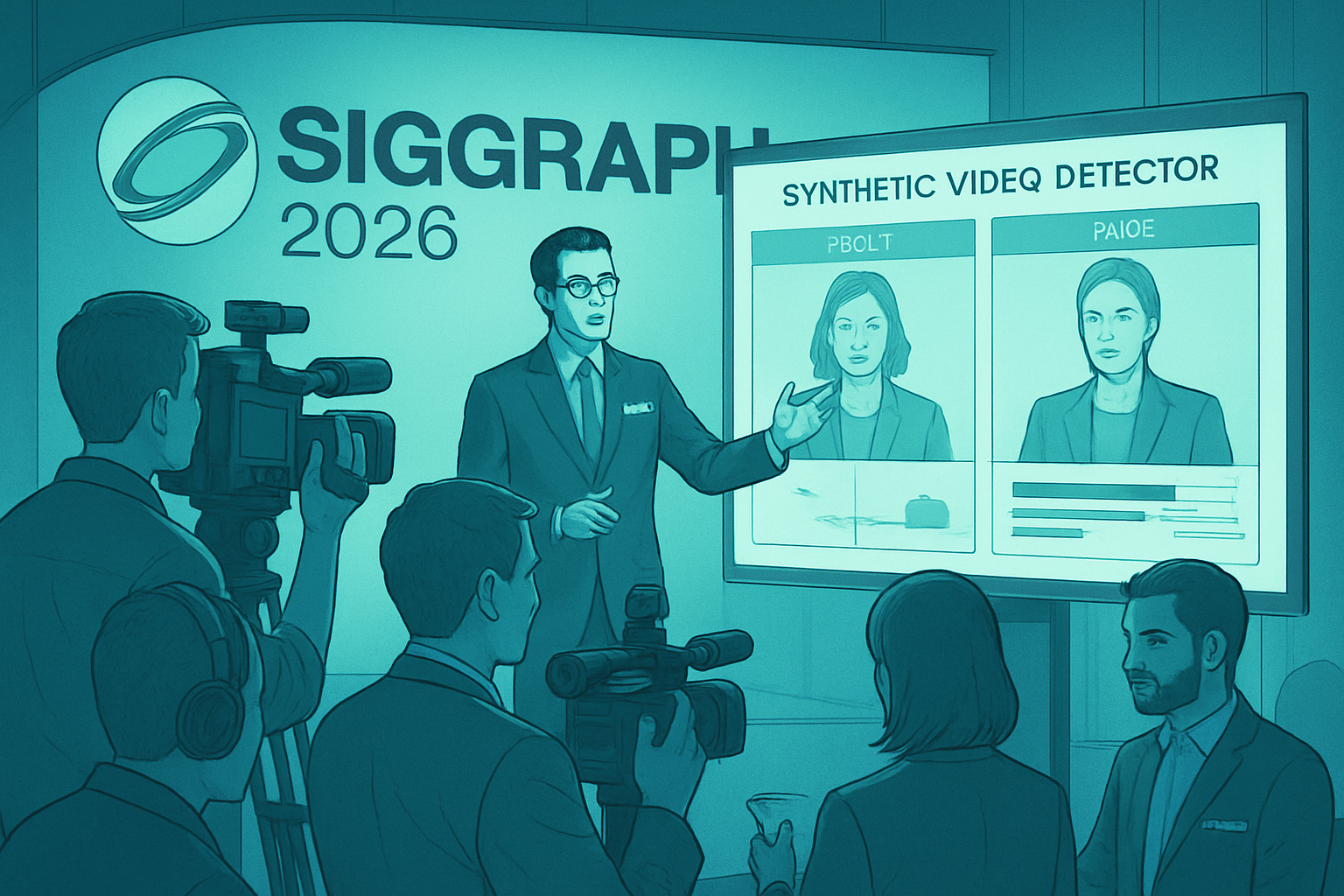
NVIDIA showcased its Synthetic Video Detector at SIGGRAPH 2026, a microservice capable of identifying AI-generated videos with up to 92% accuracy in just 22 milliseconds. The tool is aimed at newsrooms and broadcasters, not the general public.
Detecting a deepfake before it spreads: this is the challenge NVIDIA is tackling head-on with its Synthetic Video Detector (SVD), unveiled at SIGGRAPH 2026. The tool analyzes videos frame by frame, assigning each a probability score between 0 and 1, and then calculates an average to determine the authenticity of the sequence. According to Tom's Hardware, the model relies on Meta's Vision Transformers DINOv2 and DINOv3, which can detect intrinsic artifacts that the human eye cannot perceive. At 22 ms for a 1080p video on GPU RTX, the latency is low enough to fit into live broadcast workflows.
92% on Raw Video, But the Real Challenge is YouTube
The accuracy figures announced by NVIDIA deserve to be read in context. On uncompressed files, the SVD shows a 92% success rate, and that’s where the press release often stops.
At just 15% compression, this rate drops to 87%, and to 82% for 50% compression. This latter scenario is not an edge case: it is the norm on YouTube, TikTok, or Instagram, which systematically recompress uploaded videos.
82% remains a solid performance for a tool of this type, and the model claims the top spot on the AI GVD Bench, the industry benchmark. However, the ten-point gap between lab results and social platforms precisely illustrates the problem newsrooms face: the most dangerous deepfakes circulate in compressed form after multiple shares.
A Microservice Reserved for Media Companies
The SVD is distributed as an NVIDIA NIM microservice, which can be directly integrated into existing broadcast or moderation workflows. It is part of the “AI for Media Private Access” program, meaning that no independent journalists or individuals can access it for now.
A demo is available on build.nvidia.com, but the limitations are severe: slow cloud processing, file size capped at 100 MB, and frequent timeouts.
NVIDIA is already working with Wowza to integrate real-time detection into livestreaming workflows covering over 35,000 deployments in 170 countries. The tool requires the NVENC encoder, which excludes certain datacenter cards like the B100. The primary target remains broadcasters and news agencies equipped with RTX workstations.
NVIDIA is careful to specify that the SVD is not intended to replace human verification but to serve as an additional layer. This is honest, and it also raises the central question for newsrooms: can a tool reserved for already well-equipped organizations, performing especially well on uncompressed files, truly shift the balance against deepfakes that spread recompressed in minutes? The answer will depend less on the technology itself than on how quickly it becomes accessible beyond the circle of major broadcasters.
Brief IA — L'actualité IA en français
L'essentiel de l'actualité de l'intelligence artificielle, décrypté et expliqué chaque jour.