OpenAI, Anthropic: AI Redefines Business Economics
Le brief IA que les pros lisent chaque soir
Les 7 actus IA du jour, décryptées en 5 min. Gratuit.
Inclus dès l'inscription : notre sélection des meilleurs guides & comparatifs IA.
Choisis ton rythme
Gratuit · Pas de spam · Désabonnement en 1 clic
The Economic Stakes of Language Models for Businesses
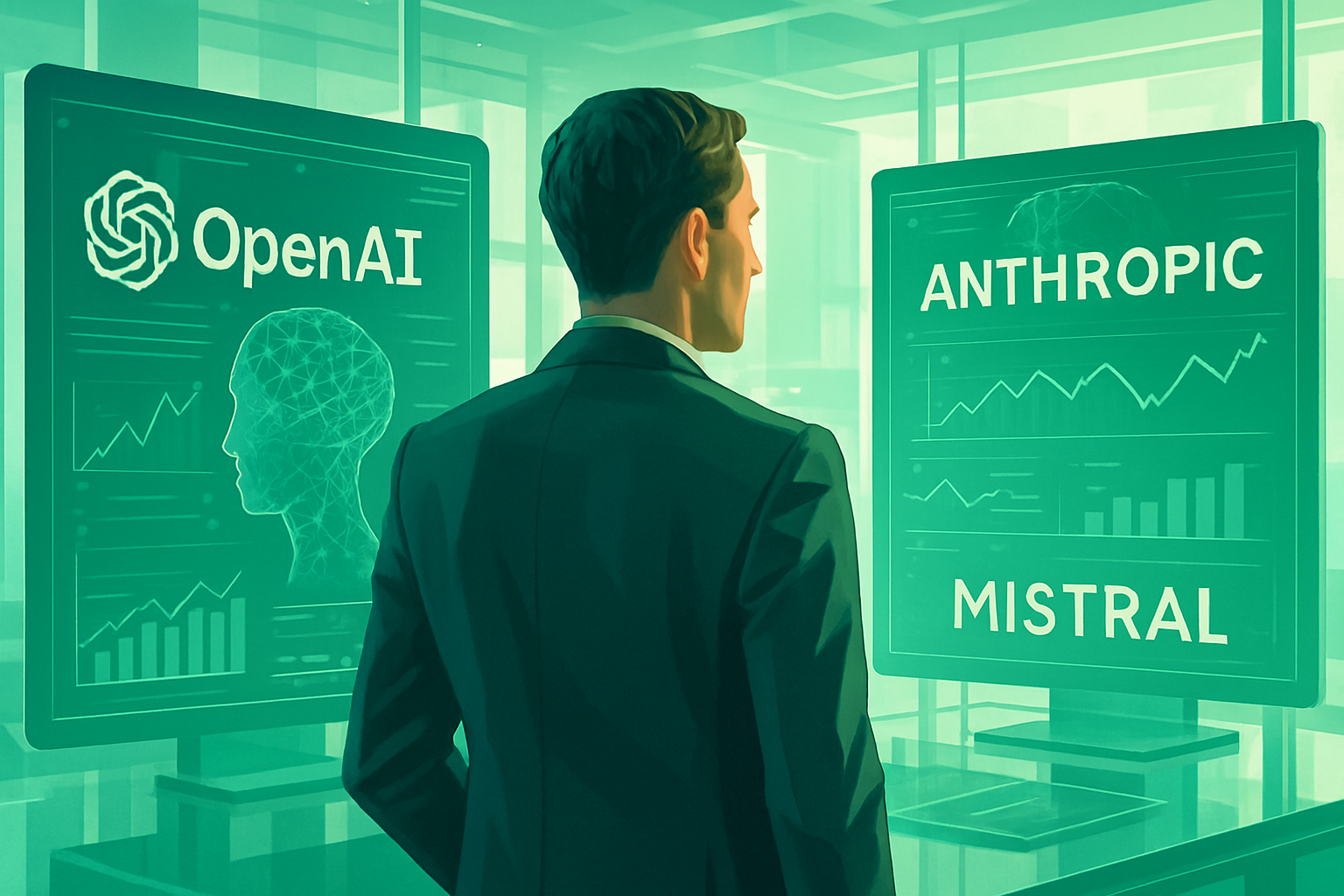
Artificial intelligence (AI) continues to transform the economic landscape, but the real challenge for companies is not the potential failure of this technology, but rather its resounding success. Large language models (LLMs) like those developed by OpenAI, Anthropic, and Mistral are reshaping the contours of a complex economic battlefield, where monopolies, dependencies, and ever-increasing costs threaten to trap businesses.
Imagine a scenario where your company relies on a strategic supplier that spends $14 billion a year to provide you with a service for just €20 a month. This is the paradox that companies face today with AI. The major risk is not the technological failure of AI, but rather the commercial success of its publishers, which could lead to an absolute monopoly or a sudden collapse, leaving businesses without the critical processes they have integrated. OpenAI, Anthropic, and Mistral represent three distinct trajectories, but all rely on scarce resources and raise sovereignty questions that executive committees can no longer ignore.
Revenue Sources and Colossal Expenses
The main LLM providers derive their revenues primarily from two sources: subscriptions and application programming interfaces (APIs). At OpenAI, subscriptions, such as ChatGPT Plus, Pro, and enterprise versions, overwhelmingly dominate, accounting for between 55% and 85% of revenues, according to estimates. This consumer-focused strategy ensures massive adoption and high visibility. APIs complement this picture, representing between 15% and 30% of revenues, particularly through professional integrations. OpenAI's annualized revenues were projected to reach around $20 to $25 billion by the end of 2025, with rapid growth but significant losses, estimated at around $14 billion in 2026.
In contrast, Anthropic derives the majority of its revenue, about 70% to 75%, from APIs, particularly for code generation and agent use cases. Direct subscriptions remain a minority, accounting for only 10% to 15% of revenues. This focus on enterprises allows for revenue concentration on large clients, potentially more stable.
Mistral, on the other hand, adopts a hybrid model, combining usage-based APIs, subscriptions (like Le Chat Pro), and licenses for private deployments. With approximately $400 million in annualized revenue at the beginning of 2026 and a target exceeding $1 billion, the French company is betting on agility and European sovereignty.
The common expenses for these companies are enormous: inference costs (model execution), training new models, infrastructure, and salaries. Structural losses remain high, as the race for performance demands massive investments before margins stabilize.
Dependence on Critical Resources
All these players heavily depend on high-performance computing chips, dominated by NVIDIA. OpenAI and Anthropic have invested hundreds of billions of dollars in data centers. Mistral, for its part, is investing in Europe, with data centers in France and Sweden, and the acquisition of Koyeb, to limit this dependence and strengthen sovereignty.
The talent war is equally intense: specialized AI engineers are rare and highly sought after, driving up salary costs. Energy is another bottleneck, with the electricity consumption of data centers raising environmental and availability concerns.
However, this dependence on chips has an unexpected downside: it has pushed isolated players, particularly from China, to drastically optimize software efficiency, challenging the American "brute force" model.
Evolving Strategies of Major Players
OpenAI has evolved from an open research logic to aggressive commercialization and a focus on practical adoption, with autonomous agents and outcome-based pricing.
Anthropic emphasizes safety and alignment from the outset, successfully capturing large accounts through robust APIs and coding tools.
Mistral is developing a European path, combining open source and proprietary models, sovereign cloud, and industrial partnerships. The company optimizes costs and regulatory compliance rather than purely racing for scale.
Each strategy engages client companies differently: gradual lock-in with American players, or greater flexibility (but less maturity) with Mistral.
Distribution Models and Closed Ecosystems
Microsoft, while not a direct competitor in terms of models, plays a crucial role as a distribution channel and infrastructure provider. Its product Copilot, integrated into Microsoft 365, serves as a daily assistant for employees in Word, Excel, Teams, etc. Copilot Studio, on the other hand, is a development platform that allows the creation of custom autonomous AI agents, relying on several models such as OpenAI, Anthropic, Grok, etc.
The main trap of these closed ecosystems is "Shadow IT," meaning the unauthorized use of AI by employees and partners of the company. While Copilot (M365) is relatively controlled by the IT department, Copilot Studio allows any business unit to create an AI agent connected to the company's data in just a few hours, dramatically increasing the attack surface and the invisible dependence on Microsoft infrastructure.
xAI (Grok) offers a more disruptive approach, integrating into the X and Tesla ecosystem, with a "maximum truth" positioning and aggressive pricing. Its availability through Copilot Studio enhances its access to businesses.
The main pitfall of these closed ecosystems is that they offer massive distribution and ease of integration, but increase dependence on a single provider and its strategic choices.
The Chinese Model: Efficiency and Ecosystem
The "DeepSeek" shock and the illusion of brute force: Contrary to the Western illusion that quality depends solely on the number of GPUs (NVIDIA), Chinese models, such as DeepSeek and Qwen from Alibaba, have demonstrated that massive investment in software engineering (optimizing MoE architectures, fine data management) can match the performance of GPT-4 or Claude with a fraction of the hardware resources.
The implication for governance is that the narrative of "chip shortage" justifying high prices among Western companies is now contested. The scarce resource is no longer the chip, but the talent for optimization.
The business model through the ecosystem: Chinese model APIs are often sold at a loss or even for free. Their economic model does not rely on selling computation but on locking in massive B2B and B2C ecosystems (DingTalk for Alibaba, WeChat for Tencent, Baidu Search). AI is an acquisition and retention cost, not a direct profit center.
The implication for governance is that a European company integrating a "free" or low-cost Chinese API is not paying with money, but with the leakage of its usage patterns to foreign players.
The "Open Weights" versus Open Source strategy: China has massively adopted the "open weights" model (the code may not be visible, but the model parameters are). This allows Western companies to download these models to run them "on-premise."
The sovereignty trap: For a mid-sized French company looking to escape American cloud services, a local Chinese model may seem appealing. But the dependence shifts: instead of relying on American infrastructure, the company depends on algorithmic updates and cognitive alignment (values, censorship) dictated by Beijing.
Comparison of Global Strategies
- United States (OpenAI/Anthropic): Direct monetization through subscriptions and APIs, priority on autonomous agents, raw dependence on hardware.
- China (Qwen/DeepSeek): Indirect monetization through ecosystems, priority on software efficiency, geopolitical "open weights."
- Europe (Mistral): Hybrid monetization, priority on compliance and sovereignty, seeking regulatory niches.
Uncertainties and Future Trends
Services and pricing will inevitably evolve. An increase is expected for advanced uses (autonomous agents, measurable outcomes) and stronger differentiation. Competition and optimizations should lower the cost of standard uses.
Major uncertainties revolve around actual profitability, resources (chip shortages, energy costs, talent), and geopolitics (sanctions, dependencies).
For enterprise users, changes are to be expected. Practical recommendations include diversifying suppliers, rigorously measuring return on investment, investing in internal skills, and establishing strong governance (CSRD compliance, dependency audits, sovereignty strategy).
This dependence on the business models of AI publishers is not just a technical issue; it is a major financial and non-financial risk. Yet, as we recently analyzed, the majority of CAC 40 companies still fail to mention their AI suppliers in their universal registration documents (DEU). Tomorrow, failing to disclose dependence on a third-party subscription model (often non-European) or the integration of Chinese open weights locally will be seen by auditors and investors as a failure of duty of care. AI governance also involves shareholder transparency.
Conclusion and Recommendations for Executive Committees
Regardless of the choice—American ecosystem, Chinese efficiency, or European path—there is a sacrifice: cost, data, values, or autonomy. Governance is no longer an option but a condition for transformation.
Brief IA — L'actualité IA en français
L'essentiel de l'actualité de l'intelligence artificielle, décrypté et expliqué chaque jour.