OpenAI and OpenClaw: Agentic AI Revolutionizes VivaTech
Le brief IA que les pros lisent chaque soir
Les 7 actus IA du jour, décryptées en 5 min. Gratuit.
Inclus dès l'inscription : notre sélection des meilleurs guides & comparatifs IA.
Choisis ton rythme
Gratuit · Pas de spam · Désabonnement en 1 clic
A Highly Anticipated Conference at VivaTech
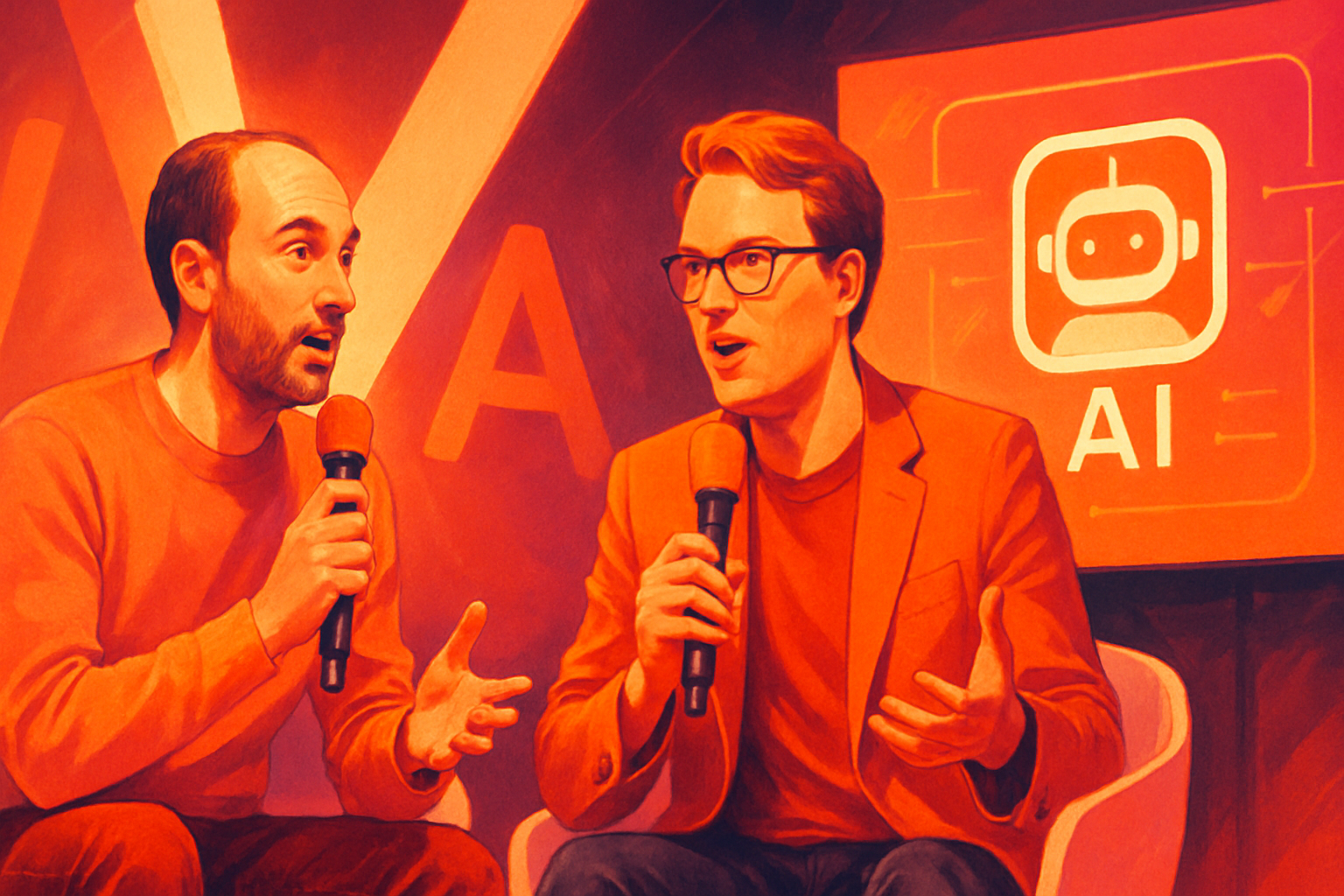
On Thursday, June 18, 2026, excitement was palpable in the halls of VivaTech. Attendees flocked to hear the conference by Thibault Sottiaux and Peter Steinberger. Thibault Sottiaux, head of the Core Product & Platform teams at OpenAI, played a pivotal role in the design of Codex, which has become one of the flagship products of the California-based firm. Before joining OpenAI in 2024, he contributed to major projects like AlphaGo at Google DeepMind. His current mission is to transform ChatGPT into a super-application. As for Peter Steinberger, he joined OpenAI after making a name for himself by developing OpenClaw, an open source autonomous agent project launched in 2025. Together, they explored the evolution of agentic AI in front of a captivated audience.
For about twenty minutes, in front of a nearly full room, the two experts provided an overview of the evolution of agentic AI. They also shared some bold predictions for the future, envisioning significant advancements by 2030, or even in the near future.
The Rise of Agentic AI
Thibault Sottiaux explained that agentic AI is now at the heart of discussions, surpassing generative AI. This transition is attributed to models capable of handling broader contexts and using tools consistently over extended periods. With the arrival of GPT-5 and GPT-5.2, these advancements have reached a new level. The concept of “harness”, an execution layer that facilitates agent interactions, is crucial for this transformation.
Peter Steinberger simplified this notion by describing how users now interact with models that delegate to other agents, creating a cascading orchestration. This ability for AI to communicate among itself opens up new perspectives.
If the concept of agentic AI is gaining so much traction, it’s because its use theoretically extends beyond the realm of development, according to the two engineers. “The biggest growth is actually not among developers, but in general daily work, which was quite surprising. It’s really becoming mainstream. Since GPT-5.5, we’ve had an enormous amount of requests, particularly from businesses.”
Applications Beyond Development
Agentic AI is no longer limited to development. According to the two experts, its use extends to everyday tasks, which has surprised many with its scope. Since GPT-5.5, demand from businesses has exploded, reflecting the growing interest in these technologies.
At OpenAI, Codex has been used by Sarah Friar, CFO, for complex financial operations, illustrating the internal adoption of these tools. She used Codex to conduct a fundraising round, “just to move funds and keep track,” thus demonstrating the efficiency and versatility of the tool. Thibault Sottiaux emphasized that this massive adoption has encouraged the company to make these technologies more accessible.
However, both men agree that designing an agent for general tasks remains much more complex. For a reason that may seem obvious, according to Peter Steinberger: sensitivity, judgment, or aesthetics are difficult concepts to convey to an artificial intelligence. To “write a great speech” or “create a website,” taste is required, he notes, and this is still an area where humans hold the advantage. “Ultimately, models are just very, very powerful tools. It’s almost like a hammer, but the hammer alone is useless. There always needs to be someone wielding it.” Thibault Sottiaux adds the issue of safety. Entrusting powerful agents to users without technical skills requires simple safeguards, so they do not take on more risks than they are willing to accept. “If you give an agent to someone who lacks technical knowledge, and they suddenly start writing code and executing it on your computer, you wonder: should they be doing that? Are they doing something dangerous?”
The Gap Between Capability and Use
Peter Steinberger noted that human imagination is often the main obstacle to innovation. Tools like OpenClaw could have been created earlier, but that did not happen. AI offers the possibility of achieving innovations through simple prompts.
The Future of SaaS and Personal Agents
When asked about the future of SaaS, the experts dismissed the idea of an imminent disappearance. Peter Steinberger pointed out that the cost of developing and maintaining software often remains higher than that of a subscription. Thibault Sottiaux envisions a future where software interfaces will be customized by agents capable of creating tailored software.
The Initial Roles of Agents
The two experts have different views on the first functions that agents will replace. Peter Steinberger sees agents as effective personal assistants for managing schedules. Thibault Sottiaux believes they will initially focus on repetitive and menial tasks, thereby freeing up time for more creative activities.
Brief IA — L'actualité IA en français
L'essentiel de l'actualité de l'intelligence artificielle, décrypté et expliqué chaque jour.