OpenAI Revolutionizes Prompt Art with a Simplified Guide
OpenAI Revolutionizes Prompt Crafting with a Simplified Guide
OpenAI has consolidated its prompt advice into a single guide aimed at everyday users, rather than developers. The focus is on four fundamental elements, practical safeguards, and Codex workflows, rather than API parameters or model tuning.
The guide arrives shortly after the launch of ChatGPT Work, a standalone product based on Codex technology and the new GPT-5.6 model, capable of working for hours on complex projects, operating across applications and files, and producing finished Excel or Word documents.
It covers both the classic ChatGPT interface and Codex within a unified framework, reflecting how the two converge into a single product. The tone is slightly different from OpenAI's recent developer documents regarding GPT-5 and GPT-5.5, which focused on API parameters, reasoning effort levels, and elaborate prompt schemes. The guide for end users discards all of that but retains the same fundamental idea: start small, express what you want, and only add rules if necessary.
Prompts: Four Optional Elements
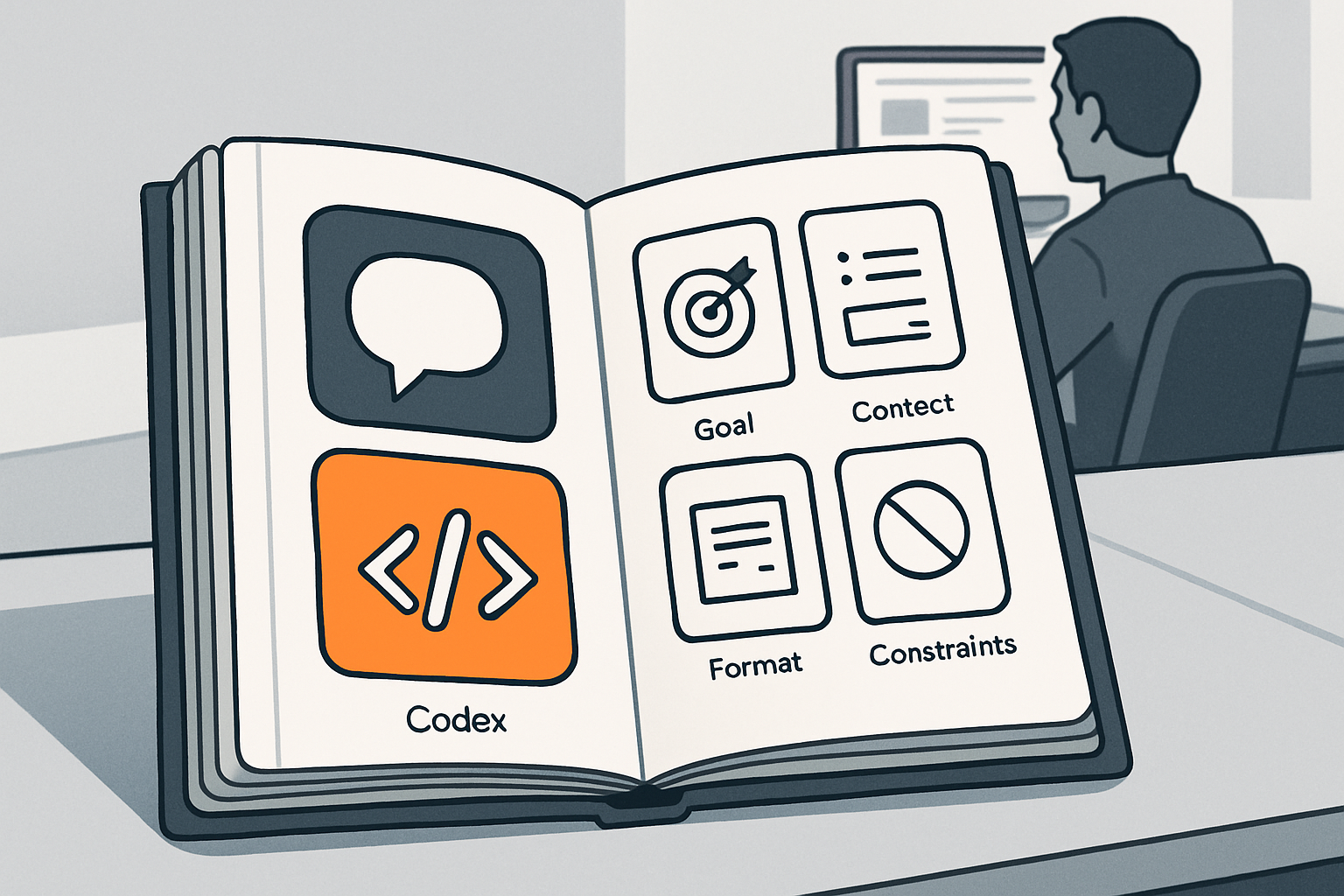
OpenAI structures prompts around an objective, context, output format, and constraints. None of these elements are mandatory. A short prompt often works, and filling in all four elements only makes sense for larger tasks, according to the company.
The guide recommends starting with the outcome, rather than a sequence of steps. "Describe a process when the process itself is important. Otherwise, leave it to ChatGPT to research, compare information, and adjust its approach," the document states. A target audience or format shapes the output far more than detailed instructions.
Constraints Outweigh Step-by-Step Scripts
Rather than scripting every move, OpenAI recommends one or two strict rules to block undesirable behaviors. Examples include: "Keep approved dates and budget figures" and "Prepare the message as a draft. Do not send it."
Le brief IA que les pros lisent chaque soir
Les 7 actus IA du jour, décryptées en 5 min. Gratuit.
Inclus dès l'inscription : notre sélection des meilleurs guides & comparatifs IA.
Choisis ton rythme
Gratuit · Pas de spam · Désabonnement en 1 clic
The same logic of less is more applies to context. Only attach sources that will actually change the response. The guide lists spreadsheets, PDFs, images, web research, and shared project files as options, along with plugins for Google Drive, Gmail, Slack, and GitHub. For critical work, OpenAI suggests asking ChatGPT to verify its own output, for example, by checking if each action item has an owner and a deadline.
Chat Handles Quick Tasks, Work Takes on Heavy Lifting
The guide draws a distinction between Chat for quick questions and rephrasing, and "Work" for tasks that involve multiple sources, require modifications, or produce larger deliverables like reports. Work tasks consume more credits but are cost-effective when they save time or support important decisions. For recurring tasks, OpenAI suggests first refining the prompt manually, then automating it.
Users do not need to nail the first prompt. Follow-ups are the expected way to refine the output. Ongoing preferences across sessions should be placed in "Settings > Personalization" under "Custom Instructions." Anything specific to a task remains in the prompt.
Codex Adds Steering, Queuing Options, and a Sandbox Mode
For the coding assistant Codex, OpenAI introduces two ways to influence ongoing tasks. "Steer" adds a message to the current execution and redirects it. "Queue" aligns a message for the next one. In the command-line interface, the Enter and Tab keys serve as shortcuts.
Codex executes commands in a sandbox that restricts access to files and the network. If a task needs to exceed these limits, Codex requests approval. Two slash commands assist with multi-step projects: "/plan" asks Codex to analyze the code and propose an approach before making changes, while "/goal" sets a high-level objective that Codex follows through multiple steps. For revisions, users can execute "/review" locally or mention "@codex review" in a GitHub comment, with an optional emphasis like "review for security vulnerabilities."
Brief IA — L'actualité IA en français
L'essentiel de l'actualité de l'intelligence artificielle, décrypté et expliqué chaque jour.