SpaceX, Anthropic, OpenAI: Imminent IPOs and Divergent Strategies
Le brief IA que les pros lisent chaque soir
Les 7 actus IA du jour, décryptées en 5 min. Gratuit.
Inclus dès l'inscription : notre sélection des meilleurs guides & comparatifs IA.
Choisis ton rythme
Gratuit · Pas de spam · Désabonnement en 1 clic
SpaceX, Anthropic, OpenAI: An Imminent IPO
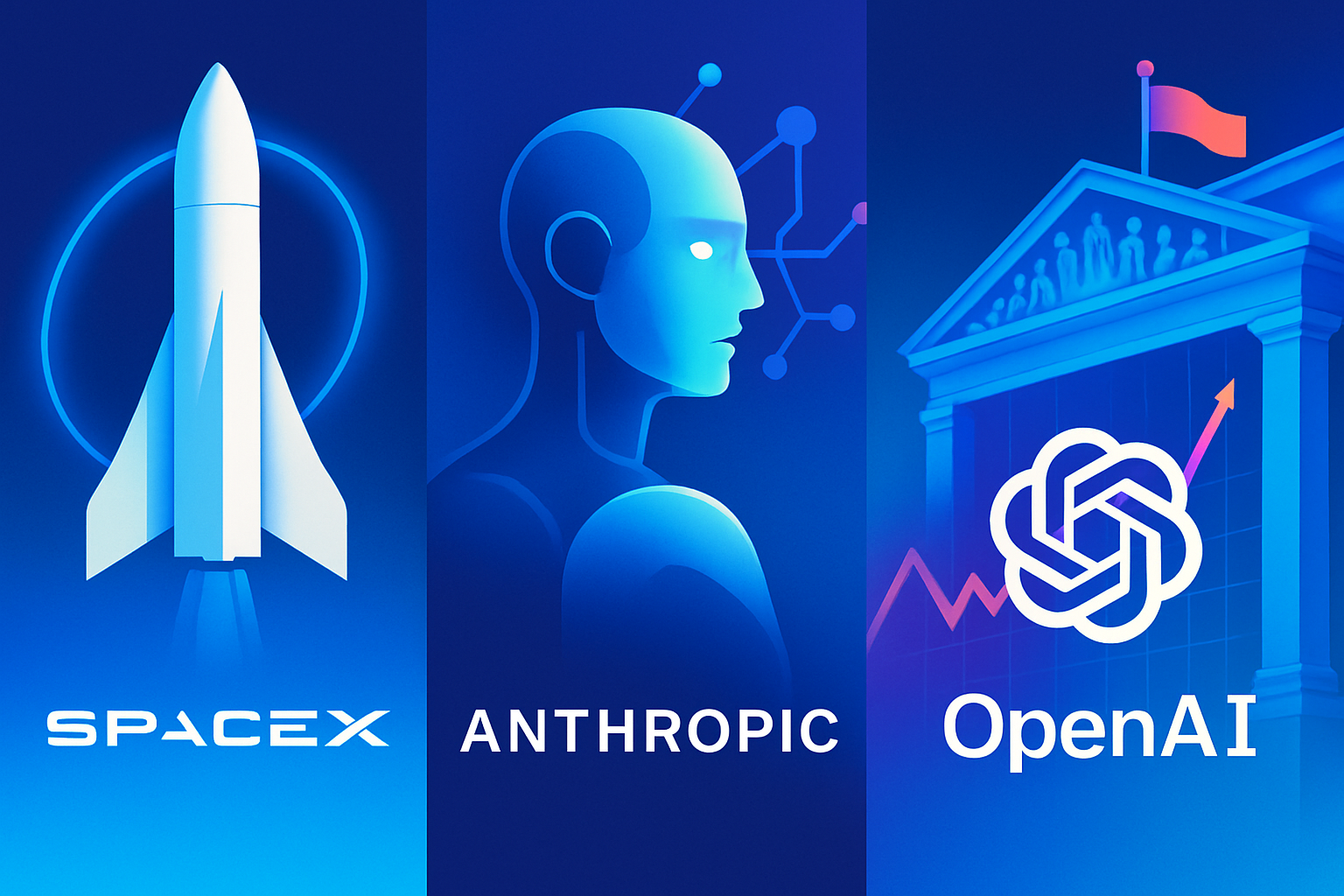
SpaceX, Anthropic, and OpenAI are preparing to enter the stock markets, promising to shake up Wall Street with post-IPO valuations potentially reaching one trillion dollars each. This wave of IPOs marks a turning point after a period of stagnation since 2022, caused by rising interest rates to combat post-Covid inflation. The IPO sector, dormant since then, could see a spectacular rebound thanks to these three tech giants.
SpaceX: A Record Valuation on the Horizon
SpaceX, led by Elon Musk, is aiming for a post-IPO valuation of $2 trillion, surpassing the previous record held by Saudi Aramco, which was valued at $1.7 trillion in 2019. The company hopes to raise $80 billion, far exceeding the $29 billion raised by Saudi Aramco. In addition to its space activities, SpaceX is integrating xAI, a recently acquired AI company, and is considering purchasing Cursor, a specialist in vibe coding, to strengthen its position in the AI sector.
The IPO of SpaceX will also mark the debut of xAI, which was absorbed by SpaceX in early February. Elon Musk is thus riding the wave of AI growth alongside the New Space and satellite internet sectors to convince investors. SpaceX is also set to acquire Cursor, one of the leading specialists in vibe coding, which could give a significant boost to xAI in the AI domain, a boost the company desperately needs. Lagging behind competitors Google, OpenAI, and Anthropic in model power, the company reported an operational loss of $6.4 billion, while most of its revenue comes from the social network X.
The IPO will therefore serve as a real-time test for the direction Elon Musk has taken with AI, determining whether investors believe in xAI's ability to carve out a niche against its competitors and the company's capacity to establish an ecosystem that includes model creation and application layers for businesses provided by Cursor. The latter is a significant asset in this regard, as its growth is spectacular: it currently boasts an annualized revenue of $3 billion, up from $2 billion in February, and aims for $6 billion by the end of 2026.
The IPO will also test investors' faith in the satellite internet market, which is still a niche service with ten million subscribers worldwide but holds strong commercial potential and is a powerful asset in terms of sovereignty.
Anthropic: Validation of a B2B Strategy
Anthropic finds itself in a strong position as it approaches its public market debut. Since the release of Claude Code and Claude Work in late 2025, the company has established itself as the leader in agentic AI aimed at democratizing AI in business. Driven by strong growth, Anthropic surpassed OpenAI in annualized revenue in early April.
Under the leadership of Dario Amodei, the company has recently achieved profitability for the first time, with an operational profit of $559 million in the second quarter, fueled by a significant revenue increase ($10.9 billion, nearly double that of the first quarter). Anthropic's revenue is now growing faster than Zoom's during the pandemic. This news not only reassures investors but also positions the company favorably against its rival OpenAI, which continues to incur heavy losses and does not expect to be profitable before 2030.
Thus, the IPO represents, in many ways, a referendum on the professional agentic AI strategy that Anthropic has bet on, as opposed to the more consumer-oriented approach of OpenAI, a gamble that the markets currently seem to validate.
However, this does not mean that Anthropic has no concerns ahead of its market entry. First, while the company has reached profitability by adopting a more frugal model (fewer GPUs purchased, less investment in data centers) and targeting a narrower audience of professionals rather than the mass consumer market, it has also achieved this result at the cost of usage restrictions for users and a financial arrangement with SpaceX that temporarily allowed it to obtain a discount on the use of the Colossus supercomputer. The company will sooner or later need to make costly additional investments in the cloud to continue fueling its growth. In fact, it has signed a series of new data center contracts in recent weeks to increase its capabilities, including with SpaceX.
Moreover, while Dario Amodei's relations with the White House have recently improved, investors will still remember the fierce dispute that pitted the company against the U.S. government in March, after which it was briefly ostracized by the U.S. administration. This issue is delicate for Anthropic: on one hand, the company plays on its image as a white knight of AI against its rivals, including OpenAI, an image that could be tarnished by too close a relationship with the Trump administration and the U.S. military. On the other hand, an open war with the administration could deprive Anthropic of lucrative professional contracts and hinder one of its main growth levers.
OpenAI: The Bet on Growth at All Costs
The stakes raised by OpenAI's IPO are almost a mirror image of those faced by Anthropic. Sam Altman's company has indeed adopted a radically different strategy from that of its younger rival. While Anthropic strives to achieve profitability quickly by offering a product tailored for enterprise adoption and focusing on selling professional subscriptions, OpenAI has chosen to target the general public and rapidly achieve a critical mass of users, even at the cost of losing significant amounts of money, with the expectation of eventually becoming profitable through advertising. This model echoes that which has underpinned the prosperity of giants like Google and Facebook.
Furthermore, in order to catch up with Anthropic, OpenAI has decided to accelerate its IPO. Its strength lies in the popularity of its product among the general public: 920 million weekly users, which provides it with a significant network effect and should convince investors that the company is not about to be sidelined in the AI race. However, it only has 55 million paying subscribers, which, combined with its enormous investments to acquire more computing power, weighs heavily on its financial results.
At the time of the IPO, investors will therefore assess its ability to convert more paying users, as well as to generate additional revenue through advertising. Despite a rocky start, OpenAI is targeting $100 billion in revenue from advertising by 2030. This is an ambitious figure, as it represents half of what the formidable advertising machines of Google and Meta generate annually (respectively $214 billion and $196 billion). It remains to be seen what investors will think of this.
Brief IA — L'actualité IA en français
L'essentiel de l'actualité de l'intelligence artificielle, décrypté et expliqué chaque jour.