VivaTech: Hidden Costs and Sovereignty Issues of AI Agents
AI Agents and Sovereignty: The Blind Spots of the Revolution
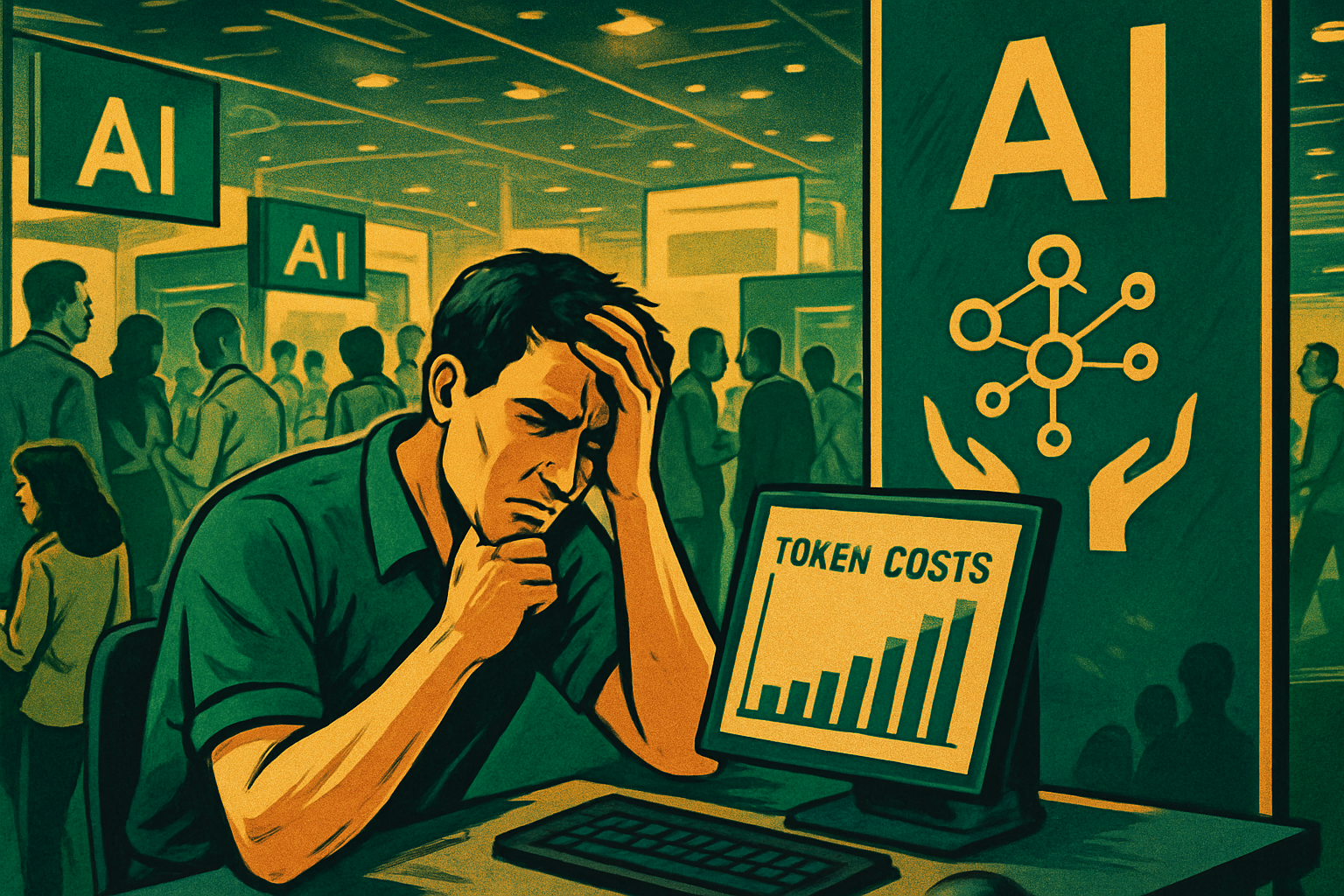
Behind the spectacular demonstrations at VivaTech, an economic reality is increasingly asserting itself: the cost of artificial intelligence is skyrocketing with the widespread adoption of agents and reasoning models. Beyond technical performance, companies must now integrate crucial issues of sovereignty, technological dependence, and cost control. This is emphasized by Rémi Tibi, VivaTech ambassador, founder of Yunik, and creator of the DeepTalk podcast.
Reading Time
From June 17 to 20, veterans of the industry and startups alike resonated in unison during the tenth anniversary of VivaTech 2026. The space dedicated to sovereignty drew attention up to the first floor, and discussions about AI agents echoed through the aisles. Meanwhile, as participants moved from booth to booth, somewhere in an office in Lyon, a developer was forced to suspend his SaaS project. The reason: his token bill had multiplied by twelve in four months. He is not alone in this situation. In 2025, global corporate spending on AI surged by 320%, while vendors continue to promise guaranteed returns on investment.
The Hidden Costs of AI Not Shown at VivaTech
What vendors often omit in their quotes is the real cost of tokens in production, the true cost of AI. In 2023, a simple interaction with an AI agent cost about $0.04. By 2026, a system orchestrated with reasoning and iterative loops costs $1.20, thirty times more. This cost, invisible in quotes, can be devastating in production. Extended reasoning modes consume thousands of hidden tokens per complex query, turning a seemingly profitable architecture on paper into a financial black hole at scale. This is the Jevons Paradox applied to compute: the cheaper the token, the more it is consumed, and the higher the bill climbs.
The Stuck Developer: The True Face of Token Shock
The scenario has become classic. A developer builds a SaaS tool on an LLM API. In the prototype phase, the bill is negligible. In production, with orchestrated agents and long contexts, it explodes. Entire communities on Hacker News and X document cases where the monthly bill has jumped from €200 to €2,400 in a matter of weeks, without user growth. The cause: reasoning capabilities activated along the way, charged in invisible tokens in standard logs.
The Return of On-Premise: When the Move to Cloud Reverses
Ten years ago, the trend was clear: move away from local servers, migrate to the cloud, reduce fixed costs. This paradigm is beginning to crack, not for ideological reasons, but under the pure pressure of AI costs. Llama, Mistral 7B, Phi-3: open-source models running on dedicated servers, without external APIs, with total cost predictability. What appears to be a technical choice is a strong economic signal. When the cloud becomes unpredictable, on-premise becomes rational again. The movement comes from independent developers, but it is also gaining traction among large companies through another route: sovereignty.
Le brief IA que les pros lisent chaque soir
Les 7 actus IA du jour, décryptées en 5 min. Gratuit.
Inclus dès l'inscription : notre sélection des meilleurs guides & comparatifs IA.
Choisis ton rythme
Gratuit · Pas de spam · Désabonnement en 1 clic
Sovereignty: The Same Fight to Curb AI Costs
Most major French groups run their AI agents on American infrastructures, subject to the 2018 Cloud Act, a law that allows Washington to demand access to data from American companies, even if stored in Europe. The response varies radically depending on the sector.
- At BNP Paribas, the HelloïZ assistant from Hello bank! has been running on Mistral since January 2026 for over a million clients: contractual and regulatory sovereignty, not military.
- Conversely, LightOn deploys its Paradigm platform directly on its clients' servers: data never leaves their environment. Clients include Safran, Docapost, and the French banking sector.
- In between, Renault decides on a case-by-case basis, critical data on Mistral, non-sensitive processing on GCP with €200 million in measured AI gains and 9,000 internal agents to govern.
This is not ideology. It is graduated risk management. In April 2026, the European Commission awarded a cloud contract worth €180 million to OVHcloud, Scaleway, and StackIT, explicitly excluding the three American hyperscalers. A strong signal: but it does not resolve anything for organizations that have not yet mapped what leaves their information systems, to which server, under which jurisdiction.
Claude / Fable 5: A Revealing Incident of Structural Dependence
On June 12, 2026, just three days after its launch, Anthropic disabled access to its Claude Fable 5 and Mythos 5 models. The decision was not due to a technical incident, but a directive from the U.S. government, based on export control powers.
The issue was the existence of techniques to bypass the model's safeguards, potentially facilitating certain sensitive uses. In light of this risk, U.S. authorities demanded the immediate suspension of access to the model for foreign nationals.
In practice, Anthropic was unable to restrict access solely to certain profiles. The company therefore cut off access to Fable 5 for all its users, regardless of their country or status.
A concrete example: product teams that had integrated Fable 5 via the API, particularly for code copilots or internal assistants, saw their calls return errors such as “model not available,” with an automatic fallback to less performant models like Opus 4.8. The result: immediate drop in quality, degraded functionalities, and in some cases, partial service interruption in production.
Consequence: products in production, integrated into applications and services, found themselves partially or completely inoperable overnight, without warning or continuity solutions.
This episode highlights a rarely articulated point in AI strategies: using models via API is not just a technical or economic choice, but a dependence on an external legal framework. In this specific case, an administrative decision from the U.S. had an immediate effect on users and companies located outside the United States. No technical failure was involved. No contractual mechanism anticipated or mitigated the impact.
When a critical model is operated by an entity subject to foreign jurisdiction, the continuity of service depends on decisions external to the user company.
What VivaTech Should Showcase
Not another demo. Three questions that should be paramount before signing any order form in the aisles of Porte de Versailles:
- What is the real cost for 100,000 monthly interactions, with extended reasoning activated?
- Who bears the drift of models over time?
- Is the pricing fixed or usage-indexed, and how will it evolve in eighteen months?
Brief IA — L'actualité IA en français
L'essentiel de l'actualité de l'intelligence artificielle, décrypté et expliqué chaque jour.