Washington: Dilemma Over Open Source AI and Its Regulation
Le brief IA que les pros lisent chaque soir
Les 7 actus IA du jour, décryptées en 5 min. Gratuit.
Inclus dès l'inscription : notre sélection des meilleurs guides & comparatifs IA.
Choisis ton rythme
Gratuit · Pas de spam · Désabonnement en 1 clic
Washington and AI Regulation
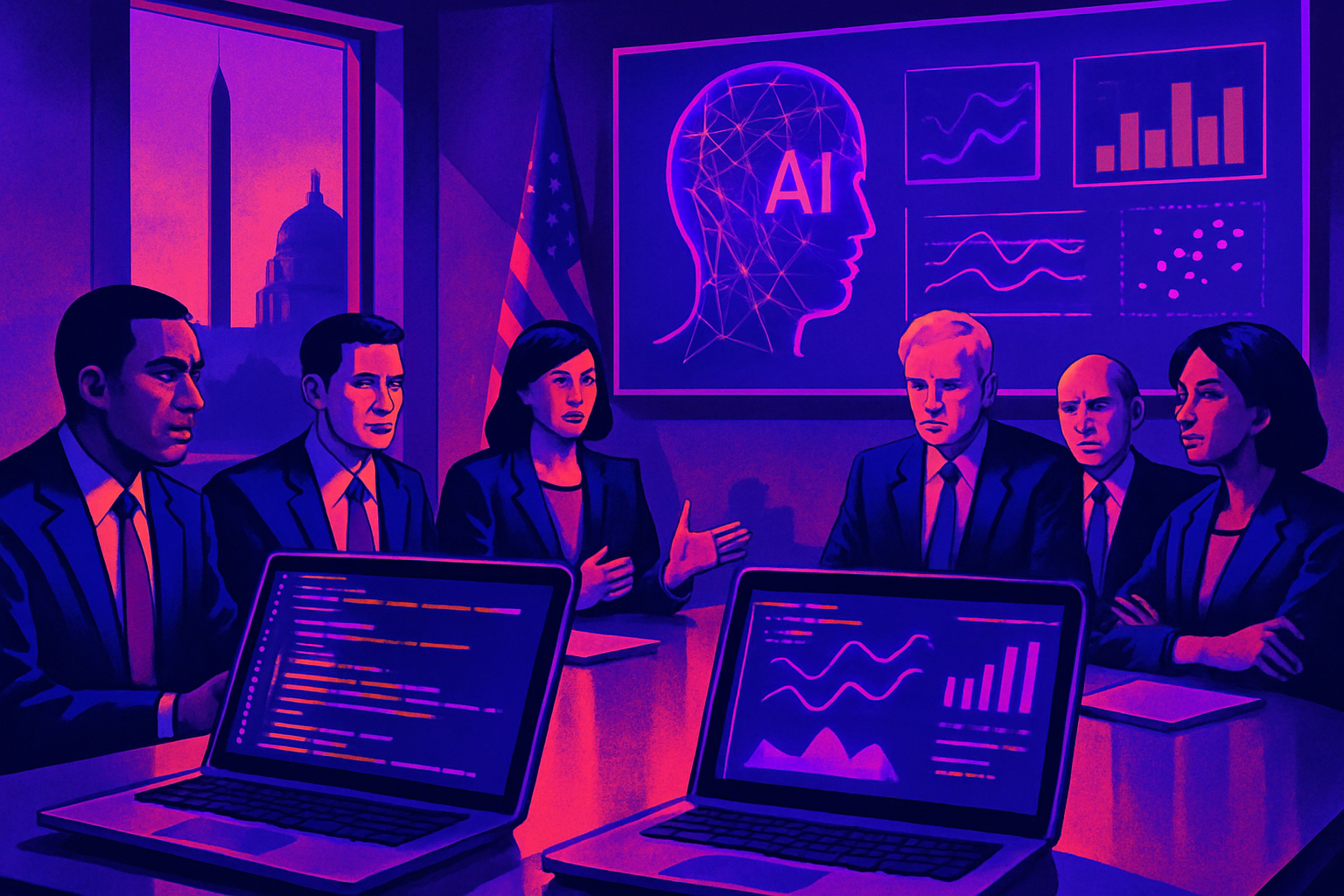
The U.S. administration is showing an increasing willingness to implement regulations to govern artificial intelligence. Recently, an executive order was issued to examine AI models, and a legislative proposal is under discussion to strengthen this framework. The government is also considering taking stakes in cutting-edge AI laboratories. Recently, a measure was taken to prohibit foreigners from accessing advanced models from Anthropic, which could be a prelude to stricter AI regulation.
However, there is growing concern that these future actions may, intentionally or not, target open source, a domain often misunderstood in the context of AI. Such regulation would be a monumental mistake.
The Importance of Open Source
Open source plays a crucial role in global technological development. It is a process that allows for the sharing, building, and distribution of technology in a public and transparent manner. Currently, over 90% of software worldwide is based on open source, generating more than $8 trillion in economic benefits, well before the advent of AI. Today, open source is essential for training, improving, deploying, and securing AI worldwide.
For over thirty years, open source has supported three major trends: education, competition, and innovation, which are core values of American society.
Open Source and Education
Open source is intrinsically linked to education. Its roots lie in academic institutions that sought to make technology accessible and free, away from the commercial interests and legal battles of large corporations.
The free software movement, a precursor to open source, emerged in 1983 on the MIT campus. At that time, every use of software, whether for teaching or research, required payment or dealings with giants like AT&T or Xerox. Thanks to open source, students from all universities, community colleges, and coding boot camps in the U.S. can now learn to program without barriers. Open source has become a pillar of technical education.
Open Source and Innovation
Open source is also a driver of innovation. It provides a set of tools and a supportive community that allows anyone to turn an idea into reality, at no cost. In conjunction with its educational role, it has nurtured many recent innovations. Some started as hobbies, bringing joy and personal learning, while others evolved into large companies, such as Meta, whose initial version of Facebook was built on an open source foundation.
Every day, new ideas take shape in dorms, garages, or basements, thanks to open source, which enables innovators to create without fear of lawsuits or prohibitive costs.
Open Source and Competition
Open source fosters competition by allowing outsiders to compete with large companies, thus preventing monopolies. Linux, the open source operating system, powers over 90% of the world's cloud computing infrastructure and was a response to the Windows monopoly. Android, the open source mobile operating system, enabled the emergence of many competitive smartphones before the iPhone dominated the market. Other examples exist in specialized fields such as autonomous driving, databases, and semiconductor design.
Without open source, the market would be dominated by monopolies, reducing competition and increasing costs for consumers.
The Impact of AI on Open Source
Is artificial intelligence a game changer? Not really.
Anthropic and OpenAI, with their closed and proprietary models, are rapidly concentrating power. Anthropic recently demonstrated its monopolistic strength by limiting the use of its advanced model to improve other models. While their capabilities are impressive, so are their prices and market dominance. Open source AI, primarily in the form of open-weight models, remains the only counterbalance for startups, educational institutions, and companies seeking alternatives.
Security and Open Source
Does open source pose security issues? Not really.
It is crucial to monitor the security implications of open source models that could reach advanced capabilities. However, the transparency of open source generally makes them safer, as it allows a larger number of engineers and researchers to correct undesirable behaviors and bugs. As a popular saying goes, "with enough eyes, all bugs are shallow." An open source model also does not transfer data when installed on a company's infrastructure, as highlighted by Airbnb CEO Brian Chesky. Therefore, open source AI is the most secure and privacy-respecting path.
The Consequences of Regulation
And what about China? Beware of unintended consequences.
China is a formidable competitor to the U.S. in many areas, but using this rivalry to justify the regulation of open source would be counterproductive.
Open source models enhance the efficiency and profitability of many American startups that cannot afford the high prices of Anthropic or OpenAI. AI companies in sectors like coding and law use open source models daily, including those from China. The fact that these models are developed by Chinese laboratories should raise alarms about the underinvestment in open source in the U.S. The response should be increased support for open source on American soil. Regulating or limiting open source due to China would have the opposite effect: stifling education, innovation, and competition, while pushing the rest of the world to adopt Chinese models.
Former Supreme Court Justice Louis Brandeis once stated that "sunlight is the best disinfectant" for eliminating wrongdoing. Open source is that "light" in the field of technology and AI. The U.S. should always support this light.
Brief IA — L'actualité IA en français
L'essentiel de l'actualité de l'intelligence artificielle, décrypté et expliqué chaque jour.