360 Challenges Mythos: Chinese AI in Search of Cyber Parity
Le brief IA que les pros lisent chaque soir
Les 7 actus IA du jour, décryptées en 5 min. Gratuit.
Inclus dès l'inscription : notre sélection des meilleurs guides & comparatifs IA.
Choisis ton rythme
Gratuit · Pas de spam · Désabonnement en 1 clic
360 Challenges Mythos: Chinese AI in Search of Cyber Parity
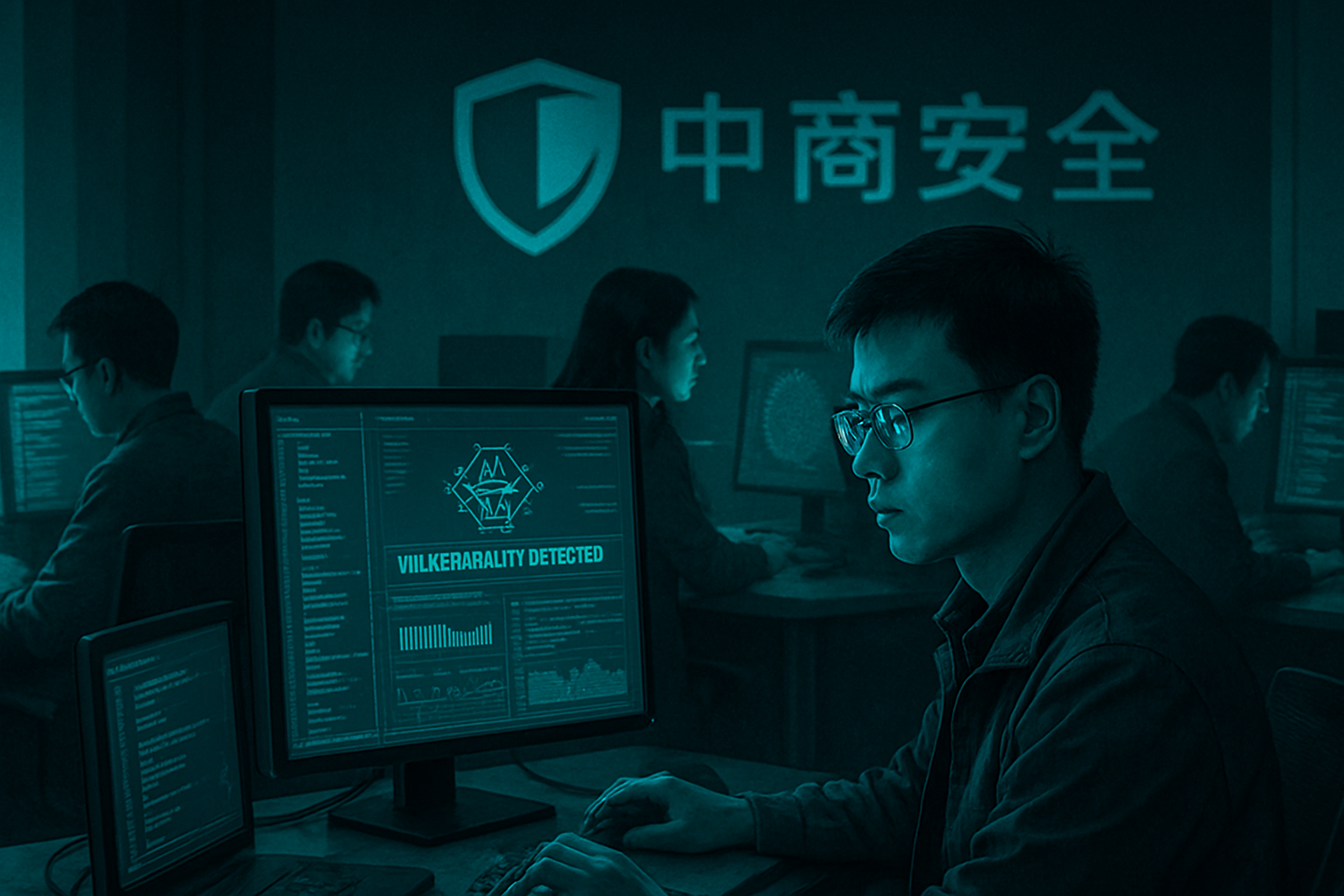
The Chinese cybersecurity company 360 Security Technology has unveiled two AI tools for automated vulnerability hunting and cyber defense, presented as China's response to Mythos from Anthropic.
Founder Zhou Hongyi claims that the best Chinese AI models still lag behind Western systems by 20 to 30%. To bridge this gap, 360 is adopting an agent-based approach that combines models with security expertise and automated tools.
Zhou compares advanced AI models for vulnerability detection to weapons of mass destruction and calls for China to build a strategic equivalent to prevent the United States from holding a monopoly.
The cybersecurity firm Qihoo 360 Security Technology showcased these tools at a conference in Beijing. "Tu Long Feng" automatically hunts for vulnerabilities, while "Yi Tian Zhen" automates cyber defense. Zhou stated that Tu Long Feng has already detected 3,432 vulnerabilities.
Zhou believes that the gap between the best Chinese models and the top-performing Western models is 20 to 30%. 360 is attempting to compensate for this with an agent-based approach that combines models with security expertise and automated tools. "China cannot wait for the capabilities of the models to fully catch up before starting vulnerability discovery. We cannot afford to wait," Zhou said.
Additionally, Jie Tang, a professor at Tsinghua University and founder of Z.ai, estimated that a Chinese model on par with "Mythos" would arrive before the first quarter of 2027.
Zhou Frames AI Vulnerability Hunting as a Nuclear Deterrence Issue
Without independent testing and benchmarks like those provided by OpenAI and Anthropic, there is no way to verify Zhou's claims. However, the rhetoric itself is noteworthy.
In his speech, Zhou immediately referenced the nuclear comparison. He described Mythos's ability to autonomously find vulnerabilities and build attack chains as the equivalent of "cyber-nuclear weapons of the AI era."
"Why has there never been a real nuclear war? Because both sides possessed nuclear weapons and deterred each other. The same applies to cybersecurity," he stated. China needs a strategic deterrent capability. A weapon "that can change the entire balance between attack and defense must not be left solely in the hands of others."
Zhou also warned against "unilateral transparency." The United States could use Mythos to scan Chinese systems for vulnerabilities while China remains in the dark. "With Mythos, it becomes a situation where the enemy is fast and we are slow, the enemy is numerous and we are few. You still rely on a few security experts for analysis, while the other side has already replicated a group of hacker agents to work simultaneously."
He cited the export ban on Fable 5 from Anthropic as evidence. Fable 5 is the "civilian and neutral version of Mythos," and if someone were to unlock it, the entire world could potentially access Mythos-level capabilities. "This is what the U.S. government finds most intolerable. It must ensure that it alone possesses this capability, forming an absolute monopoly over this strategic asset," Zhou stated.
The U.S. government uses the same national security argument to justify its own export controls on chips and Mythos. Both sides have spent years exchanging accusations regarding cyberattacks on critical infrastructure. This is the Cold War manual, simply applied to AI. One side builds a capability; the other says it cannot afford to fall behind.
Even the names of 360's tools carry a whiff of warrior romanticism, likely referencing a classic of Chinese martial literature where legendary weapons confer supremacy to their owners.
Brief IA — L'actualité IA en français
L'essentiel de l'actualité de l'intelligence artificielle, décrypté et expliqué chaque jour.