AI Agents: The Tech Stack Revolutionizing Businesses
Le brief IA que les pros lisent chaque soir
Les 7 actus IA du jour, décryptées en 5 min. Gratuit.
Inclus dès l'inscription : notre sélection des meilleurs guides & comparatifs IA.
Choisis ton rythme
Gratuit · Pas de spam · Désabonnement en 1 clic
Introduction
Imagine a scenario where you ask an artificial intelligence agent to compare prices from three competitors, compile this information into a structured report, and share it on a Slack channel before 9 AM. Pressing the Enter key, thirty seconds later, the report is ready and delivered. This process, which seems almost magical, actually relies on a complex architecture made up of seven distinct technological layers. Each layer plays a specific role and may encounter particular issues. While the base model often gets the spotlight, the other six layers are just as crucial for the agent's proper functioning.
According to Gartner's forecasts, by the end of 2026, 40% of enterprise applications will incorporate AI agents dedicated to specific tasks, up from less than 5% in 2025. This rapid adoption does not follow a linear progression but rather an exponential curve. For engineers and technical leaders, mastering the entire technology stack is essential, not just the layer they directly manage.
This article explores each layer of this stack, from the base model to the deployment infrastructure. By the end of this reading, you will have a clear understanding of the function of each layer, their interconnections, and the technological choices to consider at each level.
Layer 1: The Base Model
The base model constitutes the cognitive core of the AI agent. This is where reasoning occurs, language is interpreted, and decisions are made regarding the actions to be taken. The other layers of the stack provide context to this model or act on its outputs.
In 2026, the main options for base models include GPT-5.5 from OpenAI, Claude Sonnet 4.6 from Anthropic (or Claude Opus 4.8 for tasks requiring more complex reasoning), Gemini 3.1 Pro from Google, as well as open-weight models like Llama 4 and Mistral Large 3 from Meta. Each model presents trade-offs that are crucial to understand before making a choice.
-
GPT-5.5 is recognized for its speed and reliability in daily calls, with a mature integration ecosystem and a vast developer community that has already solved many specific cases.
-
Claude Sonnet 4.6 excels at handling long documents and following complex instructions at a lower cost than Anthropic's Opus category, which is advantageous in document-heavy workflows. For tasks requiring in-depth reasoning, Claude Opus 4.8 is recommended.
-
Gemini 3.1 Pro offers a processing capacity of 1 million tokens, which is essential for agents that need to handle large codebases or extensive knowledge bases.
-
Open-weight models like Llama 4 allow for complete control over deployment and data management, although they require heavier infrastructure to operate.
The distinction between "standard" models and those focused on reasoning, which still existed in 2025, has disappeared. OpenAI, Anthropic, and Google have integrated reasoning into a single model capable of determining the time needed for reflection. GPT-5.5 offers adjustable reasoning effort levels, ranging from low to very high, just like Claude's parameters and Gemini's reflection levels. For most agent tasks, a default or low-effort setting is sufficient, providing speed and cost-effectiveness. For tasks requiring meticulous planning or mathematical reasoning, increasing the effort level can enhance accuracy.
Layer 2: The Orchestration Framework
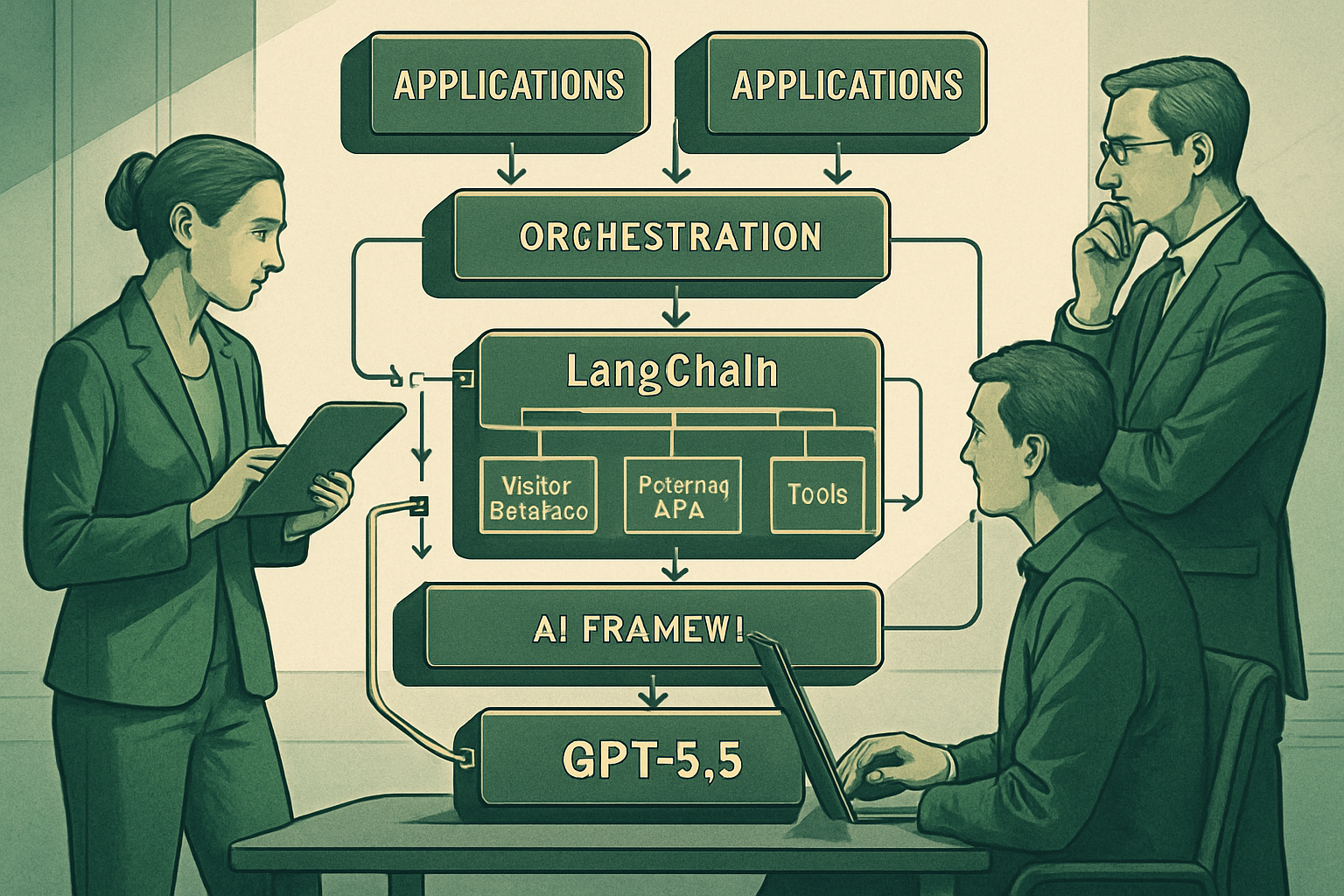
If the base model is the brain of the agent, the orchestration framework is its nervous system. It manages the flow of control, determining the agent's actions, when to call a tool, how to process results, and how to maintain reasoning coherence across multiple steps.
The most commonly used orchestration model is called ReAct. The agent generates a thought, decides on an action, executes that action via a tool, observes the result, and then reflects again. This loop continues until the agent produces a final response. While this may seem simple, it is often at this level that failures occur in production: the agent may call the wrong tool, get stuck in a loop, or fail to recognize when it has enough information to stop.
LangChain is the most widely adopted framework, offering a vast ecosystem of integrations and comprehensive documentation. Although criticized for adding too much abstraction at the prototype stage, this criticism becomes less relevant when the features provided by this abstraction become necessary. LangGraph, developed by the same team, is better suited for stateful multi-agent workflows, where precise control over the execution graph is required. If your agent involves multiple specialists coordinating a task, LangGraph is the most appropriate choice.
CrewAI is specifically designed for multi-agent coordination. It allows you to define agents with roles, assign them tasks, and have them collaborate in a structured workflow. It is higher-level than LangGraph and faster to implement, but offers less control over execution details. AutoGen, from Microsoft, takes a conversational approach to multi-agent systems, where agents interact with each other via a message-passing interface, making the interaction logic very readable.
Semantic Kernel is Microsoft's enterprise-focused option, with production-ready support in C#, Python, and Java. For enterprise environments already based on the Microsoft stack, it integrates seamlessly. LlamaIndex started as a document ingestion and retrieval framework and has evolved into a complete agent framework, with particularly strong support for RAG-rich workflows.
The choice of framework depends on the specific needs of your agent. For a single-agent task executor, LangGraph or LangChain are recommended. For a coordinated team of specialized agents, CrewAI or AutoGen are more suitable. For enterprise environments, Semantic Kernel is ideal. For document-rich retrieval workflows, LlamaIndex is the appropriate choice.
Layer 3: Memory Systems
By default, LLMs (large language models) are stateless. Each call starts from scratch, with no knowledge of previous interactions unless that context is explicitly passed. For a single question, this approach is sufficient. However, for an agent that needs to follow a conversation, remember user preferences, or build on previous work, a robust memory system is essential.
Brief IA — L'actualité IA en français
L'essentiel de l'actualité de l'intelligence artificielle, décrypté et expliqué chaque jour.