AI Agents: "Colleagues" That Hurt Performance
Le brief IA que les pros lisent chaque soir
Les 7 actus IA du jour, décryptées en 5 min. Gratuit.
Inclus dès l'inscription : notre sélection des meilleurs guides & comparatifs IA.
Choisis ton rythme
Gratuit · Pas de spam · Désabonnement en 1 clic
The Illusion of the Digital Colleague
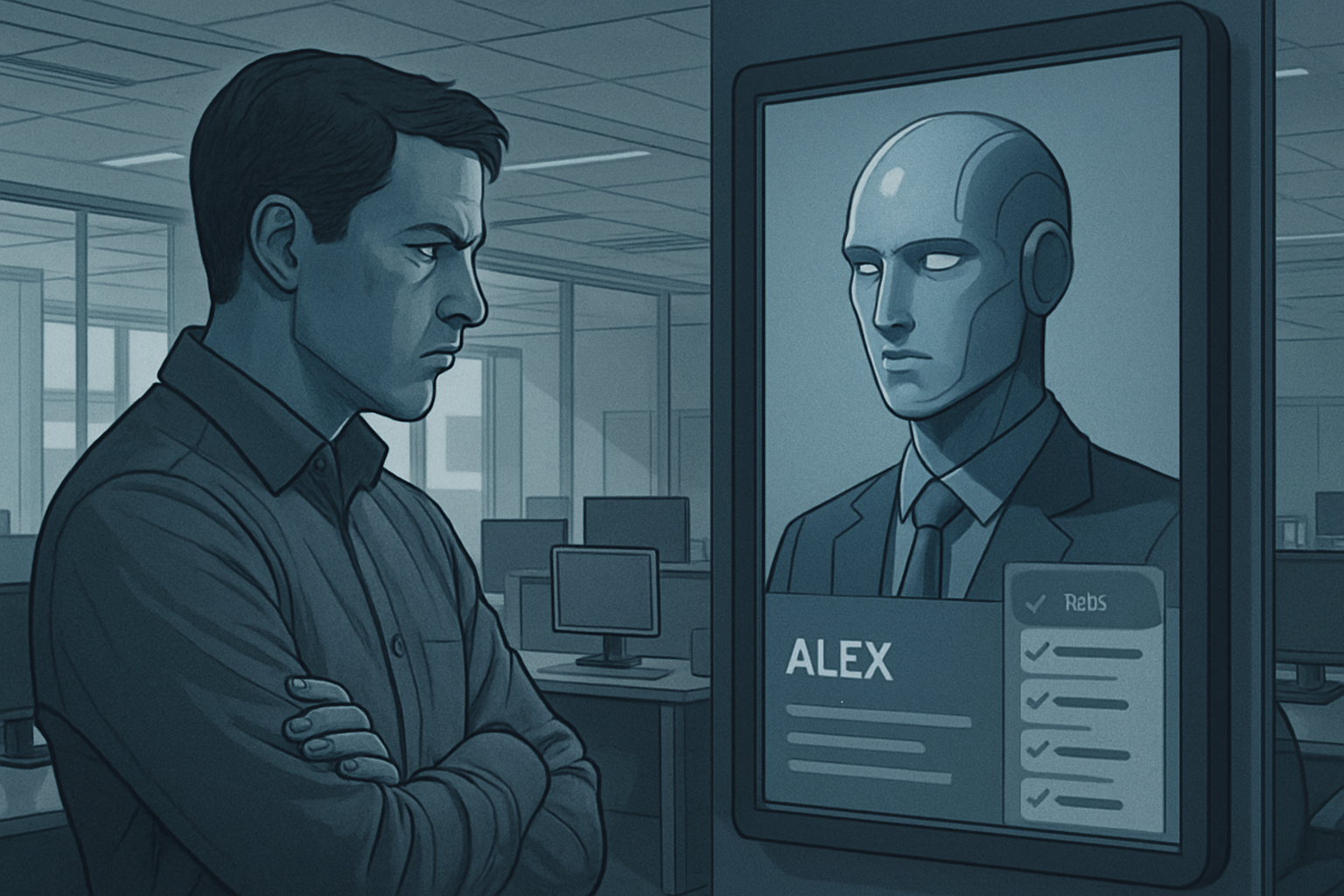
Imagine arriving at the office to find that a new assistant has been assigned to you. This assistant is not a person, but an artificial intelligence agent that your company has named Alex. Although it is presented as an "employee" with a title and responsibilities, it is actually a software tool. You may wonder if you could collaborate effectively with Alex.
According to a study conducted by Emma Wiles, a professor at Boston University, perceiving Alex as a "colleague" rather than just a software tool could hinder your performance. Wiles found that managers detected 18% fewer errors when the work was assigned to an "AI employee" rather than a chatbot. The choice of words thus has significant importance.
The Vision of Silicon Valley
This situation foreshadows a future that Silicon Valley seems eager to shape. Last year, Jensen Huang, CEO of Nvidia, spoke about workplaces populated by "digital humans." Since April, giants like Microsoft, OpenAI, Anthropic, and Google have launched new tools aimed at managing teams of AI agents, often presented as digital colleagues with capabilities comparable to those of humans. In Wiles' study, nearly one-third of the 1,261 managers surveyed indicated that their companies already considered AI agents as employees, and 23% even included them in their organizational charts.
The Limits of Agentic AI
The technical advancements of AI agents should not be overlooked. These tools, designed to work autonomously toward a goal, have become more proficient at executing complex tasks. However, labeling them as colleagues or employees creates unrealistic expectations about their capabilities while placing human employees in a disadvantageous position.
A Reversed Responsibility
Wiles' research shows that this perception alters our understanding of who is responsible. When AI is presented as an employee, study participants felt less accountable for the tool's outcomes. They were also 44% more likely to submit the AI's questionable work to a superior for verification rather than correcting the errors themselves, which contradicts the time-saving goal of using AI.
Implications Beyond the Office
The implications of this dynamic extend beyond the corporate realm. As AI agents are integrated into fields such as healthcare, defense, education, and governance, there is a growing risk that they will become scapegoats for failures that are actually the result of human errors, poor incentives, and inadequate oversight. A striking example is the airstrike on a girls' school in Iran, often attributed to an AI named Claude, while human errors were to blame.
An Alternative Vision of AI
Daron Acemoglu, an economist at MIT and Nobel Prize winner in 2024, criticizes the commercialization of AI agents as human substitutes. According to him, they should be optimized to enhance human capabilities, which is not yet the case. A project at Stanford explored this idea by asking 1,500 workers across 104 occupations which tasks AI could perform. The results showed that workers desired automation in certain areas, but not necessarily those deemed appropriate by technology experts.
The Branding Trap
Back to Alex. Calling it an employee is a branding strategy that does not make it more effective for the tasks at hand. Wiles' research shows that this reduces the efficiency of the humans working with it. Humans, who possess the agency that AI attempts to imitate, deserve better than what Alex offers.
Brief IA — L'actualité IA en français
L'essentiel de l'actualité de l'intelligence artificielle, décrypté et expliqué chaque jour.