Bercy Halts Alibaba's Qwen AI Test Over Pro-China Bias
Le brief IA que les pros lisent chaque soir
Les 7 actus IA du jour, décryptées en 5 min. Gratuit.
Inclus dès l'inscription : notre sélection des meilleurs guides & comparatifs IA.
Choisis ton rythme
Gratuit · Pas de spam · Désabonnement en 1 clic
Bercy Halts Alibaba's Qwen AI Test Over Pro-China Bias
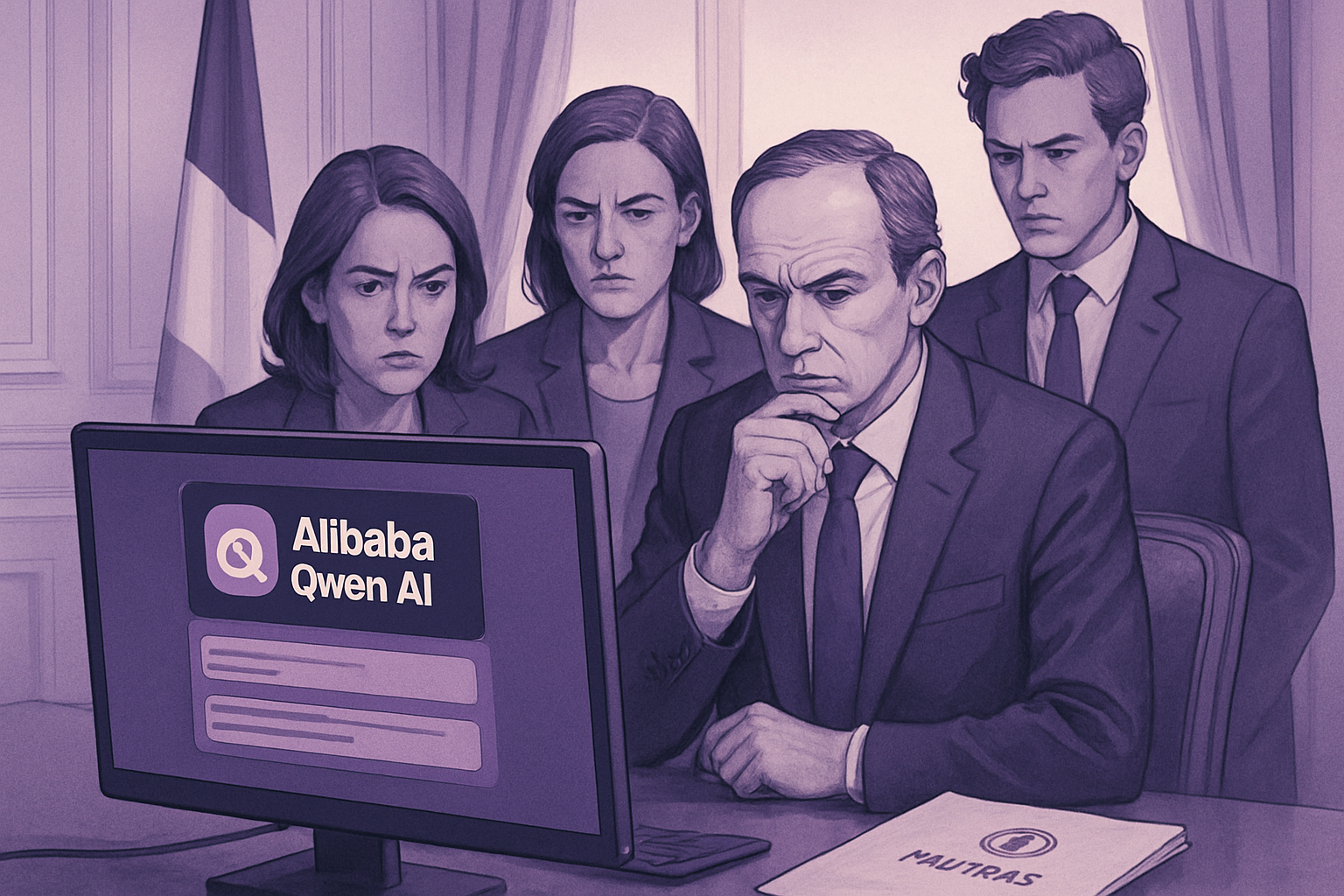
The General Directorate of the Treasury suspended the experimentation of Alibaba's Qwen model on June 23, after several users reported biased responses on topics related to China. A model from Mistral AI replaced it the following day.
The tool was called HéphAIstos. Since early June, nearly a hundred of the 1,300 agents at the General Directorate of the Treasury had been testing it daily: a conversational agent to assist senior officials in their tasks, including on confidential data, and an internal multilingual transcription application. Under the hood, the Qwen model was developed by the Chinese e-commerce giant Alibaba.
Bercy ended the experimentation. Several agents had reported responses deemed biased or skewed regarding China. The ministry did not specify which topics were involved. Alibaba Cloud, when contacted, declined to comment.
Qwen Disconnected from the Internet, But Not from Its Training Filters
Bercy indicated that HéphAIstos operated in offline mode, without internet access or any identified backdoor. Therefore, no data transmission to the outside was detected during the three weeks of testing. However, network disconnection is not enough to eliminate the embedded biases present during the model's training.
In an interview with AFP, Annabelle Blangero, an AI specialist at the consulting firm Ekimetrics, reminded that biases exist in all models, but some can be deliberately added to avoid certain responses or to steer their formulation. Research conducted by the Australian Strategic Policy Institute (ASPI) on Chinese models had already mentioned this phenomenon last December: Qwen displayed the most pronounced response divergences between its Chinese and English versions, particularly on topics related to Uyghur genocide or Tibetan independence.
Several independent tests conducted by tech media have also established that Qwen refers to Taiwan as an "inalienable part of China" and triggers a security error when users inquire about the events of Tiananmen Square on June 3, 1989.
Replacement Within 24 Hours Amid National Deployment Context
Bercy's response was swift. The following day, a model from the French startup Mistral AI replaced Qwen within HéphAIstos. This replacement coincided with the presentation at Bercy by Minister of Action and Public Accounts David Amiel of the "Our AI" plan, which aims to generalize a conversational assistant powered by Mistral for over one million state public service agents, with an initial budget of €700,000, and an estimated annual cost between €2 million and €4 million depending on usage.
The Interministerial Digital Directorate (DINUM) had conducted ten months of preliminary testing on 10,000 agents. According to the results presented during this plan, 75% of participants found the tool useful, but nearly two-thirds believe that other generative AIs better meet their needs. The chosen infrastructure is hosted by Outscale under SecNumCloud certification, the highest security qualification level required by the French state for sensitive data.
The Treasury had selected Alibaba's model based on its accessibility. Fully open source in its public versions, it allows for local deployment without transferring data to the Chinese group's servers. This made it the ideal candidate for integration into HéphAIstos. It is also the only argument that Bercy put forward to dismiss any risk of data leakage during the experimentation.
Brief IA — L'actualité IA en français
L'essentiel de l'actualité de l'intelligence artificielle, décrypté et expliqué chaque jour.