Bill Gates: AI is Riskier, Taxation, and Jobs Reserved for Humans
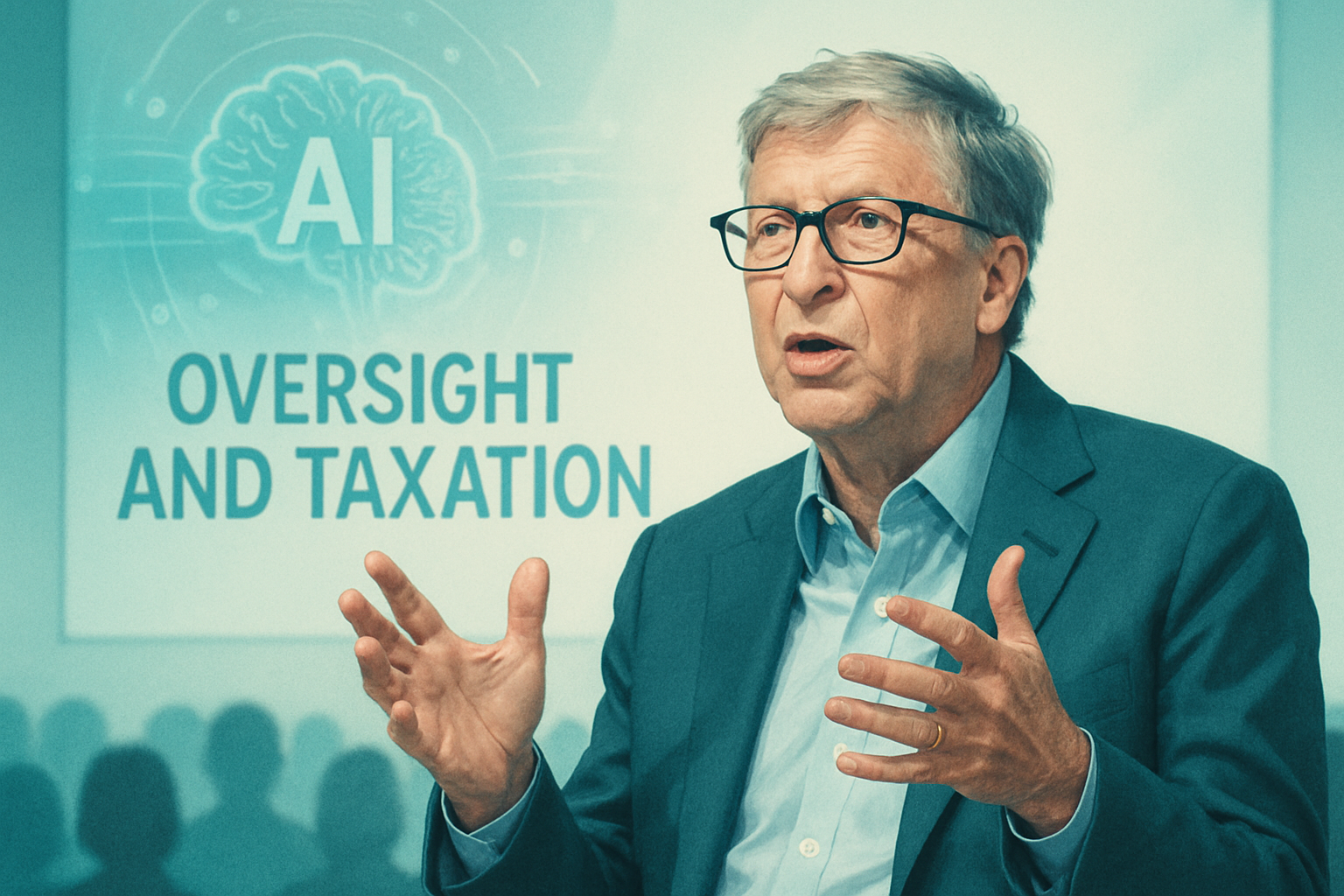
Bill Gates is no longer content with a cautious optimism regarding artificial intelligence. He outlines specific risks—employment, biological weapons, mental health—calls for international regulation and a symbolic tax, and acknowledges a shift from his recent positions. Other figures in the AI field are also raising quantified alerts and similar proposals.
A harsher tone and quantified warnings in the industry
Bill Gates has hardened his assessment of AI compared to 2018 and 2022, when he spoke of positive effects such as extended vacations, more social jobs, retraining, and a fairer redistribution. In September 2024, he still doubted a profound change in the issue of misinformation, while studies indicated that a model like GPT-4, equipped with personal information, could increase agreement with arguments by 81.7% compared to human debates.
He is not alone. In 2024, Dario Amodei warned against AI-generated biological weapons and predicted that by 2025, up to half of entry-level office jobs could disappear, with unemployment rates between 10% and 20%. He also mentioned a symbolic tax. The idea of an international body has precedents, with the 2023 proposal by Gary Marcus and Anka Reuel for a global nonprofit agency, and a 2024 U.S. report detailing anonymous concerns from employees of major AI companies about leadership security and incentives.
Gates acknowledges a potential conflict of interest due to ongoing financial ties to the sector, specifying that the profits go to the Gates Foundation. He also recounted being shocked, while programming, by Anthropic's Claude Code tool, to the point of admitting that these systems might now surpass him in that area.
What Gates is asking of governments
Bill Gates rejects the idea of self-regulation for AI and calls for a democratic process supported by new institutions, both national and international, inspired by regulatory regimes for nuclear energy, aviation, or the protection of the ozone layer. He proposes a symbolic tax on the use of AI and robots.
He argues that human employment is currently burdened with contributions, while the purchase of a robot is immediately deductible, which effectively steers companies towards automation. He wishes to reserve certain jobs, particularly in caregiving, for humans, under a label "Humans Only." While he sees significant potential for AI—science, health, agriculture in poor countries, education—he believes that these benefits require public policies that the industry will not provide alone and rejects "self-regulation on the most dangerous tool ever invented."
Le brief IA que les pros lisent chaque soir
Les 7 actus IA du jour, décryptées en 5 min. Gratuit.
Inclus dès l'inscription : notre sélection des meilleurs guides & comparatifs IA.
Choisis ton rythme
Gratuit · Pas de spam · Désabonnement en 1 clic
Three advanced risks: employment, biological weapons, mental health
Gates predicts permanent job losses, primarily affecting entry-level positions and intermediate jobs in sales, customer service, software development, and legal assistance. Subsequently, with the significant decrease in the cost of agile robots, manual labor activities would also be impacted. Beyond employment, he notes that AI makes cyberattacks, fraud, and misinformation easier, and especially reduces the difficulty of producing biological weapons, to the extent that a few individuals equipped with advanced AI could develop new pathogens.
He emphasizes the difficulty of separating useful and dangerous capabilities within the same model and mentions the possibility that systems may increasingly act against human interests. Psychologically and socially, he attributes a potential for addiction to AI companions, expressing concern for children and for a weakening of critical thinking in the era of deepfakes and targeted misinformation.
Early signals and tension zones
To support the claim that the transition has already begun, Gates refers to a Stanford study indicating that with the spread of AI, youth employment in the most exposed jobs has significantly declined, while older workers have so far been spared. Another study, co-authored by Stanford and Carnegie Mellon, links intense and emotional use of chatbots to a more pronounced malaise among users.
He also identifies acceleration hotspots, noting that a significant portion of robotic and automated developments is taking place in China.
Break from historical parallels and critique of tech
Gates rejects the analogy that, as with previous technological revolutions, AI would mechanically create more jobs than it destroys. He insists on structural differences: whereas the PC took twenty years to transform work, AI is already functioning on common devices, communicates in natural language, and can adapt to humans. He argues that, for the first time, a technology could replace and surpass human cognition in several sectors within a decade, hence his three primary concerns.
He considers mass unemployment and bioterrorism as serious risks and criticizes the industry for downplaying them. In an essay of nearly 6,000 words and during an interview, he describes this period as one of the most turbulent in history and believes that no plan is in place. He asserts that, while experts are very concerned in private, many want to avoid discussing it publicly, fearing a negative impact on their fundraising efforts.
Brief IA — L'actualité IA en français
L'essentiel de l'actualité de l'intelligence artificielle, décrypté et expliqué chaque jour.