Bruno Retailleau unveils a $25 billion AI plan at Station F
Le brief IA que les pros lisent chaque soir
Les 7 actus IA du jour, décryptées en 5 min. Gratuit.
Inclus dès l'inscription : notre sélection des meilleurs guides & comparatifs IA.
Choisis ton rythme
Gratuit · Pas de spam · Désabonnement en 1 clic
Bruno Retailleau Bets on AI to Transform the State
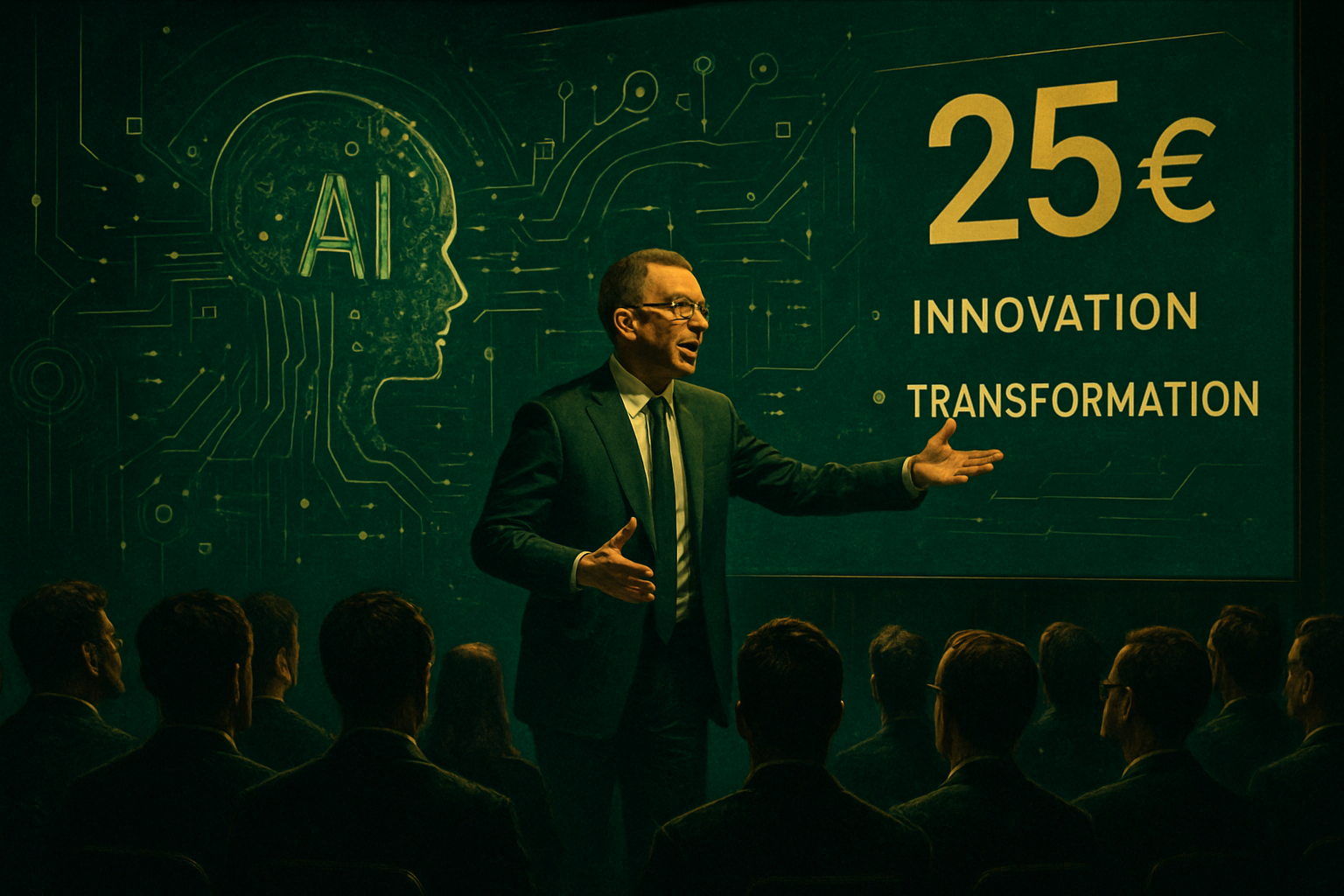
At the Machina Summit, an event dedicated to robotics and new technologies, Bruno Retailleau presented his strategy to promote the development of artificial intelligence (AI) at Station F. The Vendée senator and president of the Republicans took advantage of this platform to outline his vision of a France transformed by AI. The presentation took place on Tuesday, July 7, where he announced a funding plan of 25 billion euros, spread over five years, or 5 billion per year, to integrate AI into the administration and economy of the country. According to him, this initiative could generate savings of 15 billion euros for the State.
A Technological Leap to Modernize Administration
Bruno Retailleau views AI as a crucial lever for modernizing the State. He describes it as "the greatest technological battle in history," capable of revolutionizing administrative operations. To reduce bureaucracy, he proposes the creation of an AI agent, named "Marianne," which would facilitate citizens' administrative procedures. By integrating AI into the public service, he hopes to free between 250,000 and 300,000 civil servants. Some would be redeployed to more fulfilling tasks, while other positions would not be replaced after retirements.
Institutionally, Retailleau envisions the creation of a ministry dedicated to AI, directly linked to the Prime Minister. He also wishes to launch an emergency climate plan, named Vauban. He criticizes the current state of digital technology in France, which he deems archaic, and believes that AI could enable a "quantum leap" to modernize the State.
Security and Health: Concrete Applications of AI
In the field of security, Retailleau proposes to allow, within a strict framework, the use of smart cameras, despite the controversies they have sparked during the Paris 2024 Olympic Games. During this event, 485 cameras equipped with AI software were tested. Retailleau now wishes to generalize their use. He also sees potential in AI for fire prevention, using autonomous drones and simulation models to detect and track wildfires.
In healthcare, he praises the merits of predictive AI, which could alleviate the workload of healthcare professionals by optimizing care management and freeing up time for doctors and nurses.
Technological Sovereignty and Digital Independence
Retailleau concluded his presentation by emphasizing the importance of technological sovereignty. He warns against the "village idiots of the global village" and the financial powers hidden behind major digital platforms. He proposes the creation of a secure sovereign cloud, compliant with the SecNumCloud standard, to protect sensitive data from extraterritorial laws. Retailleau also suggested conducting an audit of all sensitive systems. He advocates for the development of sovereign data centers, with a capacity of one gigawatt by 2030, and four gigawatts by 2035.
To enhance France's economic attractiveness, Retailleau envisions a "Buy European First Act" to promote public procurement within the European Union. He also proposes creating a mechanism for accelerated depreciation to provide a tax advantage to French companies specializing in AI and robotics. Finally, he wishes to implement a plan to repatriate talents trained in France but who have gone abroad, particularly to San Francisco.
A Pragmatic Approach to European Regulation
To enable France to position itself in key sectors like AI, Retailleau advocates for a reform of the pension system through capitalization, a potentially sensitive topic for his candidacy in the 2027 presidential election. He also criticizes European regulation, particularly the GDPR and the AI Act, which he considers overly restrictive. Retailleau proposed a three-year exemption from the GDPR and the AI Act on strategic issues, asserting that European interests should not be hindered by regulatory obstacles.
Retailleau warns against two extremes: the "techno-optimist" and the "techno-reactive," advocating for a "techno-realistic" approach. While other candidates, such as Gabriel Attal with his 200 billion euro plan to make France the leading European power in AI, and Édouard Philippe with his project for the digital transformation of public services, are also positioning themselves on AI, Retailleau will need to distinguish himself in the coming months.
Brief IA — L'actualité IA en français
L'essentiel de l'actualité de l'intelligence artificielle, décrypté et expliqué chaque jour.