Why Subjective Evaluations of LLMs Undermine Their Effectiveness
Le brief IA que les pros lisent chaque soir
Les 7 actus IA du jour, décryptées en 5 min. Gratuit.
Inclus dès l'inscription : notre sélection des meilleurs guides & comparatifs IA.
Choisis ton rythme
Gratuit · Pas de spam · Désabonnement en 1 clic
The Illusion of Accuracy in LLM Evaluation
In the world of language model evaluation, accuracy is often perceived as the ultimate criterion. However, this exclusive focus on accuracy can be misleading. A model that consistently provides incorrect but coherent answers may be deemed inaccurate, yet it remains predictable. Conversely, a system that achieves 90% accuracy but fails on the 10th attempt, thereby disrupting the workflow, is accurate but unreliable.
Accuracy does not take into account the operational imperatives of businesses. For example, an agent that incurs a cost of $50 per execution due to repeated calls to GPT-4 is not viable, even if it is accurate. Similarly, an agent that takes five minutes to respond to a customer support request, despite providing a correct answer, has already failed in its mission. Recent discussions about latency and the cost of AI agents highlight that these operational aspects are just as crucial as the model's intelligence.
Optimizing solely for accuracy can often compromise latency and cost. A more complex prompt might slightly improve the response, but if it doubles the number of tokens and adds three seconds to the response time, the user experience will suffer. This dilemma is central to the evaluation of AI agents, where finding a balance between intelligence and operational efficiency is essential.
The Five Essential Dimensions of Evaluation
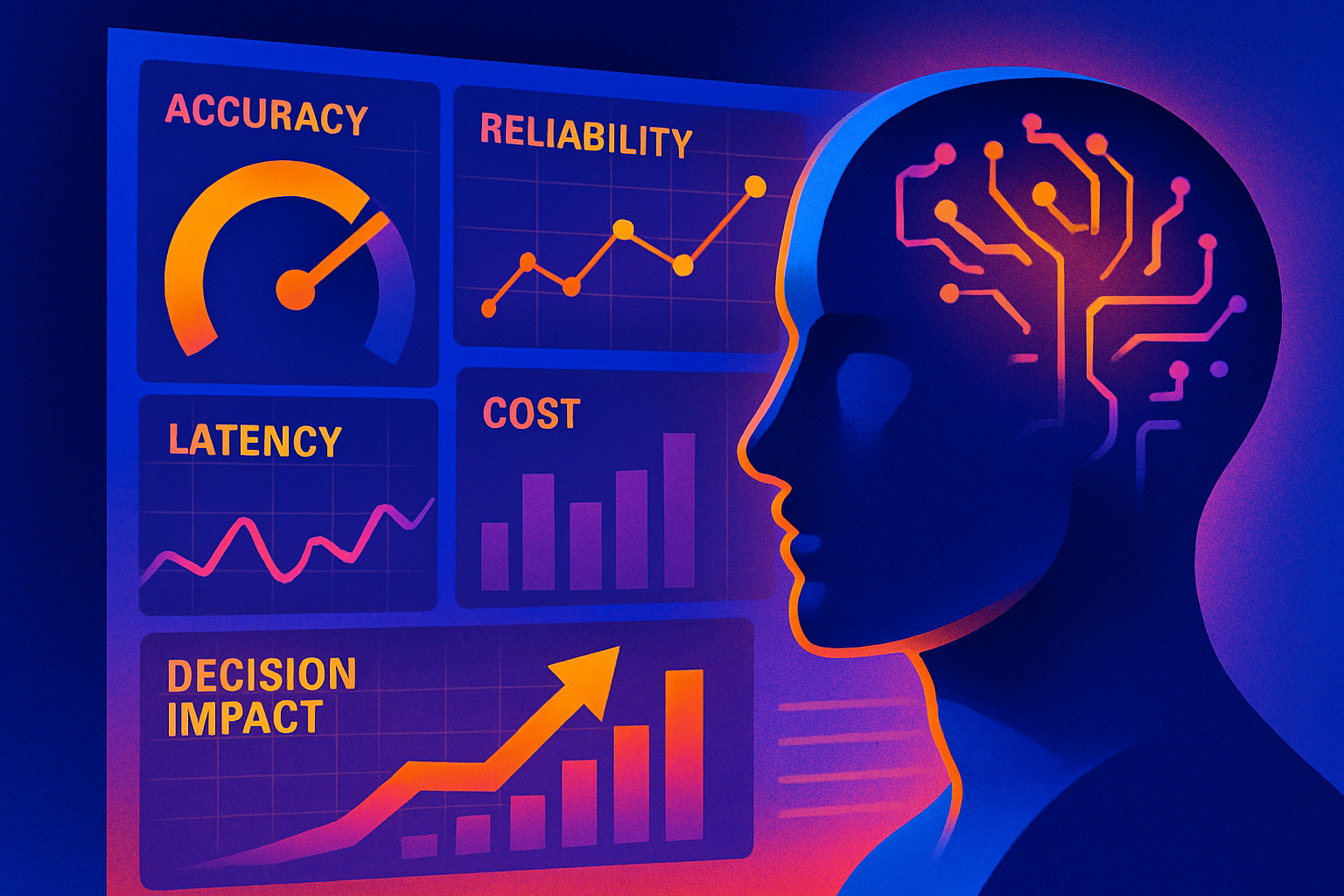
To properly evaluate a language model, it is crucial to adopt a framework that measures five distinct dimensions. When creating automated test suites, it is important to define specific and quantifiable metrics for each of these dimensions:
-
Accuracy: Is the output factually correct and based on the provided source data? This is measured by an automated comparison with a reference dataset, using an LLM as a judge to verify hallucinated entities.
-
Reliability: Does the system consistently produce valid output without crashing the pipeline? The schema validation success rate is crucial here, with a target JSONDecodeError rate of 0%.
-
Latency: Is the system fast enough for the specific workflow it serves? P90 and P99 response times, measured in milliseconds or seconds, are key indicators. The hidden costs of agentic AI often manifest as spikes in unacceptable latency.
-
Cost: Are token usage and computational costs sustainable at scale? The average cost per successful execution should be tracked through API billing metrics.
-
Decisions: Does the output actually help the user make better business decisions? Downstream business metrics, such as reduced manual review time or increased task completion rates, are essential.
The Importance of a Reference Dataset
Automating evaluation requires a solid benchmark, known as a reference dataset. This set is a carefully curated collection of diverse inputs with their expected ideal outputs. It should include not only the "happy path" but also edge cases, malformed inputs, and adversarial prompts. As highlighted in guides on building reference datasets for AI evaluation, this set is the cornerstone of your testing strategy.
Creating a reference dataset is a daunting task that requires the expertise of specialists to manually review and annotate hundreds or thousands of examples. However, this initial investment pays off in the long run. Once you have a robust reference dataset, you can evaluate new models or prompt modifications in minutes, rather than days.
When updating your agent's prompt or replacing the underlying base model, you must run the new version against the complete reference dataset. An automated evaluation pipeline, often using a separate and highly capable LLM as an evaluator, compares the new outputs to the reference outputs across the five dimensions. If the new version improves accuracy but increases latency beyond an acceptable threshold, the deployment fails. If it reduces cost but introduces schema validation errors, the deployment fails as well. This rigorous approach is essential for regulated AI applications, where failures can have serious legal and financial consequences.
The Evaluation Pyramid: A Four-Level Approach
To build an effective evaluation dashboard, it is necessary to think about evaluation at four distinct levels:
-
Unit: Does the specific prompt or function work in isolation?
-
Integration: Do the different agents or tools in the chain correctly pass data between each other?
-
System: Does the entire pipeline function end-to-end under realistic load conditions?
-
Decision: Does the final output lead to the desired business outcome?
Most teams never progress beyond the Unit level. They test a prompt in a testing environment and assume the system is ready. However, agentic systems are complex and interactive components. A prompt that works perfectly in isolation may fail catastrophically when its output is passed to a downstream tool expecting a different format.
To truly evaluate an agentic system, it is essential to test the entire pipeline. This involves simulating real user interactions and measuring the system's performance across the five dimensions. It requires building infrastructure capable of automatically creating test environments, running the reference dataset, and aggregating results into a comprehensive dashboard.
The Crucial Role of LLMs as Judges
One of the most powerful tools in modern AI evaluation is the "LLM as Judge" model. Rather than relying on fragile string matching or regular expressions to evaluate an agent's output, a separate and highly capable LLM, such as GPT-4, is used to score the output according to a specific rubric.
For example, an LLM judge might be tasked with assessing whether the agent's response accurately summarizes the provided document without introducing external facts, scoring from 1 to 5 and providing justification. This method allows for the automation of evaluating complex and nuanced outputs that would otherwise require human review.
However, it is crucial to ensure that the LLM judge itself is evaluated. Its scoring must be consistent and aligned with human judgment. This is often done by periodically having a sample of the LLM judge's scores reviewed by human experts to ensure calibration.
The Importance of Continuous Evaluation in Production
Evaluation does not stop once the model is deployed. In reality, this is when the real work begins. Models degrade over time, data distributions evolve, and upstream APIs may change behavior. To detect these issues before they impact users, it is crucial to implement continuous evaluation in production.
This involves sampling a percentage of live traffic, passing it through your evaluation pipeline, and tracking the results on a dashboard. If the accuracy score falls below a certain threshold, or if latency increases, the system must automatically trigger an alert.
Continuous evaluation also allows for building a feedback loop. When a user flags a response as incorrect, this interaction should be automatically added to your reference dataset, ensuring that the system learns from its mistakes and improves over time.
Engineering Trust: A Key Objective
The goal of a quality decision-making evaluation dashboard is not just to detect bugs, but to build trust engineering. When you can definitively prove to your stakeholders, with concrete data, that your AI system is 99.5% reliable, operates within a strict latency budget, and costs exactly $0.04 per execution, the conversation changes. You are no longer asking them to trust an "impression," but rather the engineering.
This level of rigor is what separates science fair projects from enterprise-level systems. It is the only way to build AI that truly delivers on its promises.
Brief IA — L'actualité IA en français
L'essentiel de l'actualité de l'intelligence artificielle, décrypté et expliqué chaque jour.