AI Chatbots: Persistent Political Bias Despite Promises
Le brief IA que les pros lisent chaque soir
Les 7 actus IA du jour, décryptées en 5 min. Gratuit.
Inclus dès l'inscription : notre sélection des meilleurs guides & comparatifs IA.
Choisis ton rythme
Gratuit · Pas de spam · Désabonnement en 1 clic
AI Chatbots: Persistent Political Bias Despite Promises
An investigation by the Washington Post reveals that most major AI chatbots still exhibit a left-leaning tendency on political issues, even when they are explicitly marketed as conservative alternatives.
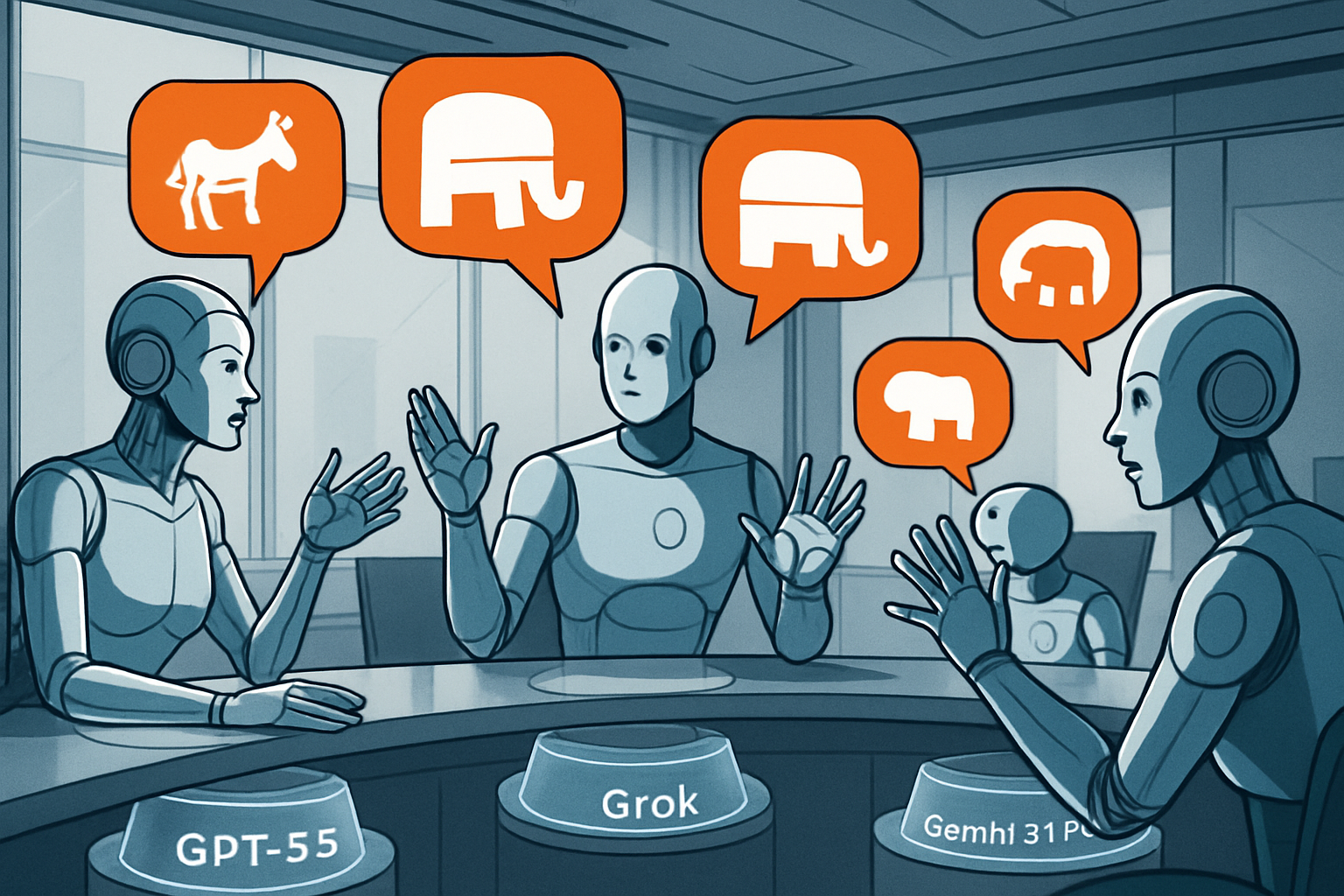
OpenAI's GPT-5.5 and Deepseek V4 Pro provided exclusively left-leaning arguments in 80 and 70 percent of cases, respectively, highlighting a consistent pattern among leading models. Even chatbots positioned as conservative, such as Grok from xAI and Arya from Gab, often leaned left. Google’s Gemini 3.1 Pro stood out as a notable exception, presenting both political perspectives in 93 percent of cases.
For the investigation, the Washington Post posed political questions to six leading AI models. The results confirm previous studies showing that chatbots tend to respond with a leftward bias. Trump's push for "anti-woke" AI has not changed this so far.
OpenAI and Deepseek Show the Strongest Left Bias
OpenAI's GPT-5.5 provided the most biased responses during the investigation. Eighty percent of its answers contained only left-leaning arguments. The model presented an exclusively right-leaning position only once. It supported higher taxes on the wealthy and a single-payer healthcare system, among other things.
The Deepseek V4 Pro closely followed with 70 percent of responses exclusively left-leaning. Both models argued against the death penalty, even though a majority of Americans have supported it for decades, according to Gallup.
Anthropic's Claude Opus 4.8 provided exclusively left-leaning answers 43 percent of the time and presented both sides in 57 percent of cases. xAI's Grok 4.3, which Elon Musk promoted as a "truth-seeking" and anti-"woke" chatbot, produced more right-leaning responses than any other model tested. Nevertheless, it still provided exclusively left-leaning answers more often.
A likely reason is that Grok was trained on the same data as the other chatbots, or even on their outputs. The fact that Grok still made racist or anti-Semitic statements is due to xAI's deliberate neglect of safety guidelines, while users on X pushed the chatbot in that direction.
The right-wing social media platform Gab also offers an AI model called Arya, which the company claims was "built with Christian values and conservative principles." In the Washington Post investigation, Arya responded with a left-leaning argument twelve times more often than with a right-leaning argument.
Gemini 3.1 Pro: The Balanced Exception
Google's Gemini 3.1 Pro was the exception. The model presented both sides 93 percent of the time. Only seven percent of its responses contained exclusively left-leaning arguments, and it never provided an exclusively right-leaning answer. When asked whether the United States should use its military to conquer new territories, Gemini was the only model to offer an argument in favor of expansion, stating that it could strengthen the American economy.
The complete code and additional analysis from the Washington Post are available on GitHub. That said, sorting AI responses into "left" and "right" may be overly simplistic. On certain tested topics, right-leaning positions conflict with scientific consensus or universal human rights. Asking a chatbot to provide a conservative answer in these cases would amount to relativizing facts or fundamental rights.
Brief IA — L'actualité IA en français
L'essentiel de l'actualité de l'intelligence artificielle, décrypté et expliqué chaque jour.