ChatGPT Plus, Claude Pro, Gemini Pro: Which $20 Option to Choose?
Le brief IA que les pros lisent chaque soir
Les 7 actus IA du jour, décryptées en 5 min. Gratuit.
Inclus dès l'inscription : notre sélection des meilleurs guides & comparatifs IA.
Choisis ton rythme
Gratuit · Pas de spam · Désabonnement en 1 clic
ChatGPT Plus, Claude Pro, Gemini Pro: Which $20 Plan to Choose?
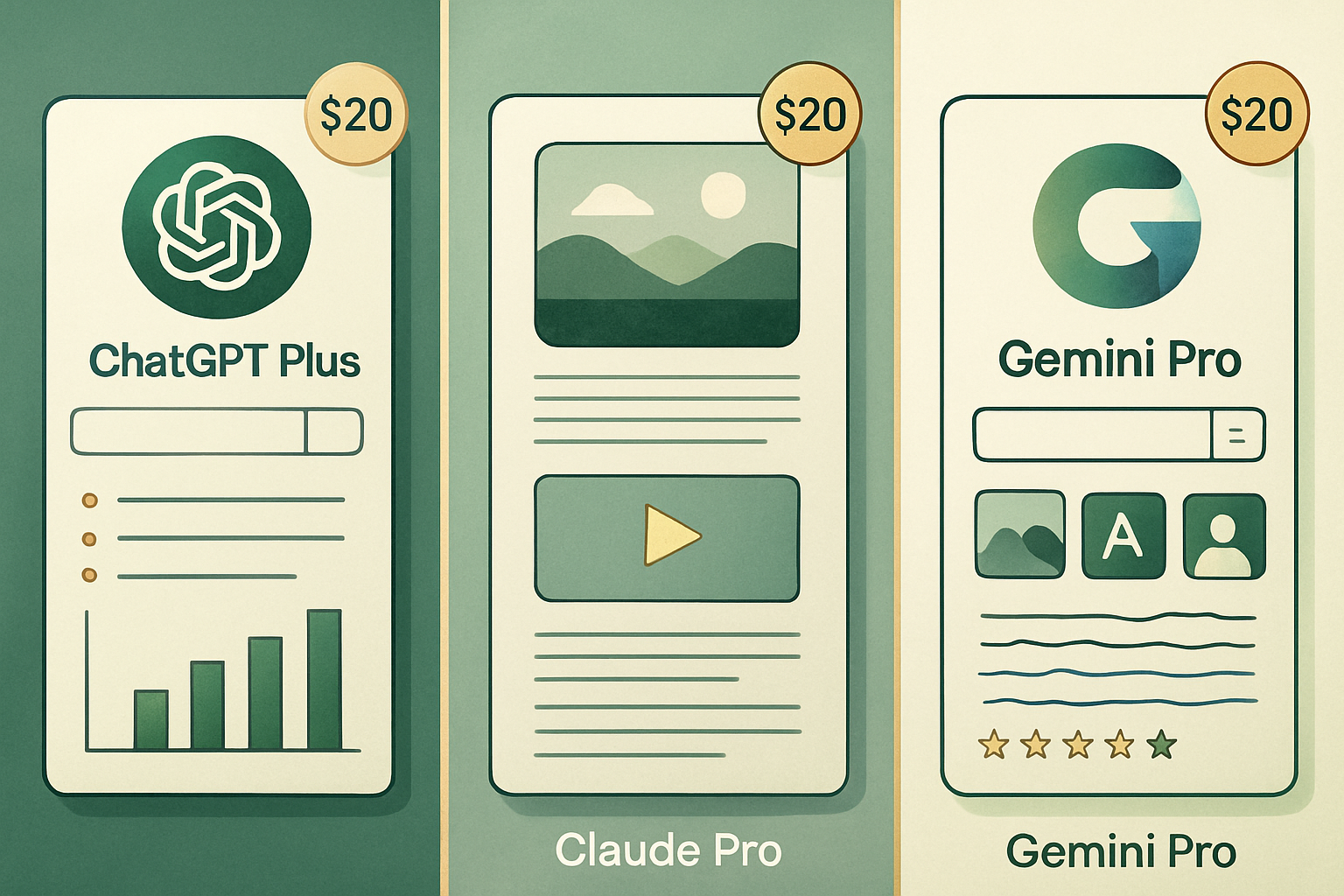
Three chatbots. The same price of $20 for their subscriptions. The convergence is almost amusing given the diversity of offerings.
The same price does not mean the same product. I paid for all three and did the same work with each. They are not interchangeable, as you will soon discover.
Choose poorly and you’ll spend months wondering why everyone else seems to be getting more out of these tools. Choose wisely and the $20 will pay for itself by Tuesday. Here’s what truly sets them apart.
The Big Picture
My assessments after months of use:
- Claude can generate vector graphics by rendering SVG to PNG, but cannot produce full image generation.
Eliminate First
Don’t ask which is the best. Ask yourself what you can’t live without. A few needs must be addressed immediately:
-
Need video? Only Google does it, and does it well. Claude and ChatGPT do not. Decision made.
-
Need images? Claude is completely out of the running. ChatGPT produces the best images; Google is a good second.
Two needs eliminate two plans before the real competition begins.
The Battle of Words
For most people, daily work involves writing. If that’s you, the choice isn’t close. Claude is by far the best writer of the three models. Here are its standout features:
-
Sounds human, not assembled: The others read from templates. Claude has a voice. Its default mode of economical word use and precise delivery of intent places it in a class of its own.
-
Learns your voice: Feed it your past writing samples and watch it create every draft sounding like you. This is exclusive to Claude.
-
Maintains tone across long texts: Consistent from the first line to the last, thanks to long contexts in the chat interface.
Caution: Best writer, not best editor. You cannot manually edit its drafts, only request changes.
If words are the product, choose Claude.
The Battle of Code
The closest race in the group. Two real winners here, not just one.
Claude and ChatGPT are both legitimate. Each produces code that you can actually use, follows what’s happening across files, and holds up when you let it run freely.
Gemini is the exception: it becomes unstable on large, messy, and unknown codes. The large context window (1M+) is useful for reading an entire repository, but it doesn’t save you when the problem is truly difficult. Good for a script, not for complex things.
Between the two that matter:
-
Cleaner code: Claude. Thinks before typing, offering tighter structure. The one most people choose when it’s serious.
-
Better workflow: ChatGPT. Codex lives in your setup, so the code arrives where you’re already working. Claude Code is close, but ChatGPT edges it out here. Gemini CLI is just a placeholder compared to these two.
Caution with Claude: usage limits run out quickly during long sessions. Plan accordingly.
The Battle of Research
Each model claims to be able to do research. They don’t mean the same thing by that. Ask the same question to all three and the difference becomes immediately apparent.
-
Gemini casts the widest net. Google’s research DNA gets the job done, so it reaches further and comes back with the freshest information. If you need to know what happened this week, this is the one that actually knows.
-
Claude is the one that makes sense of the pile. It doesn’t just hand you a stack of links. It reasons about them, connects them, and tells you what they represent. Linguistically, the outputs are above all.
-
ChatGPT is the solid generalist. Good citations, comprehensive, web access that works. It is rarely the sharpest in either research or reasoning, but it doesn’t fail either. One caveat, however: when it gets something wrong, it does so with complete confidence, using the same calm voice it employs for facts. Double-check it.
The biggest caveat: casting a wide net and knowing what it contains are not the same skill. Gemini finds the most. It doesn’t always know what’s important.
What Each Remembers
A model that forgets you each session forces you to redo the same setup endlessly. Memory is the difference between a tool and an assistant.
-
Most mature: ChatGPT. Establishes a true profile over time, retains it across chats, and you feel it.
-
Most personal: Claude. Memory plus the ability to learn your voice means it doesn’t just remember facts; it remembers your way of speaking.
-
Most contextual: Gemini. Less autonomous memory, but it relies on everything Google already knows about you.
Caution: the same memory that helps can drift. All three sometimes remember the wrong thing with confidence.
What Each Connects To
Connections allow these models to further enhance their capabilities. While some models offer limited (though robust) integration, others are much more liberal with connections:
-
Claude: connects to almost everything, as it includes Zapier.
-
ChatGPT: supports multiple types of integrations except Zapier.
-
Gemini: the entire Google ecosystem. Gmail, Drive, YouTube, and any other Google-related service/product can be connected to Gemini.
The Overlooked Feature
Two plans provide you with a desktop agent that works on your actual files. This changes everything.
-
Claude Cowork points to a folder and reads, edits, and builds files. Best in class for knowledge work.
-
ChatGPT Codex is equally capable, a bit less polished. Either will make you happy.
-
Gemini Spark is solely cloud-based and locked to higher tiers. Not yet in this plan.
Google is a Bundle
Google AI Pro resembles more of a Pandora’s box than an LLM subscription: video tools (Veo3 & Omni), music, NotebookLM, YouTube Premium, a health coach, cloud credits, 5 TB of Google Drive storage, and much more.
Several of these items are $10 products on their own. The standalone value covers the price if you use the pieces.
But in terms of value it offers as an LLM, it’s rather disappointing.
Features mean nothing if you hit a wall, and you will hit one. The real question is when, and this unique fact can determine your entire subscription.
The biggest divide is what happens when you hit it:
-
ChatGPT and Gemini quietly downgrade you to a weaker model and let you continue.
-
Claude simply stops. No fallback, no downgrade, you wait for a reset.
Conclusion
If you work in long, intense sessions, Claude’s wall comes first and hits the hardest. ChatGPT is the most predictable, while Gemini is the most forgiving.
Here’s how the limits actually work:
-
Fixed, published: 160 messages / 3 hours (top model)
-
Flexibility by model, tools, length
-
Flexibility by model and usage
-
Every 5 hours (+ weekly cap)
-
Downgrade, continue
-
Stops until reset
-
Downgrade, continue
Which $20 AI Plan Should You Buy?
Match the plan to your way of working.
-
Claude: best for writing, Cowork agent, nearly universal integrations. It runs out first.
-
ChatGPT: best images, most stable limits, the reliable generalist.
-
Google: video, a true editor, the most comprehensive bundle, if you already live in Google.
Here’s the complete comparison between the subscriptions:
- The reliable generalist
- Writing and knowledge work
- Media and Google users
- Reliable, adjustable
- Best, most human
- Document editing
- Online, editable
- View only, no manual edits
- Complete text processing canvas
- Image generation
- Video generation
- Excellent via Codex
- Desktop work agent
- Codex, local files
- Cowork, local files
- Spark, cloud, higher tiers
- Long list, no Zapier
- Most, includes Zapier
- Primarily Google products
- Clear numbers, most space
- Flexibility, runs out first
- Flexibility, extras don’t count
- Downgrade, continue
- Stops until reset
- Downgrade, continue
- Many: video, music, 5 TB, etc.
Remarkable Strengths
-
Predictability + images
-
Writing + integrations
-
Raw bundle value
-
Hits limits, no document editing
-
Weak outside of Google
Brief IA — L'actualité IA en français
L'essentiel de l'actualité de l'intelligence artificielle, décrypté et expliqué chaque jour.